Why We Must Focus on “Embodied” Emissions Immediately—In Practice, Policy, and Legislation
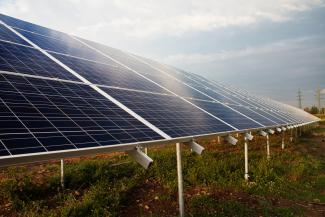
Solar Panels
Wednesday, November 17, 2021

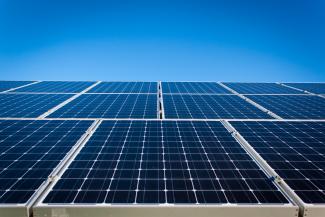
With the 2021 UN Climate Change Conference (COP26) focused on pledges reducing carbon emissions 2030 and beyond, the urgency to cut emission now seems overlooked. Unfortunately, the 2020s are ground zero in our uphill battle to thwart the rise in global warming, soon enough for those pledges to be meaningful. As global warming already exceeds 1°C of the 1.5°C targeted and continues to climb, we must slow emissions growth within this decade for a reasonable chance of future success.

Climate Adaptation at the Local, State, and Federal Levels
Chicago
Wednesday, November 10, 2021

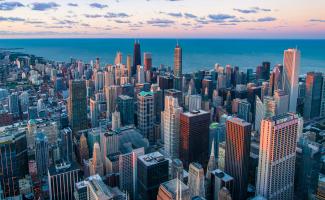
How prepared is the United States to adapt to climate change? To answer this question, on a recent People Places Planet Podcast episode, “Is the U.S. Government Ready for the Climate Crisis? Examining Federal, State, and Local Climate Adaptation,” Staff Attorney Cynthia Harris spoke with three climate experts: Dr.

The New Galapagos Islands Reserve: A Shift in Paradigm
Galapagos Islands
Monday, November 8, 2021

Ecuador is undoubtedly one of the most megadiverse countries in the world. It currently has 18,439,141.75 hectares of protected areas, which means that 13.7% of its territory is under special protection. Without underestimating the rest of the ecosystems and habitats that make up this small piece of land located in the middle of the world, the Galapagos Islands usually take the limelight. The Galapagos Islands have been declared a natural world heritage and are the reference by which many foreigners identify the country.

As AI Proliferates, Environmental Protection Hopes and Fears Rise
Solar Panels
Wednesday, October 20, 2021

In recent years, Artificial Intelligence (AI) applications have rapidly become more sophisticated and widespread, “even as legal and regulatory frameworks struggle to keep up.” Moreover, AI’s often-overlooked environmental implications are simultaneously “sweeping and quite complicated,” and for all of its promise to help improve the environment, AI could in fact cause environmental harm. With those framing remarks, Andrew Tutt, a Senior Associate with the law firm Arnold & Porter, opened a February 18 webinar on “Environmental Applications & Implications of Artificial Intelligence,” the third in ELI’s GreenTech series running through 2021.

Are We Ready for the Emerging Circular Economy? Ready or Not...
Plant
Wednesday, October 6, 2021

“The United States has a very effective liability management policy and legal framework, but that same framework has some unintended consequences for the circular economy,” including risk aversion that can create barriers to circular economy businesses, said John Lovenburg, Vice President of Environment at BNSF Railway, in his opening remarks as moderator of ELI’s fourth GreenTech webinar March 24, 2021, on “The Emerging Circular Economy.”

A Progress Report From the War on Science — and the Environment
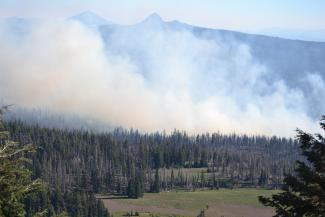
Wildfire
Wednesday, September 29, 2021

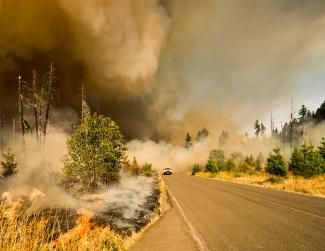
One voter in seven believes that Hillary Clinton is running a cabal of satan-worshipping cannibalistic pedophiles. A member of Congress charges that last year’s wildfires in the western states were caused by Jewish space lasers. A U.S. senator insists that China aims to breed a race of super soldiers by harvesting visiting athletes’ DNA when it hosts the winter Olympics in 2022. The Ohio legislature recently heard testimony alleging that the Covid vaccines are magnetizing people. According to a 2012 survey, one in four members of the U.S. public does not know the Earth orbits the Sun. A poll by the Associated Press in 2014 found that four in ten Americans dispute evolution and half do not believe the Big Bang theory.