The Environmental Argument for Less Meat in Your Diet
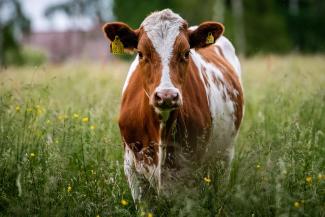
Cow in grass field
Thursday, July 7, 2022

Just over a half-century ago, Diet for a Small Planet, Frances Moore Lappé’s surprise best seller, exposed the harms of animal agriculture to a wide audience in the same way that Rachel Carson’s book of a decade earlier, Silent Spring, put to widespread shame the practice of applying pesticides to cropland. The title of Moore Lappé’s book encapsulates her thesis. The math in 1971 made a compelling case that abandoning meat is indeed necessary to avoid crossing planetary boundaries.

Food Staples for Thought
Rice terraces
Tuesday, July 5, 2022

Rice is a primary food source for more than half of the world’s population—especially in Asia, Africa, and Latin America. In China, the rice-consuming culture I’m most familiar with, rice is breakfast, lunch, dinner, and dessert. Even the Chinese character for “cooked rice” simultaneously means “food.” Rice is security, sustenance, and life itself.

Some Deductions on Induction
Induction stove_by Akielly Hu
Tuesday, June 21, 2022

I encountered an induction cooktop for the first time recently, and my life has never been the same. Boiling water, which usually bores me to tears, took half as much time as it did on a gas stove. Garlic sizzled in seconds; broccoli softened in a minute or two. With a press of the on button, I sped up time itself, whizzing through a recipe that would take me an hour on a traditional electric stove, 45 minutes on a gas cooktop.

Migration With Dignity: Experiences of Pacific Islanders in Oregon
Ocean in Palau
Monday, June 6, 2022

The COVID-19 pandemic has exposed and exacerbated inequities that lead to differences in health outcomes, particularly for racial and ethnic minority groups. One community that has been particularly affected is the Pacific Islander community in the United States, which has experienced exceedingly high rates of infection, hospitalization, and morbidity.

We Can Unleash the Private Sector for Climate Action (Part 2)
web of people
Wednesday, April 27, 2022
Around the same time as the American Business Act on Climate Pledge in 2015, the investment community began to look at investment risks from businesses and industries that could be impacted by climate change. They examined both the physical aspects of vulnerability as well as the potential financial impact of climate change. From a financial and sustainability perspective, demand for products and services could decline or increase as society tackles climate change. Most notably, BlackRock, an investment firm with over $6 trillion in assets, began urging its clients and customers to build sustainability and climate change implications into their corporate planning. This in turn helped many CEOs further discussions on climate with their boards.
We Can Unleash the Private Sector for Climate Action (Part 1)
Leaf growing
Wednesday, April 20, 2022

For the last several decades, many leading businesses have expressed support for climate policy in the United States. While there are many businesses that expressed concerns and even advocated for policies back into the late 1990s, here I will trace efforts back to 2006. That was the year the U.S. Climate Action Partnership (USCAP) was initiated. The USCAP was a collaboration between leading businesses and climate-focused NGOs. Its goal was to develop consensus policy recommendations and principles for Congress and the new executive administration that would be elected in 2008.

Cut Methane Now or Doom the Planet
Iceberg in Antarctica
Thursday, April 14, 2022

The climate emergency is here, and the only way to stop the downward slide to chaos is to cut methane and other super climate pollutants as fast as possible, while also dramatically reducing carbon dioxide emissions. One message has been made clear by the United Nations Environment Programme and Climate and Clean Air Coalition’s Global Methane Assessment, and the IPCC’s Sixth Assessment reports: Cut methane now or doom the planet.