Citizen Science and Environmental Agencies
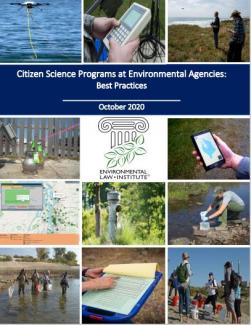
Cover of Citizen Science Programs at Environmental Agencies report
Tuesday, January 12, 2021

Environmental agencies are increasingly transforming their approach to citizen science, from viewing it as a source of data primarily for education and awareness to a potential source of concrete value for their programs. Although this relationship has existed for some time, the emergence of new technologies, an increasingly aware public, and the rise of unexpected pollution events has reinvigorated the way agencies and the public work together.


Cutting the NEPA Rules’ Gordian Knot
Knotted rope
Tuesday, December 22, 2020

National Environmental Policy Act (NEPA) administration is in a serious tangle, given new Trump Administration regulations, the long-standing procedures administered by scores of federal agencies, and inconsistent environmental review obligations depending on various dates. This knot, like the legendary knot of King Gordias, is not easily unraveled. But it is not impossible.

EPA at Its 50th Anniversary: Remembering the Early Days
United States Capitol
Wednesday, December 16, 2020

In observing the U.S. Environmental Protection Agency’s 50th anniversary, I have a few early-days reflections. I had my first brush with EPA while in law school, when I drafted South Carolina’s Resource Conservation and Recovery Act Interim Status and Part B regulations. “Drafting” is somewhat generous, as my work was primarily cutting and pasting the EPA rules that were set up to apply in the absence of state program authorization and conforming them, and their corresponding preambles, to the South Carolina context. But it was a meaningful baptism into the complexity of EPA’s work within the labyrinth that is the Federal Register. In my last year of law school, I was accepted under the honors program at the U.S. Department of Justice, and was soon off to work as a trial attorney in their Environmental Enforcement Section. My primary client? EPA.

Reasserting Tribal Forest Management Under Good Neighbor Authority
Forest
Monday, December 14, 2020

Earlier this year, the Environmental Law Institute hosted a webinar on cultural fire management—just prior to yet another devastating fire season across the West Coast of the United States. The discussion highlighted the millennia of Indigenous peoples’ sustainable forest management practices, drawing a sharp contrast with the consequences of over a century of federal fire-suppression policy, now exacerbated by climate change. That discussion now prompts a deeper conversation about options available to Indigenous tribes for regaining their stewardship role over forest resources on their traditional lands.

COVID-19 and the Future of Environmental Law
face mask
Wednesday, November 18, 2020

The COVID-19 pandemic has rendered profound changes to our everyday lives and economy that will have both immediate and long-term impacts on environmental law. In this month’s issue of ELR—The Environmental Law Reporter, Arden Rowell explores the implications of these changes for environmental law, and argues that grappling with them as the pandemic progresses may help lawmakers develop more effective strategies for environmental regulation.

Citizen Science: Concepts and Applications
globe
Friday, November 13, 2020

The first session of the International Network for Environmental Compliance and Enforcement (INECE) six-part citizen science webinar series explored the current and potential uses of citizen/community science initiatives to improve environmental monitoring, compliance, and enforcement around the world. Citizen science encompasses a broad range of activities, ranging from the use of low-cost hand-held air monitors by individuals to sophisticated, university-based monitoring networks and satellite monitoring plans by large environmental NGOs. These activities can raise awareness of environmental issues, inform agency actions including compliance and enforcement programs, and inform citizen litigation to stop polluting activities.

Improving Indoor Air Quality in Schools During the Pandemic . . . and Beyond
school
Thursday, October 22, 2020

The novel coronavirus has focused public attention on the indoor environment as never before. Even though most people in the United States spent the large majority of their time indoors before the pandemic, COVID-19 has increased awareness of the connection between indoor air quality and health. In addition to cleaning and disinfecting, technical topics such as building ventilation and filtration are now the subject of articles in popular media, not to mention conversations around the (virtual) water cooler and the school listserv.

Heading Down Different Paths: An Update on PFAS Regulatory Developments in Northeastern States and at the Federal Level
water
Monday, October 19, 2020

In May 2016, EPA issued a lifetime Health Advisory (HA) of 70 parts per trillion (0.07 ug/L) for the combination of two per- and polyfluoroalkyl substances (PFAS) chemicals, PFOS and PFOA, in drinking water. EPA’s HA is not enforceable or regulatory—it provides technical information to state agencies and other public health officials on health effects, analytical methodologies, and treatment technologies associated with drinking water contamination. In EPA’s subsequent 2019 PFAS Action Plan, EPA noted that over 4,000 PFAS may have been manufactured and used in a variety of industries around the world since they were first synthesized in the 1940s. Because PFAS are water soluble, over time PFAS from firefighting foam, manufacturing sites, landfills, spills, air deposition from factories and other releases can seep into surface soils and potentially percolate into groundwater, thus implicating drinking water sources.