
Vibrant Environment
All
All | Biodiversity | Climate Change and Sustainability | Environmental Justice | Governance and Rule of Law | Land Use and Natural Resources | Oceans and Coasts | Pollution Control
By Amy Reed
Last month, fellow ELI Gulf Team member Teresa Chan and I travelled to Mississippi to attend two public events hosted by the Deepwater Horizon natural resource damage assessment (NRDA) trustees: a community education workshop in Gulfport, and the Trustee Council’s annual public meeting in Long Beach.
By Amy Reed
Last month, fellow ELI Gulf Team member Teresa Chan and I travelled to Mississippi to attend two public events hosted by the Deepwater Horizon natural resource damage assessment (NRDA) trustees: a community education workshop in Gulfport, and the Trustee Council’s annual public meeting in Long Beach.

By Linda Breggin
Every year, the Environmental Law Institute in collaboration with Vanderbilt Law School publishes a special issue of the Environmental Law Reporter’s News & Analysis. The issue contains condensed versions of articles selected by Vanderbilt law students, in consultation with an expert Advisory Committee, ELI senior staff, and their professors, because they offer some of the year’s best legal and policy solutions to pressing environmental problems.
By Linda Breggin
Every year, the Environmental Law Institute in collaboration with Vanderbilt Law School publishes a special issue of the Environmental Law Reporter’s News & Analysis. The issue contains condensed versions of articles selected by Vanderbilt law students, in consultation with an expert Advisory Committee, ELI senior staff, and their professors, because they offer some of the year’s best legal and policy solutions to pressing environmental problems.
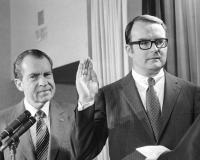
By Stephen R. Dujack
I met William D. Ruckelshaus a year after the Saturday Night Massacre, and 18 months after he left the U.S. Environmental Protection Agency (EPA) as its founding administrator. I was a reporter for the Daily Princetonian, and he was on campus to give a talk. I recognized that here was a true American hero. Nine years later, Ruckelshaus would return to EPA for more heroics: restoring the Agency to its original sense of idealism and high purpose.

By Lovinia Reynolds
On July 19, the U.S. Fish and Wildlife Service (FWS) and National Oceanic and Atmospheric Administration (NOAA) released their highly anticipated proposed changes to the rules implementing the Endangered Species Act (ESA). Enacted in 1973, the ESA is credited with saving iconic American species like the bald eagle and the grizzly bear. It is one of the hallmark pieces of legislation of the early environmental movement and the legislation for species conservation in the United States. While the public generally supports the Act, the ESA is notoriously controversial for corporations and agribusiness. Industries such as oil and gas, land development, and mining criticize the ESA as a costly barrier to project development. Supporters of the ESA highlight its role in preventing the extinction of species that are crucial to U.S. ecosystems.
By Lovinia Reynolds
On July 19, the U.S. Fish and Wildlife Service (FWS) and National Oceanic and Atmospheric Administration (NOAA) released their highly anticipated proposed changes to the rules implementing the Endangered Species Act (ESA). Enacted in 1973, the ESA is credited with saving iconic American species like the bald eagle and the grizzly bear. It is one of the hallmark pieces of legislation of the early environmental movement and the legislation for species conservation in the United States. While the public generally supports the Act, the ESA is notoriously controversial for corporations and agribusiness. Industries such as oil and gas, land development, and mining criticize the ESA as a costly barrier to project development. Supporters of the ESA highlight its role in preventing the extinction of species that are crucial to U.S. ecosystems.

By Hunter Jones
On June 27, 2018, Justice Anthony Kennedy announced that he will retire from the U.S. Supreme Court on July 31, 2018. Kennedy, who was nominated by former President Ronald Reagan and confirmed in 1988, became a crucial swing vote on a variety of environmental issues during his tenure. On July 11, 2018, ELI hosted John Cruden, John Elwood, and Richard Lazarus at a Breaking News webinar to explore the influence Kennedy has had on environmental law and to discuss the implications of his retirement from the Court for the future of environmental law.

By Kristin Morico
I’ve witnessed some tumultuous times throughout my professional journey, which has mostly involved the industrial sector. The current global political climate, industry takeovers, mergers, and portfolio rationalization, as well as companies vying over a competitive talent pool of leaders, has resulted in a fair amount of distraction and turbulence across all industry functions, including Environmental, Health & Safety (EHS). Observing these circumstances, how does an organization proactively manage EHS compliance? Below, I share some thoughts I’ve gathered over the years.

By Samantha Goins
Most people probably haven’t heard of Anote Tong, the former president of Kiribati, but he is somewhat of a celebrity in the international climate sphere. His ideas were radical and often subject to criticism, even within his own nation. Yet, radical action may be the very thing that Kiribati, and so many other island nations, require.