

Vibrant Environment
All
All | Biodiversity | Climate Change and Sustainability | Environmental Justice | Governance and Rule of Law | Land Use and Natural Resources | Oceans and Coasts | Pollution Control
Any self-respecting environmental lawyer knows, 2019 marks a major anniversary for environmental law: the Cuyahoga River fire of 1969. While we note the anniversary today, I doubt onlookers in Cleveland appreciated at the time that it would give rise to a five-decade era of environmental lawmaking.
By Hunter Jones
On April 12, 2019, the U.S. Court of Appeals for the Fifth Circuit vacated portions of the U.S. Environmental Protection Agency’s (EPA’s) 2015 Effluent Limitation Guidelines (ELGs) and Standards for the Steam Electric Power Generating Point Source Category (ELG Rule). ELGs are nationwide standards set by EPA to govern pollutant discharges from point sources.

By Kasantha Moodley , By George Wyeth
In ways that did not exist even ten years ago, everyday people are acting as scientists: contributing their time and data to make notable discoveries, answer lingering questions, and develop awareness. Motivated by technology innovations, public concern, and limited institutional capacity, citizen science is gently reshaping the conventional systems that address human health and environmental protection.
By Kasantha Moodley , By George Wyeth
In ways that did not exist even ten years ago, everyday people are acting as scientists: contributing their time and data to make notable discoveries, answer lingering questions, and develop awareness. Motivated by technology innovations, public concern, and limited institutional capacity, citizen science is gently reshaping the conventional systems that address human health and environmental protection.
By Kasantha Moodley , By George Wyeth
In ways that did not exist even ten years ago, everyday people are acting as scientists: contributing their time and data to make notable discoveries, answer lingering questions, and develop awareness. Motivated by technology innovations, public concern, and limited institutional capacity, citizen science is gently reshaping the conventional systems that address human health and environmental protection.

By C. Scott Fulton
“For everything there is a season,” says the old Pete Seeger song, quoting the much older still book of Ecclesiastes. It seems that we are currently in the season of walls. The physical manifestation of this particular period may be the issue of the wall on our southern border. But there are other walls, and some of them have law as their concrete or steel.
By C. Scott Fulton
“For everything there is a season,” says the old Pete Seeger song, quoting the much older still book of Ecclesiastes. It seems that we are currently in the season of walls. The physical manifestation of this particular period may be the issue of the wall on our southern border. But there are other walls, and some of them have law as their concrete or steel.
By Stephen R. Dujack
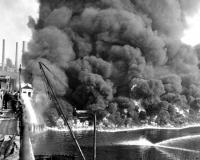
The famous Cuyahoga River fire of June 22, 1969 — the spur that started debate on pollution across the nation, and led to passage of the Clean Water Act three years later — is lodged more in legendary storytelling than in reality. The fire was actually fairly minor, causing only $50,000 in losses to the Republic Steel Mill located along the river, damaging some wooden trestles. Moreover, no photograph of the event exists — the photo reproduced here, like the one a month later in Time magazine, was from a much larger 1952 blaze.
By Stephen R. Dujack
The famous Cuyahoga River fire of June 22, 1969 — the spur that started debate on pollution across the nation, and led to passage of the Clean Water Act three years later — is lodged more in legendary storytelling than in reality. The fire was actually fairly minor, causing only $50,000 in losses to the Republic Steel Mill located along the river, damaging some wooden trestles. Moreover, no photograph of the event exists — the photo reproduced here, like the one a month later in Time magazine, was from a much larger 1952 blaze.

By Kashaf Momin
By now, you have seen how biotech is transforming the food industry. You have also seen how it can revolutionize the construction and textile industries. In this final episode, we will explore biotechnology products you may find in your home in the near future.
The same platform used to brew hoppy beer without the hops, discussed in our last episode, is also transforming the fragrance business. In partnership with a Swiss perfume company, the bioscience firm Amyris synthetically produced patchouli, one of the essential oils that constitutes traditional perfume. This product, called CLEARWOOD®, was created using engineered yeast as its microbial platform, a more sustainable alternative to the costly and lengthy cultivation and extraction process of the patchouli plant. Meanwhile, Ginkgo Bioworks has designed its own aromatic oil....