This Month in ELR—Climate Change, Indigenous Peoples, and Access to Water

Native American totem pole, Ketchikan, Alaska, Jeremy Keith
Wednesday, March 8, 2017

Access to water is a fundamental climate change issue. It is related to significant political, social, and ecological struggles that indigenous peoples face internationally and here in the United States, as recent protests at the Dakota Access Pipeline clearly illustrate. Yet, governments and courts have done little to address such climate change inequities. So argues Dr. Itzchak Kornfeld, the Giordano Research Fellow at the Faculty of Law of the Hebrew University of Jerusalem, in The Impact of Climate Change on American and Canadian Indigenous Peoples and Their Water Resources.
Which Wetlands Can Reduce Risk From Climate Change Impacts?
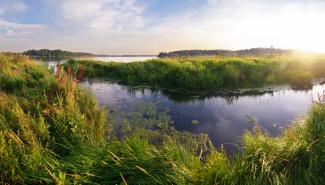
Wetlands, Svetlana Makarova
Monday, February 27, 2017

Climate change presents immense challenges to coastal communities and to ecosystems affected by sea-level rise, salt water intrusion, changes in average temperature, storm frequency, and species composition. Existing wetland complexes are among the “natural and nature-based features” that currently buffer human communities from catastrophic storm events and that help ecosystems rebound from major stresses and impacts.

Freshwater Lakes are Warming at Surprising Rate
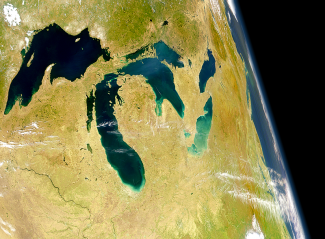
U.S. Great Lakes, NASA
Wednesday, February 22, 2017

There is an alarming new study out, funded by NASA and the National  Science Foundation. It was published in Geophysical Research Letters and announced at the American Geophysical Union fall meeting. Together, these are the heavyweights in climate change research and analysis. Their findings: The world’s lakes are warming at an alarming rate, much faster than the oceans or the atmosphere. The study monitored 235 lakes, spanning six continents and representing half the world’s freshwater supply, for 25 years.

FOOD WASTE: City and State Strategies for Source Reduction
Farmers Market Produce
Monday, February 20, 2017

Strategies for cities and states to reduce food waste can be thought of through the lens of the “Three Rs” of EPA’s Food Recovery Hierarchy—reduction, reuse, and recycling. In food waste terms, the Three Rs mean preventing wasted food at the source, donating wasted food leftovers, and recycling food waste through composting or anaerobic digestion.

The recent ReFED report on reducing food waste quantifies the economic value and diversion potential of different strategies related to each of the Three Rs. According to ReFED, source reduction and donation generate the most economic value per ton of food saved, while food recycling and composting have the potential to divert a much greater quantity of food from landfills.

How Private Actors Can Keep Climate Action Moving Forward
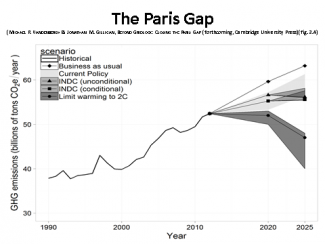
The Paris Gap, Mike Vandenberg
Wednesday, February 15, 2017

Early in the fall of 2016, there was growing cause to celebrate the international momentum building around climate mitigation. In October, United Nations actors reached agreements to limit airline emissions and later HFCs. On November 4, the Paris Agreement under the U.N. Framework Convention on Climate Change went into effect. Then, four days later, Donald J. Trump was elected president, casting doubt on the U.S. climate commitments made by President Obama’s Administration. Though his Tweets and stump speeches may not equate directly to his eventual climate policy, the surprise election results have certainly caused consternation among advocates of climate mitigation and adaptation.

This Month in ELR—Litigating Climate Change in National Courts
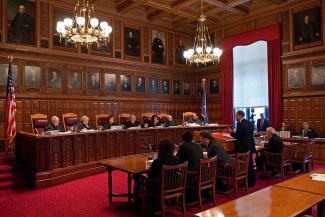
Court of Appeals, Tracy Collins
Wednesday, February 8, 2017

In the February issue of ELR’s News & Analysis, ELI President Scott Fulton and Visiting Attorney Dr. Maria L. Banda highlight the role that national judiciaries worldwide have played in developing the field of “climate law.” In Litigating Climate Change in National Courts: Recent Trends and Developments in Global Climate Law, Fulton and Banda examine the procedural tools and interpretive principles that judges have used to decide novel legal issues in climate litigation, focusing on some of the key lawsuits from civil and common-law jurisdictions that may influence climate law beyond their borders.

The “Paris Gap,” and How to Fix It
Global Warming
Wednesday, January 25, 2017

The Paris Agreement on climate change is a world-shattering event, a rare coming together of the international community to face a shared threat. Former President Obama deserves a lot of credit for the success of the two-week conclave, because of his earlier diplomacy with China and executive actions to reduce emissions, and Secretary of State John Kerry also deserves kudos for staying on site in Paris to see the agreement to its conclusion. Praise also belongs to the conference organizers, staff, and leaders, not to mention the hundreds of delegates.

After Youth Activists’ Surprising Win in Climate Change Litigation, What’s Next?
Discovering the Trees, Alessandro Pucci
Wednesday, January 4, 2017

On November 10, 2016—just two days after Election Day—there was another surprising turn of events: a federal district court judge in Oregon handed a long-shot victory to a group of young activists suing the federal government over its history of action and inaction regarding fossil fuels and climate change. Denying the defendants’ motions to dismiss in a thorough and groundbreaking opinion, Judge Ann Aiken found there was a sufficient legal basis for the plaintiffs to pursue their constitutional and common-law claims for the case to proceed to the next litigation stage. Now, in the waning days of the Obama Administration, the case is entering uncharted territory. On top of the unprecedented nature of the case itself, the uncertainty regarding the presidential transition extends to the course this case may take and to its importance going forward.

Maps Show Grim Future for Nation
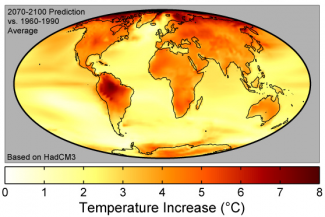
Global Warming Predictions
Wednesday, December 28, 2016

After the revelation that July and August tied as the warmest months ever recorded in human times, the discovery of a potentially habitable planet circling a red dwarf star that is part of the nearby Alpha Centauri system was welcome news. Proxima Centauri b is the closest Earth-like planet beyond the solar system, 4.3 light years away. By the year 2500, when a new study predicts almost 50 feet of sea-level rise — which would wipe out the homes of billions, erasing whole nations from the globe — we should have the star drive needed to migrate to a new planet.

Environmental Literacy is a Key to Overcoming Climate Denial
Children in class, Amanda Mills
Wednesday, December 21, 2016

The sage lexicographers at the Oxford Dictionary chose the hyphenated couplet post-truth as the Word of the Year for 2016 — twelve months that saw made-up facts supersede real facts on a daily basis. An analysis by BuzzFeed concluded that “in the final three months of the U.S. presidential campaign, the top-performing fake election news stories on Facebook generated more engagement than the top stories from major news outlets” including the New York Times, Washington Post, and 17 others — combined.