Dancing with Elephants: Startup Entrepreneurs and Corporations Collaborate on Massive Clean Energy Innovation

Baby elephant
Tuesday, March 9, 2021

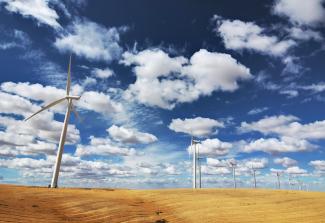
Until recently, environmental protection discussions have mainly centered on law and policy. But the rapid emergence of advanced technologies has opened opportunities for established corporations and innovative startup companies to partner and thereby play a vital role in shaping 21st century environmentalism. A panel of experts described the massive, elephantine opportunities during the Environmental Law Institute’s January 14 GreenTech webinar on “Liberating Digital Solutions for the Environment: Catalyzing New Ideas,” the second in an eight-part series launched November 17, 2020.

Opportunities for Climate Diplomacy: The Biden Administration and the Road to COP26
International flags outside UN
Wednesday, February 24, 2021

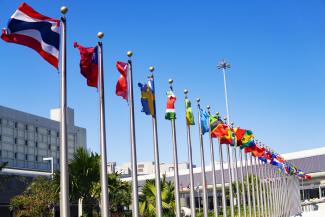
In these early days of the Biden Administration, it has become clear that climate diplomacy is returning to the U.S. foreign policy agenda. On Inauguration Day, the new Administration announced that the United States would rejoin the Paris Agreement, signaling an abrupt shift from the previous administration’s approach toward multilateral environmental agreements. Signed in 2015, the Paris Agreement made history as the first legally binding agreement to oblige states to limit global warming to well-below 2°C by the end of the century. Limiting warming to this threshold would help prevent irreversible damage to our climate system and planetary boundaries, as demonstrated by the Intergovernmental Panel on Climate Change. To accomplish this ambitious feat, signatories of the agreement are asked to submit Nationally Determined Contributions (NDCs) every five years to communicate how countries will reduce their emissions and build resilience to adapt to a warming world.

Reaching Out With a Digital Helping "Handprint" to Decarbonize Every Sector
Earth surrounded by digital numbers
Thursday, February 4, 2021

“The future has arrived—it’s just not evenly distributed yet,” observed writer William Gibson, whose observation was cited during the Environmental Law Institute’s November 17 webinar, “Digital Solutions to Climate and Water Challenges,” the first in a series that will serve to continue exploring the dynamic intersection of policy and cutting-edge technologies begun in 2019 with ELI’s inaugural GreenTech conference in Seattle.

Beyond Greenwashing: Paths Toward Sustainability in the Fashion Industry (Part 1)
fashion
Friday, October 30, 2020

The fashion industry is thirsty. Every year, it consumes 93 billion cubic meters of water—enough for the survival of over 5 million people. The problems within the fashion industry go beyond water use. Due to the rise in fast fashion, global clothing production has exponentially increased, doubling between 2000 and 2014. Fashion is now the second-most polluting industry worldwide.

Discounting Benefits of Saving Human Life
money
Wednesday, October 7, 2020

Environmental Protection Agency chief Andrew Wheeler proudly details the administration’s deregulatory record in a Newsweek opinion article published in late July. He frames his success story within President Trump’s January 2017 executive order requiring agencies to eliminate two regulations for each new one. While Wheeler touts the avoided costs, he doesn’t mention the avoided benefits the repealed rules would have provided.

Still Much We Do Not Know: Climate Uncertainty and Adaptive Management in the Gulf of Mexico
hurricane
Wednesday, September 30, 2020

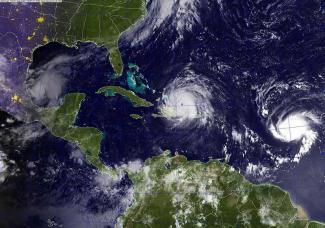
The National Oceanic and Atmospheric Administration (NOAA) reported in August that this year’s Gulf of Mexico dead zone was unexpectedly small—in fact, the third-smallest ever measure in the 34-year record. Interestingly, this comes just two months after NOAA had forecasted a larger-than-average dead zone in early June. The cause of this shift appears to be Hurricane Hanna, whose large, powerful waves agitated the water column, disrupting algal accumulation in the Gulf.

A Road Map to Net-Zero? BLM’s Authority to Mitigate Climate Change on Public Lands
Public land
Wednesday, September 9, 2020

Almost one-quarter of all U.S. CO2 emissions come from fossil fuels extracted from public lands. Producing more than 274 million barrels of oil, 3.3 billion cubic feet of natural gas, and 302 million tons of coal each year, BLM’s management decisions have a significant impact on climate change. In this month’s issue of ELR—The Environmental Law Reporter, authors Jamie Gibbs Pleune, John Ruple, and Nada Wolff Culver argue that the Bureau has not only the authority, but a legal duty to mitigate climate change in its permitting decisions. Using existing legal structures, they provide a road map for requiring all new BLM oil and gas development to achieve net-zero emissions.

We Have What We Need to Address Climate Change Equitably
Wednesday, July 29, 2020

We have the solutions we need to build an equitable and just climate resilient future. Over the past year, coalitions of frontline environmental groups, labor organizations, tribal groups, and other mission-driven organizations in the United States have developed and published comprehensive policy platforms to address the climate crisis. These platforms outline federal, local, and state policy for building resilience and transitioning to renewable and regenerative economies.