2005 Status Report on Compensatory Mitigation in the United States
Author
Jessica Wilkinson and Jared Thompson
Date Released
April 2006
2005 Status Report on Compensatory Mitigation in the United States

ELI’s groundbreaking mitigation research continues with the completion of the 2005 Status Report on Compensatory Mitigation in the United States. The report, an update of the seminal 2001 Banks and Fees Study, is designed to determine the extent and nature of wetland mitigation banking and in-lieu fee mitigation activities in the nation.
Wetlands, Wildlife Habitat, and Flood Hazards in the Cedar River Basin, Iowa
Author
Rebecca L. Kihslinger, David Salvesen, and Eric Thomas
Date Released
February 2013
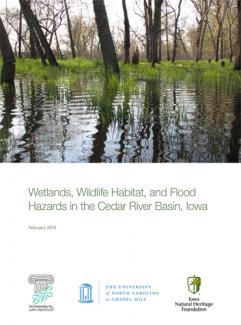
Wetlands, Wildlife Habitat, and Flood Hazards in the Cedar River Basin, Iowa

The Wetlands, Wildlife Habitat, and Flood Hazards in the Cedar River Basin, Iowa workshop report is the final report of the 2012 Wetlands Wildlife Habitat, and Flood Hazards in the Cedar River Basin Workshop designed to find ways to protect wetlands and wildlife habitat and promote resilience to flooding.

State Wetland Program Evaluation: Phase IV
Author
Environmental Law Institute
Date Released
October 2007
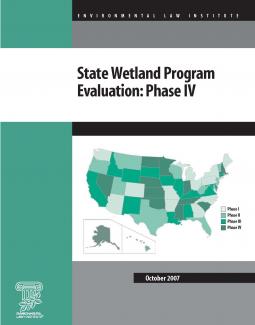
State Wetland Program Evaluation: Phase IV

This report is the fourth and final phase in ELI's multi-year study on the "core" components of state wetland programs (which include: state laws, regulations, and programs; monitoring and assessment; restoration programs and activities; water quality standards; public-private partnerships; coordination among state and federal agencies; and education and outreach activities). Each phase of the study examines a cross-section of states representing various approaches to wetland protection and regulation, as well as geographic diversity.

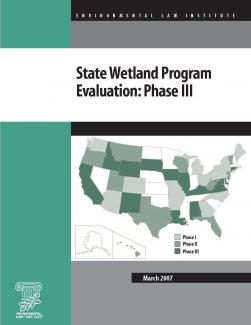
State Wetland Program Evaluation: Phase III
Author
Environmental Law Institute
Date Released
March 2007

ELI is currently conducting a multi-phased study designed to describe and analyze seven "core" components of state wetland programs: state laws, regulations, and programs; monitoring and assessment; restoration programs and activities; water quality standards; public-private partnerships; coordination among state and federal agencies; and education and outreach activities.  Each phase of the study examines a cross-section of states representing various approaches to wetland protection and regulation, as well as geographic diversity.

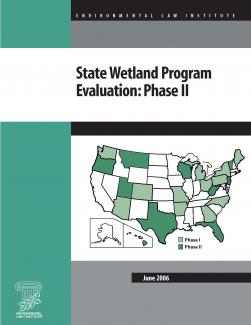
State Wetland Program Evaluation: Phase II
Author
Environmental Law Institute
Date Released
June 2006
State Wetland Program Evaluation: Phase II

ELI is currently conducting a multi-phased study designed to describe and analyze seven "core" components of state wetland programs: state laws, regulations, and programs; monitoring and assessment; restoration programs and activities; water quality standards; public-private partnerships; coordination among state and federal agencies; and education and outreach activities.  Each phase of the study examines a cross-section of states representing various approaches to wetland protection and regulation, as well as geographic diversity.

The Status and Character of In-Lieu Fee Mitigation in the United States
Author
Environmental Law Institute
Date Released
June 2006
The Status and Character of In-Lieu Fee Mitigation in the United States

The Status and Character of In-Lieu Fee Mitigation in the United States provides a comprehensive profile of the nation's active aquatic resource in-lieu fee mitigation programs. The report is the first to examine, in-depth, the status and administration of in-lieu fee mitigation in the nation, including detailed discussion of federal in-lieu fee policy and extensive analysis of how in-lieu programs implement such policies. The study was made possible by a generous grant from the U.S. Environmental Protection Agency.

State Wetland Program Evaluation: Phase I
Author
Roxanne Thomas, Brad Klein, Jessica Wilkinson, and Seema Kakade
Date Released
January 2005
State Wetland Program Evaluation: Phase I

This study seeks to analyze seven core areas of state wetland programs, including regulatory programs, water quality standards, monitoring and assessment programs, restoration projects and initiatives, public/private partnerships, education and outreach, and coordination with state and federal agencies. Twelve states are examined in Phase I of the study, which will eventually expand to cover all 50 states.