NEPA Roundup: Where Do Things Stand and Where Are They Headed?
sunset smoky mountains
Thursday, July 24, 2025

National Environmental Policy Act (NEPA) policy and practice has been in flux in recent months. Between executive orders, the recission of longstanding Council on Environmental Quality (CEQ) implementing regulations, a much-anticipated U.S. Supreme Court decision in Seven County Infrastructure Coalition v. Eagle County, and announcements by several federal agencies rescinding or modifying their own NEPA regulations, it’s worth a brief recap. 

NEPA’s Environmental Review Requirements Face Two Big Tests
Author
Bethany A. Davis Noll - NYU Law
NYU Law
Current Issue
Issue
2
Bethany A. Davis Noll

The National Environmental Policy Act is under significant pressure in court right now. In two pending cases, courts are poised to restrict the scope and impact of this environmental review statute.

NEPA requires agencies to prepare a “detailed statement” of the “reasonably foreseeable environmental effects of the proposed agency action.” In Seven County Infrastructure Coalition v. Eagle County, the Supreme Court is considering how much environmental review the Surface Transportation Board needed to do before approving a rail line that is supposed to transport waxy crude oil. The project developers argue that the agency does not need to analyze any impacts that are “remote in time and place” and under the jurisdiction of another agency. At argument in December, Justice Coney Barrett questioned that test, asking if it was “unmoored” from the purpose of the statute. She also asked if principles of deference would help, essentially proposing that the Court bow to an agency’s determination that an impact is relevant.

A coalition of states, led by Colorado, argued that the test proposed by the project developers would harm them because it would cut off analysis about impacts that are caused by the project but could be seen as “remote.” For example, a project that causes air pollution that travels across state borders could affect a state’s ability to comply with the Clean Air Act. The federal government also argued that the project developers’ test would improperly limit NEPA review. The case is pending.

Marin Audubon Society v. Federal Aviation Administration is another case where major changes to NEPA are at stake. Marin Audubon is about whether the Federal Aviation Administration complied with NEPA when it analyzed the impacts of tour flights over national parks. In order to conduct an environmental review like this, an agency has to, at minimum, begin with an assessment of the baseline number of flights and then assess the changes that will be caused once more tour flights are permitted—from additional pollution to other impacts. The problem was that the agency had previously allowed flights through an “interim order,” without assessing their environmental impact. When it finalized the decision at issue, the agency assumed that those flights were part of the baseline rather than assessing the total impact of the new flights, plus the ones allowed under the “interim order.” The court found that this violated NEPA—thus fully resolving the case.

Rather than stop there, a divided panel of the D.C. Circuit court also held that the Council on Environmental Quality does not have authority to issue binding regulations on how agencies implement NEPA. The parties had not made this argument to the court. It was not even necessary to the court’s decision, as the court agreed with petitioners even without considering the CEQ regulations issue.

NEPA, passed in 1969, created the Council on Environmental Quality. The statute instructs CEQ to review how agencies are implementing the foundational law and to make recommendations to the president on how to improve environmental quality. In 1977, the president issued an executive order instructing agencies to comply with CEQ regulations in order to promote uniformity across all the agencies working to comply with NEPA. Those regulations have provided guidance to agencies for decades. A recent Congressional Research Service report highlights that 100,000 agency actions are subject to NEPA each year. And in mid-2023, Congress codified many parts of CEQ’s regulations in the Builder Act.

In Marin Audubon, the appeals court found that making the regulations binding meant that the president had seized “the law-making power of Congress.” The court itself could also be seen as seizing “law-making power,” given that any issue with these regulations was not presented in the case. Moreover, declaring the regulations invalid, like the court did, throws many agency processes into disarray. Both parties moved for rehearing en banc, and, in late January, the court denied the motion, but also explained that the finding about CEQ’s authority was wholly dicta and not controlling. In addition, the judges said that the court should only be making decisions like this if the parties raise and brief the issue.

The Trump administration will likely have an impact on both of these cases. A new executive order, titled “Unleashing American Energy,” rescinded the 1977 executive order that made CEQ’s regulations binding. In Seven Counties and Marin Audubon, the federal government has informed the courts about this development. A change in the government’s position in the cases could affect the course of these two cases. Regardless of the government’s eventual position, both of these cases present an opportunity for courts to constrict NEPA reviews going forward.

NEPA’s Environmental Review Requirements Face Two Big Tests

EJ, Climate Change Procedures Result in CEQ NEPA Controversy
Author
David P. Clarke - Writer & Editor
Writer & Editor
Current Issue
Issue
1
David P. Clarke

Immediately upon assuming office in 2021, President Joe Biden declared a “whole of government” commitment to tackling climate change and environmental justice. Now, with the White House Council on Environmental Quality’s proposed rules placing Biden’s commitment at the center of National Environmental Policy Act reviews, environmentalists and Democratic lawmakers have voiced strong support.

But equally strong opposition has come from 17 governors and Republican members of the Senate Environment and Public Works Committee, among others, ensuring that administration attempts to advance climate and EJ policies through CEQ will face pushback.

The disagreement centers on whether NEPA is a “purely procedural statute.” CEQ acknowledges that view as “correct,” but nevertheless proposes removing NEPA-is-procedural language from the regulations because the council considers such a view of the law’s purpose “inappropriately narrow” and a limitation that minimizes its vision. Lawmakers enacted an “ambitious and visionary national policy” aimed at promoting environmental protection for present and future generations, CEQ states.

The council proposes a new requirement for the environmental documents created during NEPA reviews. When considering alternatives, project reviewers must explicitly identify “environmentally preferable” alternatives, defined as those that would maximize environmental benefits, such as addressing climate change or minimizing effects on EJ communities.

Applauding CEQ’s proposal, the Natural Resources Defense Council, National Audubon Society, and several EJ advocacy groups state that, while NEPA is “procedural in nature,” procedure and substance are “integrally connected.” NEPA’s procedures aim to fully investigate a project’s environmental impacts toward the substantive goal of creating and maintaining conditions that will allow current and later generations to exist in “productive harmony” with nature, the groups argue. They “strongly support” CEQ’s proposal to restore and strengthen a requirement for federal agencies to consider a “reasonable range of alternatives” to a project to lessen climate and EJ impacts.

In a letter to CEQ Chair Brenda Mallory, more than 80 Democratic House members and 11 senators also extol the proposal, asserting that climate and EJ considerations are urgently needed and are “consistent with CEQ’s regulatory authority.” Climate change effects are environmental effects, but despite a “clear obligation” to robustly analyze climate issues, some federal agencies conduct “little or no” analysis, they write. While offering their support for the changes, the Democratic attorneys general of 20 states and the District of Columbia urge “strengthening” certain provisions—for example, the analysis of cumulative effects on communities with EJ concerns and of climate change effects at specific points during NEPA reviews.

In contrast, GOP senators in their own letter to Mallory accuse CEQ of willfully misinterpreting bipartisan reforms adopted in the 2023 Fiscal Responsibility Act, which included the “most substantive” NEPA amendments since the law’s enactment. FRA reforms were intended to streamline an “overcomplicated, needlessly burdensome” NEPA environmental review process. But, instead, CEQ has added more uncertainty and potential legal liability into an “already labyrinthine process,” and has undermined and politicized the FRA’s agreed-upon revisions, the senators write.

Likewise, 17 GOP governors opposing CEQ’s proposal assert it will “undermine” several laudable FRA reforms and will undo the Trump administration’s 2020 NEPA rule, which was designed to increase the process’s efficiency and effectiveness. The rule made no mention of EJ. CEQ’s proposal will decrease efficiency and “drastically” increase the potential for NEPA litigation, the governors concur, and reject CEQ’s proposal to eliminate language describing NEPA as a purely procedural statute, noting that CEQ admits that the description is “accurate.”

Alaska’s Department of Natural Resources in its comments expresses general support for the proposal, but cautions that given the litigious nature of federal permitting, it is “of utmost importance” to avoid ambiguity or “additional process” that enables project opponents to make viable projects “economically unfeasible” through costly litigation and delays. The state emphasizes that NEPA must remain a purely procedural statute and opposes CEQ’s proposal to “recast” NEPA as “the primary regulatory mechanism” for advancing substantive EJ and climate goals. It is “inherently inappropriate” to include substantive requirements in NEPA, and the FRA reforms did not give CEQ any mandate that CEQ could “interpret or clarify” regarding those issues, Alaska’s letter argues.

Lawyers tracking CEQ’s proposal say that, going forward, litigation will undoubtedly focus on the adequacy of EJ and climate change analyses.

EJ, Climate Change Procedures Result in CEQ NEPA Controversy.

We Are All Sustainability Lawyers Now
Author
John Dernbach - Widener University
Scott Schang - Wake Forest University
Widener University
Wake Forest University
Current Issue
Issue
6
Cross-Examination

The record-breaking high temperatures of last summer, exposing hundreds of millions of people in the United States and around the world to unsafe levels of heat, have made it even clearer (if additional clarity were required) that more needs to be done to sharply reduce greenhouse gas emissions, adapt to unavoidable climate change, and move toward a sustainable society. A great many Americans—and those living in other countries—have a sense of helplessness about climate change. Among most in the United States, and especially younger people, climate anxiety is now common.

Quite plainly, the environmental statutes so many of us have advocated and drafted, and now help implement, counsel clients about, and litigate, are no longer enough. We are in this and other global predicaments because society continues to put economic development ahead of environmental protection. The result, says Renato Valencia, a forest ecologist in Ecuador who studies oil drilling in the Amazon, is that “nature always loses.” And it is not just nature that loses; environmental degradation also hurts people who are dependent on the affected environment, as well as future generations.

Encouragingly, Americans largely agree that something needs to be done. Nearly 7 in 10 favor the country taking steps to become carbon-neutral by 2050. The critical and essential question for all Americans is, What can we do that will actually matter? The good news is that there is a lot we can do, but it comes with a catch. We—meaning all of us, not just the government—need to do it. And again, Americans agree: two-thirds believe the job should be done not just by government, but by companies and private citizens alike.

On paper, at least, all countries now support sustainable development (or sustainability for short)—a decisionmaking framework first endorsed by the United States and other countries at the U.N. Conference on Environment and Development in Rio de Janeiro in 1992. As the name of the conference suggests, this decisionmaking framework integrates and reconciles human development—not only economic development but also social well-being, including eradication of extreme poverty, hunger, and gender and racial discrimination—with environmental protection. Its ultimate aim, in the words of the Rio Declaration, the statement of 27 sustainable development principles adopted at the conference, is that humans lead “a healthy and productive life in harmony with nature.” Other key principles stated in the declaration include intergenerational equity and a precautionary approach to environmental protection when there is significant scientific uncertainty. And all of this is built on a foundation of national security. But the Rio summit was not just about defining sustainable development; the United States and other countries agreed to an ambitious action plan for achieving sustainability within their boundaries, known as Agenda 21.

As this article explains, sustainable development grows out of environmental and natural resources law, but it is different in many ways. In our experience, American environmental lawyers, like most citizens, see sustainable development through the lens of environmental law and the overall policy it represents, and thus miss the transformative potential of this framework. Sustainable development also does not have the kind of heft or visibility environmental law does because so much of it comes from international conferences and agreements that are not considered “law.”

If the United States remains stuck in seeing sustainability largely or entirely through the lens of environmental law, or even environmental and energy law, we are not going to get the environmental protection we need. Nor are we going to get the kind of economic development, social wellbeing, and peace and security that will be essential in the decades to come. While other countries, such as many in Europe, as well as Japan, closely focus on coordinating across environmental, economic, and social goals, our own myopia will likely put the United States at a long-term competitive disadvantage.

What needs to be done to achieve a sustainable America? This article describes the many specific recommendations for action published by the Environmental Law Institute over the three decades since the Rio summit. They make clear that while all of us have a role to play in achieving a sustainable society, regardless of where we live, what kind of work we do, and whatever our skills and abilities, environmental lawyers in particular need to reimagine ourselves as sustainability lawyers.

Sustainable development grew out of environmental law. Attendees at the seminal 1969 Airlie House conference that helped create the field of environmental law (and the Environmental Law Institute as well as the Environmental Law Reporter) recognized “the need for legal reform based on far-reaching changes in social, economic, and political thought” to achieve “a world made livable for future generations,” according to attendees Malcolm Baldwin and James Page Jr.

Congress adopted what amounts to a national sustainable development policy two months after Airlie House. The National Environmental Policy Act of 1969 states that it is the “continuing policy of the federal government, in cooperation with state and local governments, and other concerned public and private organizations . . . to create and maintain conditions under which man and nature can exist in productive harmony, and fulfill the social, economic, and other requirements of present and future generations of Americans.” This policy, which is still in place, captures key elements of sustainable development.

NEPA also requires federal agencies to prepare an environmental impact statement prior to conducting major federal actions that may significantly affect the quality of the human environment. Prior to this law, federal agencies more or less ignored environmental impacts in their decisionmaking; after NEPA, they had to understand and consider them. This is a key form of integration in decisionmaking, and the Rio Declaration endorses it.

Public participation, which is built into NEPA and other environmental laws, can also further integrated decisionmaking. Under these statutes, the public gets notice of permit applications and proposed projects, gets an opportunity to comment on them, and can file a citizen suit to enforce the law in appropriate circumstances. This has helped to open the traditional binary government-industry relationship to include additional perspectives, particularly on the environmental and social impacts of a proposal. In addition, it invites other federal agencies as well as tribal and state governments to the table to share their insights and coordinate.

More basically, in spite of its name, the objectives of environmental law are not just environmental protection. As Celia Campbell-Mohn wrote in ELI’s 1993 treatise Sustainable Environmental Law: Integrating Natural Resource and Pollution Abatement Law From Resources to Recovery, the most important objective of environmental law is protection of human health. Other objectives, she explained, include efficiency, national security, preservation for aesthetics or recreation, sustainability, intergenerational equity, community stability, biocentrism, and pursuit of scientific knowledge and technology. Environmental justice is also a key goal. When we use this list to teach environmental law, the students invariably see social, economic, environmental, and even security dimensions in each of these objectives.

While there are elements of sustainability in environmental law, sustainable development is quite different. Most obviously, sustainable development is a normative framework for changing law and policy; environmental law is actual law. And unlike NEPA, sustainability is not just considering the environment as part of the decisionmaking process; the environment must actually be protected. Sustainable development differs from environmental law in a variety of additional ways.

First, and most fundamentally, sustainable development would modify the law of development by making it both environmentally and socially sustainable. This body of law may seem relevant only to developing countries, but this is incorrect. The law of development, in the United States and the rest of the world, is the law that supports economic development—including tax law; financing law; natural resources law; direct and indirect subsidies; zoning; and the laws enabling the wide variety of financial assistance provided by federal, state, and local governments for various development projects. The law of development is not recognized as a field in the United States. There is no text or treatise that collects or analyzes the U.S. law of development. But economic development agencies throughout the country, and the lawyers who represent clients interested in their assistance, know it well.

Development, we should add, also has a distinct social or human rights component aimed at fostering human dignity. Indeed, the famous Brundtland Commission definition of sustainability—"development that meets the needs of the present without compromising the ability of future generations to meet their own needs"—is based on that understanding.

Fossil fuel subsidies are a commonly cited example of unsustainable development. The alleged conflict between jobs and the environment, J. William Futrell, then ELI’s president, wrote in 2004, tends to “arise in sunset industries whose activities are economically viable only because of indirect or direct government subsidies that undermine sustainability.” In 2009, ELI published a ground-breaking study revealing that over 70 percent of federal energy subsidies from 2002-08 had gone to fossil fuels.

Sustainable Environmental Law was the first serious effort in the United States to move sustainable development from principles to law. Edited by Campbell-Mohn, Futrell, and Barry Breen, and published only a year after the Rio Summit, it examined holistically the law related to many different kinds of economic activity. There are separate chapters on such topics as timber; agriculture; fisheries; solar, wind, and geothermal energy; energy efficiency; coal; metals; and chemicals. The treatise examines each of these through their entire life cycle—from “resource to recovery.” The laws discussed in the three stages of the life cycle are resource extraction, resource use, and resource recovery.

“When the various laws that affect each industry throughout the cycle are analyzed in this way,” Futrell wrote later, “it becomes readily apparent that our laws governing development and our laws governing the environment often act in conflict.” While environmental laws were attempting to reduce environmental degradation, the book’s authors found, other laws were directed at exploiting these resources as rapidly as possible. The treatise exposed on a systematic basis what Futrell described as “the vast structures of cowboy economics, policies, and laws that militate for rapid exploitation and wasteful use of resources.” Changing these laws, the treatise’s authors found, was essential to creating the law of sustainable development.

And instead of resource recovery, the third stage, the book’s authors saw mostly waste disposal. In addition, they wrote, “No law currently addresses all three phases together.” The book’s focus on specific economic sectors is a significant contribution to what we now describe as the circular economy.

In his speeches and other writings, Futrell cautioned against getting hung up on the definition of sustainable development, which he likened to getting hung up on the definition of justice. Rather, he said, “The sense of injustice is the foundation of crafting just laws. In a similar fashion, sustainable development law would prevent or remedy unsustainable behavior.” Of course, many are uncomfortable with, and even averse to, the “development” part of sustainable development, principally because of development’s history of anti-environmental effects. But ignoring the law of unsustainable development simply perpetuates it.

Rewriting development laws to discourage unsustainable activities is one thing; encouraging sustainable development is another. The Inflation Reduction Act of 2022, perhaps the most significant piece of climate legislation thus far adopted in the United States, provides an example. Instead of requiring increased use of renewable electricity, it provides $369 million in tax and other incentives for renewables. By making clean energy cheaper, it will encourage more rapid expansion of renewable electricity as well as the renewable energy industry. It is sustainable development legislation.

Sustainability also addresses the wide variety of issues that, for whatever reason, are not addressed by environmental law. It does so, in large part, through the use of private law. Sustainable development principles are being translated into private law through certification programs (green building, sustainable forestry), private supply chain efforts, and the like. While these private laws account for a vast amount of the sustainable development work that is now being done, they are largely invisible to the public and others who see environmental law only as public law. Private law also has a critical advantage over public law: it can be adopted and implemented even when polarized politics prevent the adoption of public law.

Private law also brings with it an embrace of sound management principles, such as setting goals, deciding upon metrics to measure progress toward these goals, and then executing and reporting against them. As described below, sustainable development calls for using explicit goals and metrics to help measure progress or backsliding. Interestingly, when ELI in 2015 surveyed environmental law reinvention efforts, it found that adoption of such management techniques was a common recommendation for the improvement of environmental law.

In addition, as noted earlier, sustainable development has a social dimension that overlaps with, but is distinct from, environmental protection. Sustainable development has included an anti-poverty agenda from the beginning. The Rio Declaration describes “the essential task of eradicating poverty as an indispensable requirement for sustainable development.”

The social dimension is most explicitly stated in the 17 Sustainable Development Goals adopted by the UN in 2015—notably, with the support and approval of the United States. Goals 6 (“Clean Water and Sanitation”), 13 (“Climate Action”), and 15 “(Life on Land”) are among those with a recognizable environmental dimension (though not solely environmental). By contrast, Goals 1 (“No Poverty”), 2 (“Zero Hunger”), and 10 (“Reduced Inequalities”) are distinctly and primarily (though not entirely) social. And Goals 16 (“Peace, Justice, and Strong Institutions”) and 17 (“Partnerships for the Goals”) are foundational to all of the goals. As U.S. environmental laws largely focus on protecting human health, it is critical that they be accompanied by efforts to assure human well-being in other ways. These goals, like economic, environmental, and social prosperity, are interdependent—achievement of one requires achievement of all.

A final key difference is the role of citizens and other stakeholders. Environmental law authorizes public participation in governmental decisions, which implies the primacy of government in its implementation. Governments are important to sustainable development as well, but the framework emphasizes the importance of all citizens and stakeholders. They are not simply allowed to participate in governmental decisions; they (we) are asked to make their (our) own sustainability decisions.

The Rio Summit and subsequent international conferences have produced action plans for sustainable development. The emphasis on action led one of us (Dernbach), back in 1997, to begin what has become a series of five comprehensive reviews of U.S. sustainable development efforts since Rio, all published by ELI. These reviews address two questions: What progress is the United States making in its sustainable development commitments, and what more needs to be done? This series is the only effort of its kind in this country.

The 1997 review, conducted with the help of Widener law seminar students, showed isolated examples of individual, municipal, state, and corporate leadership on sustainable development across a broad range of fields, but nothing systematic. This review was published as an article in ELR-The Environmental Law Reporter; the other four are books written by experts from a wide range of disciplines and backgrounds and published by ELI Press.

The first two books showed growing if modest progress. Stumbling Toward Sustainability was issued on the 10th anniversary of the Rio Summit. It showed growing but limited leadership by some individuals and organizations “in every area of American life.” The next book, Agenda for a Sustainable America, was published after the 15-year anniversary. It identified significant and accelerating progress in six sectors: local governance, brownfields redevelopment, business and industry, higher education, K-12 education, and religion and ethics. Each of these books made recommendations for future action.

The third book, Acting as if Tomorrow Matters: Accelerating the Transition to Sustainability, was published on the 20-year anniversary of the Rio Summit. Instead of focusing on specific recommendations for specific topics, as the two previous books had, this one was focused thematically on how to accelerate progress on sustainable development, and at a larger scale, as discussed in more detail below.

The SDGs were adopted three years later, in 2015, and were intended to accelerate the transition to sustainability by translating its broad agenda into specific objectives to be achieved by a specific date (mostly 2030). The 17 goals include 169 specific targets. For example, Goal 11 (“Sustainable Cities and Communities”) is to be implemented by achieving 10 targets. Two of these are ensuring “access for all to adequate, safe, and affordable housing and basic services,” and providing “access to safe, affordable, accessible, and sustainable transport systems for all.” There are also indicators to measure the achievement of these goals and targets. The SDGs do not change the centrality of integrated decisionmaking to sustainable development; the basic idea is that progress on any given goal or target should also advance progress on other goals or targets across the social, environmental, and economic spheres.

The fourth and most recent book was published this year. Governing for Sustainability, which both of us edited, reviews U.S. progress (or the lack of it) based on the SDGs. While the United States continues to make some progress toward sustainability, the book concludes, there have been many setbacks (Covid-19, economic recessions, the Trump administration, and the Russian invasion of Ukraine) and much remains to be done.

The book makes some 500 recommendations for federal, state, and local governments, as well as nongovernmental organizations and the private sector. In doing so, it translates the targets and indicators in the SDGs to an agenda that can usefully and constructively be applied in the United States. An index of recommendations organized by actor allows advocates and policymakers to see all relevant recommendations in one place, regardless of the chapter in which they were made.

This U.S. agenda provides a basis for accelerating the transition to a sustainable society. Achieving that transition is often described as a journey, but the rapid pace of unsustainable development, as exemplified by growing climate disruption, makes another analogy more appropriate. The transition is more like a car chase in a James Bond film; it is not enough to go fast; we must go much faster than the car we are chasing (unsustainable development and its effects). Accelerating our speed to some degree isn’t good enough if we can’t catch that car. Sadly, there is considerable evidence that climate and other conditions are getting worse faster than we are acting. In the language of a journey, the destination is getting farther away every year.

How do we accelerate the transition to a sustainable society? There is no single answer, no silver bullet. But a suite of answers emerge from the Sustainable Development Goals themselves, the U.S. experience with sustainable development over the past several decades, and the ideas of the contributing authors to this most recent book.

The SDGs, if taken seriously, can accelerate the transition. In a variety of contexts, targets and timetables are extremely helpful tools for accomplishing change at an accelerated rate. Specific targets and timetables are particularly important for sustainable development because of the wide variety of public and private decisionmakers whose activities need to be coordinated, or at least be consistent. Political and other leaders come and go, but properly established targets and timetables remain in place.

The recommendations in this book further each of the four approaches for accelerating the transition described in 2012.

First, when more-sustainable options are more attractive than others—whether because they are cheaper, work better, taste better, or achieve greater benefits—these options are more likely to be widely adopted. Green building, locally sourced food, energy efficiency, and renewable energy are examples. These more attractive options also include new laws and decisionmaking tools. The legal and policy tools provided in this book are intended to achieve progress toward more than one goal, which means that they should have multiple benefits.

Second, the 2012 book argued for the use of a greater variety of legal and policy tools, including economic development, and repeal of laws that foster unsustainable development. Governing for Sustainability makes that point abundantly clear, recommending changes in every major category of public law, including not only environment and energy law but laws concerning civil rights, criminal justice, and food assistance. It also addresses the basic laws needed for effective governance.

Third, to accelerate the transition to sustainability, public and private governance must be visionary (because it has a sustainable society as its objective) and pragmatic (because it is grounded in political reality). The legal and policy changes recommended in the 2012 book required such governance. The SDGs could provide a foundation for that by setting out an agenda that is independent of political parties and that does not vary from one election cycle to the next, in no small part because they focus on improving quality of life for all.

Many multinational corporations already weave the SDGs into their own sustainability efforts, which is both encouraging and a warning to American environmental lawyers ignorant of the SDGs. Of course, there are strong headwinds against integrating this approach into public governance. These include lack of political leadership, political polarization, and a focus on short-term problems. None of these obstacles is insurmountable. The recommendations in this book, and using them in a concerted way to undertake and track progress toward the SDGs, can help in bypassing or overcoming them.

So can the fourth and final approach: a stronger and more vibrant American sustainability movement. This movement exists in the great many local, state, organizational, and sector-specific sustainability activities that are already occurring. Los Angeles, Houston, and Baltimore are working to achieve the SDGs. The state of Hawaii has started the Aloha+ Challenge, a statewide public and private effort to achieve the SDGs by 2030. Many American businesses are participating in achievement of the SDGs, including through the UN Global Compact, a voluntary nonprofit organization that describes itself as the “world’s largest corporate sustainability initiative.” The insights and energy of corporate leaders have the potential to dramatically scale the sustainability movement within the United States.

In the introduction to Law and the Environment, the compiled works from the 1969 Airlie House conference, Baldwin and Page note that “the magnetism of the environmental revolution has given many lawyers a soul” in what was often a soul-less profession. Today, we live in a time of diminishing hope for the future and need an updated clarion call for direction. Sustainable development, including the SDGs, provides an alternative and more hopeful vision of what the future could bring, and that future begins with each of us.

The environmental law profession has, in many ways, been building toward this moment for decades. The “right” place to start is where we are, with what we are doing, and with the particular problems or tasks in front of us. The works described in this article provide a point of departure for how to do these things to achieve a more sustainable future for all.


CROSS-EXAMINATION The environmental laws so many of us have advocated for and drafted, and now help implement, counsel clients about, and litigate, are no longer enough.

Depoliticize to Decarbonize
Author
Joel B. Stronberg - JBS Group
JBS Group
Current Issue
Issue
5
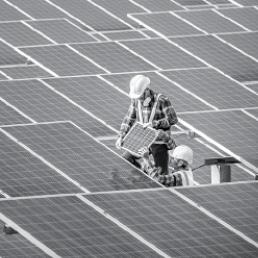
Solar Panels

The science community warns that the world is fast approaching a temperature increase threshold of no return—1.5 degrees Celsius, the “aspirational” but necessary ceiling of the 2015 Paris Agreement. Beyond that point, many of the changes we are now seeing—more damaging storms, habitat loss, prolonged droughts in vital agricultural regions, cities flooded by torrential rains and rising oceans, climate-driven migration—continue to increase in severity, scope, and frequency.

To avoid the worst global warming has to offer requires nations to replace fossil fuels with cleaner alternatives like solar and wind at a rate and scale never before attempted in an energy transition. According to the White House, achieving the president’s goal of reaching net-zero for U.S. greenhouse gas emissions by 2050, and for the rest of the world to follow, will “require a nearly complete transformation of today’s energy system—which relies on fossil fuels that emit carbon dioxide in meeting 80 percent of global demand—to one that relies on zero- or negative-emission technologies.” The White House clearly views the situation as an opportunity for America to lead by example, and this article will look at whether that is possible (the answer is a clear yes) and whether it is likely. The answer to that depends on the ability of leaders at all levels to heed human nature.

To start, can the United States replace fossil fuels with wind, solar, and other clean technologies at a pace and scale capable of accomplishing a nearly total metamorphosis of its energy systems—in less than thirty years? That would mean setting a rigorous and stable standard on how to establish and achieve emissions goals and work with all sectors to realize them—a questionable assumption that is at the crux of the issue. That includes industry as well as the population as taxpayers and energy users. And as voters. There are also other stakeholders—including communities affected by new facilities and infrastructure.

Second, is the task technologically realizable? In theory the United States can reach net-zero by 2050. And in so doing, one of the globe’s leading emitters can serve as both an example for other countries and as a purveyor of world-class, innovative American clean energy technologies. History has shown that the United States almost always accomplishes whatever it sets its collective mind on doing—whether that’s to help win a world war, land astronauts on the Moon, place a powerful folding telescope in space that can see back to the Big Bang, or formulate a vaccine against a heretofore unknown killer virus in less than a year.

On paper, transitioning the nation to a low-carbon economy seems an eminently doable task—when looking at the scale and the available resources. Analysts at the National Renewable Energy Laboratory have concluded that current clean technologies coupled with a flexible grid could reliably supply, on an hourly basis, 80 percent of 2050 electricity demand. It is not hard to imagine new technologies will fill the gaps and address other sources of greenhouse gas emissions by mid-century. For example, medium-sized geothermal plants can supply low-cost heating and cooling to existing neighborhoods while new construction prioritizes net-zero housing. Skyscrapers with no emissions are already being built. Green hydrogen can free industry from its dependence on fossil fuels and also run fleet vehicles and long-distance trucks.

Having the needed technology means the emphasis of our analysis will now be on widespread deployment. Markets are proving to be accepting of solar and wind power. And momentum for the transition has long been building in the private sector. But corporate America cannot accomplish the transition on its own—the task is too big and requires national coordination and standard-setting, with state and local implementation. Only government at all levels can gather the entire cast of needed players.

There are several relevant trends. For instance, recent commitments by the auto industry show it willing to manufacture only electric vehicles by the midpoint of the next decade. The White House and Congress are providing stimuli to the carmakers with the recent passage of the Infrastructure and Investment Jobs Act, the Inflation Reduction Act, and the CHIPS bill. These measures coupled with pledges from Detroit and the renewables sector are a firm foundation that increases the probability of achieving President Biden’s net-zero goals.

Accomplishing so total a transformation of the economy within the 2050 timeframe is problematic. Standing in the way are practical and political problems that must be resolved. Not the least of these is resistance to large, utility-scale solar and wind projects at the neighborhood level. The community is a critical—if complicated and conflicted—stakeholder that cannot be ignored. A study by Columbia Law School found that “228 local laws, ordinances and policies have been enacted in 35 states to restrict renewable energy.”

Meeting the nation’s power needs with solar, wind, batteries, and other clean options requires installing new wind capacity at six times the rate of 2020. For rooftop and utility-scale photovoltaic installations, the expedited rate is nearly four times that accomplished in 2020. Becoming a renewables economy will change the energy landscape—both figuratively and literally. Solar and wind need up to ten times the land per unit of produced power than fossil and nuclear power plants. Currently, the nation’s energy footprint is 81 million acres of land—about the size of Iowa and Missouri combined. Acreage estimates for renewables vary between the models and depend on the assumptions used to run the programs. NREL researchers estimate that 22,000 square miles of photovoltaic panels would be needed—roughly the size of Lake Michigan. At 20 percent efficiency, a conversion rate thought possible by solar experts, land drops to 10,000 square miles—roughly the size of Lake Erie. According to analysts, up to 250,000,000 more acres of land will be needed for onshore wind farms and 15,000,000 for offshore projects—roughly equivalent to the combined acreage of Arkansas, Iowa, Kansas, Missouri, Nebraska, and Oklahoma. Land will also be needed for new transmission lines. Between 1,400 and 10,100 miles of new high-voltage lines will be needed annually by 2035. Rolling out renewables at the above scales means that a lot of communities will be affected; indeed, overcoming resistance at the local level may be the biggest outstanding challenge in achieving net-zero.

The wide range in estimates reflects how much is not yet known about where the new generating facilities will be sited, their distance away from the grid, and where the end users are. Obtaining the needed permits and rights of way add layers of complexity and additional time to the project approval process.

Including nuclear in the mix would both reduce greenhouse gas emissions and land requirements. However, entrenched opposition and strict environmental regulations mean nuclear projects will take much longer to commission and complete than solar and wind. The Energy Information Agency is projecting nuclear will be a declining part of the mix—going from today’s 19 percent to 12 percent in 2050. As time is of the essence, nuclear contributions remain problematic.

There are systemic legal choke points that slow the deployment process—often to a crawl. At the federal level the National Environmental Policy Act requires reviews for any project on federal lands or with federal funding or involvement. NEPA requires an Environmental Assessment when the impact of a project is unclear. An agency may take a year or longer to complete an EA. If the EA concludes that a project needs a full-blown Environmental Impact Statement, then a notice of intent to conduct the study is published. On average, an EIS takes 4.5 years to complete. The Fiscal Responsibility Act of 2023 extending the U.S. debt limit also included provisions designed to streamline the NEPA process. The new law places a one-year limit on the time required to complete an assessment and two years for an impact statement. Other changes should be considered. Would it not be possible to amend NEPA to permit master environmental assessments and studies, leaving decisions on the particulars of any given project subject to staying within broad guidelines? In addition to NEPA states have their own laws governing required environmental impact studies. It is not unusual for a project to be subject to both federal and state laws and even municipal restrictions. A solar farm may be on federal lands, while new transmission lines cross private and state properties—each subject to a different set of evaluation, permitting, and licensing requirements. Clearly, reforms are necessary in the siting process if we are to meet the 2050 goals.

It can be difficult to tell whether a government is being cautious because of the environmental harms involved or to reduce the risk of litigation. Both incur avoidable delays that we need to get serious about reducing. Although substantive assessments and impact statements can provide a defense in case of a lawsuit, they don’t ensure that a legal challenge won’t be levied with its attendant costs and delays. Since lawsuits can be filed by citizens who are affected by a project, litigation is one of the biggest drags on a timely transition to a decarbonized economy.

The NEPA process isn’t the only one that creates project delays. The Clean Air Act and Administrative Procedure Act guarantee citizens an opportunity to comment on proposed rules. Transparency and public input are sound governance practices, but the requirements can put a heavy burden on agencies. Four million comments were submitted to EPA prior to the issuance of the Clean Power Plan, President Obama’s legacy climate policy that ran afoul of the Supreme Court.

Surely there are ways to shorten the notice-and-comment process that wouldn’t compromise the health and welfare of a community. Or the success of a project. Since the 1980s, scholars have found that the failure to include public input at the earliest possible opportunity complicates and extends the project-approval process—often leading to abandonment of the proposal. A study of 53 utility-scale renewable energy projects that experienced community resistance sought to build on earlier works by answering the question, Why wouldn’t a community want to have a renewable energy power project given the environmental, health, and economic benefits that would likely accrue? The studied projects were located across 28 states. The sources of power included solar, wind, and geothermal. In both their original research and their survey of the literature, the researchers found that individual reasons for resistance can be quite different—even conflicting.

The Susskind, et al. study confirmed earlier findings of researchers like David Bidwell from the University of Chicago and others that the reasons for opposition go deeper than what is generally referred as NIMBYism—Not In My Back Yard. The reasons for resistance varied. They include potential negative impact on property values; the lack of transparency on the part of government siting commissions; a belief that alternatives have not been fully considered; infringement of tribal rights; environmental concerns, e.g., water pollution; conflicts between local, state, and federal governments; aesthetics; and, partisanship.

It’s a mistake to think that because people believe the climate crisis is real and support the transition from fossil fuels that they are guaranteed to welcome a utility-scale wind or solar farm in an otherwise rural setting. Ironically, opposition to a project may be one of the few places climate deniers and environmental defenders are able to find common ground.

In most cases, opposition to a project involves a combination of motivating factors. The proposed Cape Wind Project would have located 130 turbines spaced over almost 25 square miles on Horseshoe Shoal in Nantucket Sound. The farm would have been the nation’s first offshore wind project and would have supplied power to 200,000 homes on Cape Cod and spur the building of other farms up and down the East Coast. The reasons for Cape Wind opposition differed. The area’s economy relies heavily on tourism and fishing. It’s also a seasonal home to many wealthy and politically influential families, many of whom opposed the project. Among the challengers was the Wampanoag Tribe, who claimed the project was to be built on sacred ancestral lands. Other objections included environmental concerns involving losses to commercial fishing and property values, regulatory issues, and aesthetic changes to an iconic American seascape.

There are other examples. In 2017, Georgetown University inked an agreement with MD Solar 1 to construct a 100,000-panel, 32-megawatt solar project on a 537-acre tract in Charles County, Maryland, about 30 miles from its campus. The project was part of the university’s overall commitment to reduce its carbon footprint in part by shifting to electricity generated from clean sources. The proposed project would have supplied over half the university’s demand.

To make room for the panels and remove any obstructions to sunlight, the developer planned to clear-cut 210 acres of trees. The proposed chop was opposed by local environmental organizations like the Audubon Naturalist Society (now Nature Forward) and the Southern Maryland Sierra Club. As in the Cape Wind example, concerns varied. The potential negative impact of the lost trees on wildlife and water sources flowing through the property and ultimately into Chesapeake Bay prompted the project’s rejection by Maryland’s environment secretary. Problems included not just the environmental impact but also the lack of public input, and intergovernmental conflicts between the Maryland Public Service Commission and the state’s Department of Environment. The project was cancelled. The university has since entered into a 15-year agreement for the purchase of power from 11 existing solar farms in Maryland and New Jersey.

Pushback on energy projects can take different forms, including legal challenges and political campaigns. A 2021 Ohio law allows county governments to create exclusion zones where no utility-scale solar or wind project can be sited. Thirteen rural counties have availed themselves of the law. An effort by Apex Clean Energy to override the denial of its plan to construct a 300-megawatt project in Crawford County ended up on the November 2022 ballot. The ban was upheld by voters, while the debate leading up to the election was fraught with alternative facts.

One can’t help but wonder if the Cape Wind and Georgetown projects couldn’t have been saved if in responding to community concerns the developers had considered alternatives to the original design. There are multiple ways to hide solar installations using berms and plantings. In the case of Georgetown, perhaps a smaller solar farm would have been more acceptable, making up for the lost panels by using the rooftops of university buildings or partnering with the many big box stores in the Washington, D.C., metropolitan area.

Opposition to solar projects in semi-rural and rural communities often revolves around the concern that lands used for a solar farm will no longer be used for agriculture. Increasingly, however, developers and farmers are finding ways to produce both power and foods. With the world getting hotter, cash crops like tomatoes are being threatened. A new industry is cropping up in response to such citizen concerns. Under the banner of agrivoltaics, farmers are shading tomato plants under the panels. Developers are meeting the challenge keeping down weeds, grasses, and saplings using goats and sheep to do what they do naturally.

The Cape Wind project failed but it’s not as though all proposed wind projects off the Massachusetts coast have been rejected. Offshore wind projects like the 800-megawatt Vineyard Wind have been approved. Vineyard Wind is 15 miles south of where Cape Wind would have been built, and thus further out to sea.

Different sites require different responses and not all responses will clear away the opposition. However, developers need to be willing to engage communities on a basis other than “take it or leave it”—rather, an approach that asks how can a proposed project meet community concerns as well as a developer’s needs. Will flexibility always lead to a successful conclusion? No, but it will certainly increase the rate of acceptance.

It doesn’t help any that U.S. climate policy is a hostage of America’s culture wars, in which party affiliation tends to dominate all other issues. As a consequence, rational policy is constantly being buffeted by political winds too often blowing in different directions. Among the first actions of every president beginning with George W. Bush has been to rip up the climate-related executive orders of their predecessors. As with many issues of the day, Democrats and Republicans view the world through much different lenses. Substantial differences are consistently seen in voter surveys. Democrats and independents view climate change as real and place a high priority on combatting it. Republicans tend to believe that the science is unclear and that government proposals will fail if attempted—and that the matter is best left to the private sector.

An inverse relationship exists between the time left to complete the sum of actions to stay on the right side of the temperature threshold and the intensity of effort to slow and ultimately reduce the presence of greenhouse gases in Earth’s atmosphere. Change of the magnitude needed to transition the United States to a low-carbon economy will take time—to draft and finalize new codes and regulations covering nearly every aspect of the built environment and how energy is created and used. So will construction of new power-generating facilities and the build out of the infrastructure needed to connect them to the grid. And as will happen when electrifying the transportation sector.

Passage of the IRA, infrastructure, and CHIPS and Science acts are a credible start to a decade of deployment of proven, cost-competitive solar and wind projects. If implementation of the IRA all goes according to plan, the United States would make significant progress toward the Biden administration’s goal of reducing emissions by at least 50 percent from 2005 levels by 2030. When was the last time a government policy—especially one with as many moving parts as the IRA and the infrastructure law—was rolled out as envisioned? It’s an immutable law of governance that stuff always happens.

Voter surveys have for years shown a majority of Americans expressing concern for the environment and a belief that climate change is real. A Pew Research Center survey conducted in January 2022 showed that 42 percent of American adults think climate change should be a top priority of Congress. The survey also found that 75 percent place blame for climate change where it belongs, on human activity and burning fossil fuels. A high number (69 percent) of survey respondents also think developing clean energy alternatives is important and that the United States indeed should be carbon neutral by 2050.

The number of Americans who believe climate change is real and clean energy alternatives are an answer has been generally rising for a decade or more. But survey numbers can be misleading. The high percentage of respondents that are understandably concerned about the consequences of climate change is rarely reflected in the top priorities of voters. Maggie Koerth at FiveThirtyEight writes that the “relationship between voters and climate policy has long fallen under the label of ‘it’s complicated.’ There is an established gap between what voters say they want—action on climate change—and what they’re willing to do to achieve that.”

The nation can no longer afford incremental change in its efforts to deploy available clean energy technologies at the pace and scale needed to avoid the worst consequences of Earth’s warming. The sweep of needed changes requires the rarest elements of all these days—trust and confidence in our elected decisionmakers and government bodies. But American’s confidence in its major institutions is at a historic low. Recent Gallup polls show that only 7 percent of those surveyed have much trust in Congress. For the presidency the number is 23 percent, while trust in the Supreme Court to keep politics out of its decisions rests at 25 percent and is going lower. Trust is better at the state and local levels, but only in comparison. A Pew Research Center survey showed trust at 54 and 66 percent respectively.

A lesson of the pandemic was the willingness of many Americans to get their information from political ideologues over the evidence of experts, including government bodies like the Centers for Disease Control. A study by Johns Hopkins University public health experts found that more than demographics, and at least as much as partisan identification, the factor that distinguished doubters from believers was their trust in science. A recent Gallup poll showed only 45 percent of Republicans trust science compared to Democrats and independents at 79 and 65 percent, respectively.

Missing from today’s debate on climate change—including its causes and consequences—is a national, nonpartisan, science-based narrative of the issue. It’s hardly surprising how little agreement there is on possible solutions given how little agreement there is on the nature of the problem.

Throughout the studies on the causes of opposition to utility-scale solar and wind farms is the consistent observation that transparency and early involvement of the public in the siting process can overcome many of the barriers. Other lessons learned from opposition to proposed large renewable energy projects include knowing the alternatives—the criticality of rewarding communities for accepting large-scale projects, for example by offering discounts on local utility bills or investments in community projects.

The timely decarbonization of the U.S. economy requires depoliticizing the climate debate at least to the point where most are singing in the same key. Admittedly, it is difficult to conceive of how that might happen given the levels of mistrust and the amount of misinformation that characterize the current debate. For the answer to that, I turn to the media scholar and visionary Marshall McLuhan, who believed “there is absolutely no inevitability as long as there is a willingness to contemplate what is happening.” I would add “truthfully” before the word “happening.”

Through whose eyes should what is happening be described? If the message is mistrusted, then perhaps it’s the messengers we should focus on. That medium, as McLuhan would have us say, defines the message and shapes the debate. But the disparity in world views from different media outlets undermines the social consensus needed for McLuhan’s prescription of “willingness” to take hold.

There’s no single solution for speeding up the deployment of clean energy alternatives and the needed infrastructure because there is no single issue preventing their widespread adoption at the pace and scale capable of closing the distance between where we are and where we need to be to stay on the right side of the temperature threshold to avoid the worst consequences of Earth’s warming.

A concurrent approach to streamlining the project approval process up and down the line means attempting to change NEPA and a host of other laws, from the federal to the local levels, including who has standing to sue and on what grounds. Change of this magnitude will be looked at suspiciously. Questions having to do with the willingness to streamline the NEPA process for renewables like solar and wind, but not for fossil fuels, must be addressed and in a nonpartisan manner.

If, as a nation, we are not to march backwards into the future, then voters must be given a much clearer understanding, in terms they can relate to, of why the transition to a low-carbon economy is needed and their individual and collective roles in bringing it to fruition. Resistance to solar and wind farms comes about largely because of misinformation and mistrust. Crucial to the successful siting of large-scale wind and solar projects is early engagement with the candidate communities in semi-urban and rural areas unaccustomed to such installations and wary of the reasons they are needed. Siting is not rocket science. But it is a people game. Solving tomorrow’s siting problems is really more a matter for the social sciences than the physical. Developers need to be mindful of the concerns which motivate and frighten people. The earlier problems are identified, the earlier they can be resolved. But flexibility is required.

If a community is concerned that the presence of thousands of unsightly solar panels will compromise the rural nature neighborhood, a developer should be willing to employ design features, such as setbacks and plantings, to reduce or solve the problem. If the community views the loss of agricultural lands as a deal breaker, then agrivoltaics may be the solution.

Too often in the effort to save Mother Nature, we forget about human nature. For as long as climate change continues to be a part of today’s culture wars, it will be impossible to deploy clean energy technologies at the scale and pace needed to avoid the worst consequences of climate change. It’s unrealistic to think the transition to a low-carbon economy will happen without stable bipartisan collaboration. The simple truth is that to decarbonize, the nation needs to depoliticize climate change. TEF

OPENING ARGUMENT Too often in an effort to save Mother Nature, we forget about human nature. Solving problems with rolling out clean renewable energy is less a matter of the physical sciences than the social sciences—overcoming users’ habits and project resistance at the local level.

Searching for Solutions to Permit a Carbon-Free Energy Transition
Author
David P. Clarke - Writer & Editor
Writer & Editor
Current Issue
Issue
5
David P. Clarke

With bipartisan demand for reforming what the National Law Review has described as a “lengthy, expensive, and perilous environmental review process,” is Congress set to break a logjam that has delayed and killed numerous infrastructure proposals? The answer has far-reaching consequences. Achieving President Biden’s goals of a carbon-free power sector by 2035 and net-zero economy by 2050 will require significant reform, and soon.

At a May Senate Energy and Natural Resources Committee hearing on permitting reform, chairman Joe Manchin (D-WV) declared, “We’re going to make something happen.” Less than a month later, Biden signed the Fiscal Responsibility Act of 2023, the debt ceiling deal, that includes several noteworthy National Environmental Policy Act reforms. For example, the FRA establishes a two-year deadline for completing NEPA environmental impact statements and a one-year deadline for environmental assessments. Project sponsors can now challenge agency delays in court.

Environmentalists aren’t happy about the reforms. Christy Goldfuss, chief policy impact officer for the Natural Resources Defense Council, complained that revising permitting through the debt-ceiling package was “the wrong way” to debate reforms and will “do more harm than good” by limiting needed environmental reviews. She also complained about the legislation’s “ramming” through approval of a West Virginia natural gas pipeline that Manchin wanted.

But Brandon Tuck, counsel to law firm Vinson & Elkins, describes the FRA changes as “modest” and likely to do little to move the needle on infrastructure projects. Even the new mandatory timelines might not drive project approvals, because federal agencies still have numerous substantive environmental law obligations whose timelines might not be compressible to fit tighter NEPA timelines. The FRA reform allowing permit applicants to prepare EISs is the one change that could actually save months during early NEPA stages, Tuck says, by enabling project sponsors to circumvent delays from limited agency resources and cumbersome federal contracting requirements.

Indeed, NEPA environmental reviews aren’t the biggest roadblock facing the clean energy transition, Tuck adds. Large-scale solar and other clean energy projects will be built, but to get their clean power to market the construction of large interstate transmission lines must be accelerated. To date, however, states’ authority to oppose interstate lines has thwarted new projects, he says, a problem that has emerged front and center of permitting reform negotiations.

The concern is not new. The Energy Policy Act of 2005 gives the Federal Energy Regulatory Commission “backstop siting authority” when states reject or fail to act on a transmission project. FERC can approve power lines in National Interest Electric Transmission Corridors designated by the Energy Department. But FERC’s authority “has never really been called into play,” Tuck notes. Right now, even if FERC exercises its authority, that power would not trump state authority to oppose transmission passing through its territories.

During Manchin’s hearing, Jason Grumet, CEO of the American Clean Power Association, representing 800 clean energy companies, highlighted that concern. Past congressional efforts to support national interest transmission buildouts has been “entirely ineffective,” with no line permitted in the nearly two decades since FERC got its backstop authority, Grumet said. A single state stakeholder can block a project that would stretch for hundreds of miles, even if all other states involved had approved it.

Now, climate change has made demand for interstate transmission increasingly urgent. According to a Princeton University analysis, if U.S. transmission development continues at the last decade’s one percent rate, over 80 percent of the greenhouse gas emission reductions achievable through wind, solar, and other clean energy supported by Biden’s $369 billion Inflation Reduction Act investments would be lost.

Congress took another step to strengthen FERC’s backstop authority in the 2021 Infrastructure Investment and Jobs Act. To implement that additional authority, in January FERC published a proposed rulemaking notice that, among other things, would allow the commission to supersede a state regulatory body’s decision denying approval of a proposed NIETC transmission project.

In search of a solution to the transmission buildout problem, Manchin introduced his Building American Energy Security Act of 2023, which includes provisions that would again enhance FERC’s backstop permitting authority, giving states one year to issue or deny a permit before the commission could act. Biden “doesn’t love everything” in Manchin’s bill but supports it, according to the president’s senior clean energy advisor, John Podesta.

Searching for Solutions to Permit a Carbon-Free Energy Transition.

Fix America's Forests
Author
Jonathan Wood - Property and Environment Research Center
Property and Environment Research Center
Current Issue
Issue
2
White house surrounded by smoke

As the Caldor Fire made its menacing march toward South Lake Tahoe last summer, it burned through more than two hundred thousand acres and destroyed more than seven hundred homes. While the effects of the fire were tragic, a greater disaster was fortunately averted when firefighters steered the fire away from the city and to an area where fuel loads had been reduced through active forest management. This tamed the fire enough to get it under control.

South Lake Tahoe was not the only area where recent management actions helped stave off disaster in 2021. The Dixie Fire, the largest single fire in California’s history, burned nearly one million acres, including 70 percent of Lassen Volcanic National Park. Thankfully, firefighters “successfully leveraged the park’s previous and current fire and fuels management projects to preserve park resources and structures,” according to a Park Service release. Without the benefit of these projects, more of the park’s infrastructure could have been lost, making its recovery from the fire more difficult.

Fire is nothing new to western forests, which are adapted to flame due to climate, terrain, and Indigenous tribes’ use of prescribed fire for millennia. However, recent catastrophic wildfires are far more destructive than historic fire regimes. They are more likely to threaten old-growth trees, wipe out habitat for wildlife, and cause erosion that degrades watersheds and fish habitat.

And due to growing populations near forests, modern fires also threaten communities and property in ways not seen before. From 2005 to 2020, wildfires destroyed nearly 100,000 structures. But 62 percent of this destruction occurred in 2017, 2018, and 2020 alone, according to a report from Headwater Economics.

As with any complex phenomenon, no single cause explains the wildfire crisis. Climate change plays a major role by extending the wildfire season and drying out fuel. But decades of mismanagement also bear a significant part of the blame. The federal government’s fire suppression efforts throughout much of the 20th century removed low-intensity fire from forests. Unrestrained by burning, brush and small-diameter trees grew to compete with old growth, making forests more vulnerable to insects and disease. Eventually, the buildup of excess fuel encouraged fires to burn hotter and to move from the ground to the canopy, where they do more damage and are more difficult to suppress.

Unlike other factors contributing to the wildfire crisis, excess fuels are a problem the Forest Service can do something about in the short term. But it isn’t—or at least not enough.

Forest restoration, the use of mechanical thinning, prescribed fire, replanting, and erosion control techniques, could reduce wildfire damage while promoting healthier forests. However, the Forest Service reports an 80-million-acre backlog in needed restoration, more than 40 percent of the 193 million acres under the agency’s control. 63 million of these acres are deemed by the agency to be at high or very high risk of burning. Add to this the 54 million acres managed by the Department of the Interior, and the total area of federal land facing high or very high fire risks is larger than the state of California.

Yet, from 2009 to 2018, the Forest Service averaged only 4 million acres of forest restoration per year. At that rate, it would take decades to address the backlog even if, miraculously, no new risks arose in the interim.

Of course, wildfires are not limited to federal forests. But they nonetheless play an outsized role, due to the concentration of federal land in the west as well as the conditions throughout many national forests. While the federal government owns less than a third of forests nationwide, it controls roughly half the forested land in Arizona and Washington, 60 percent in California, Colorado, Montana, and Oregon, and 80 percent in Idaho and Nevada. Due to this concentration and differences in how federal and private lands are managed, the total area of federal land facing high or very high wildfire risks far exceeds the 52 million private acres facing such risks. And federal lands are consistently overrepresented in the total area burned, including 75 percent of the acreage burned in the West during 2020.

Recognizing the clear shortfall in managing federal forests, Congress appropriated roughly $1.5 billion in the recent infrastructure legislation for mechanical thinning, prescribed fire, and post-fire recovery projects. But there may be a long road from appropriating money to on-the-ground restoration because the problem is not simply a lack of funds. In a recent report, “Fix America’s Forests: Reforms to Restore National Forests and Tackle the Wildfire Crisis,” the Property and Environment Research Center documents significant obstacles keeping the Forest Service from clearing the restoration backlog.

For one, the agency’s personnel have shifted dramatically away from forest management. Perhaps understandably, the Forest Service has responded to fire’s political salience by shifting resources to suppression. The programs that fell victim to the agency’s “fire borrowing,” a euphemism for raiding other programs to fund firefighting efforts, were “often those that improve the health and resilience of our forested landscapes and mitigate the potential for wildland fire in future years,” according to a 2015 Forest Service report. Consequently, the number of staff specializing in forest management has declined by half since 1992, while the firefighting staff has doubled. “It is readily apparent that the Forest Service cannot meet national direction to increase the pace and scale of forest restoration with its current workforce,” concludes a 2019 survey of Forest Service managers.

Second, forest restoration projects must navigate significant bureaucratic obstacles, including review under the National Environmental Policy Act. Depending on the extent of anticipated impacts, NEPA may require the Forest Service to analyze a project through, in order of increasing complexity and expense, a categorical exclusion, environmental assessment, or environmental impact statement. The agency may also need to develop a range of alternatives to the project and analyze their impacts. The resulting documents routinely span hundreds of pages of dense text, with appendixes spanning another thousand pages or more.

While well-intentioned, NEPA reviews can significantly increase project costs and inject substantial delays. The average delay varies by type of review, from nine months to document a project’s consistency with a categorical exclusion to nearly three years for an environmental impact statement.

Unfortunately, NEPA presents a bigger obstacle for forest restoration projects than other Forest Service projects. Forest restoration projects are roughly twice as likely to require an environmental impact statement than the agency’s overall average. Forest restoration project reviews also tend to take longer, for a given level of analysis, than other project types. An environmental assessment for a forest restoration project takes, for instance, one and half times as long to complete as an environmental assessment for a mining plan of operations.

Moreover, the kind of ambitious, large-scale forest restoration projects needed to tackle the restoration backlog are likely to result in unusually complicated reviews and long delays. The top quintile of environmental impact statements, which take an average of six years to complete, may be a better approximation of the challenge.

NEPA is premised on a type of precautionary principle: that it is better to do nothing than to do something without fully studying the environmental and other risks. Whatever the case for this approach in other circumstances, the wildfire crisis is increasingly showing that the “do nothing” option presents its own substantial risks. A delay may increase the risk that a fire will break out, threatening communities, wildlife habitat, and watersheds. Or the cost and time required to review a project may sap the agency’s ability to pursue other restoration projects.

The recent infrastructure legislation includes a small but important tweak to address NEPA’s effect on forest restoration. An amendment proposed by Senator Steven Daines, Republican of Montana, and included in the final text authorizes the secretary of agriculture to declare an emergency situation based on hazards to human health and safety or threats to natural resources. If an emergency is declared, the Forest Service need only compare its proposed response and a “no action” alternative. This may facilitate more prompt responses by avoiding the need to develop and consider a range of alternatives where the costs of delay are especially high.

In many western forests, the Endangered Species Act presents an additional complexity. If a project funded or implemented by a federal agency may jeopardize a species or adversely modify critical habitat, the agency must consult with the Fish and Wildlife Service to identify ways that impacts to the species can be avoided or mitigated.

Again, the law’s intention is good but the means of pursuing it presents under-appreciated risks. Consider the Forest Service’s ill-fated Pumice Project, which was proposed in 2011 to reduce wildfire risks on nearly 10,000 acres of Klamath National Forest. The project faced a decade of objections from local environmental organizations over alleged impacts to the northern spotted owl, a species listed as threatened under the ESA. Ultimately, 2021’s Antelope Fire “burned through the site before a single chainsaw touched a tree, destroying the owl habitat that the environmental groups were trying to save,” report the Sacramento Bee’s Ryan Sabelow and Dale Kasler. Lamenting the time and resources sunk “into kind of bulletproofing” the environmental analyses, Drew Stroberg, a district ranger in the Klamath Forest, observed that “now, they might as well be in the trash can.”

In much of the West, delays can give the ESA a cascading effect. If a new species is listed or critical habitat is designated during the period between an environmental review and project completion, the agency can be penalized for failing to anticipate and hit a moving target. Under the Ninth Circuit’s 2015 Cottonwood decision, such regulatory changes require the Forest Service to restart consultation with the Fish and Wildlife Service at the forest plan level, then to restart consultation for individual projects, all before proceeding. The Obama administration urged the Supreme Court to reverse Cottonwood, explaining in a petition that the Court review the case that the ruling “has the potential to cripple the Forest Service.”

Litigation is another obstacle—one that compounds the others. Roughly two-thirds of the lawsuits challenging Forest Service projects from 2005 to 2019 targeted forest restoration projects. However, the consequences of litigation have not been evenly felt. 85 percent of cases were filed in courts within the Ninth Circuit. Nearly half were filed in only two district courts: the District of Montana and the Eastern District of California, both areas facing significant wildfire risks.

The effects of litigation are not limited to those projects that end up in court. The Forest Service is risk averse, preferring the delay and increased expense of ever-longer reviews over the negative media and political attention that comes with losing a lawsuit. Thus agency personnel respond to the perceived threat of litigation by trying to “litigation proof” NEPA and ESA reviews, which adds to the time and resources required while often failing to avoid lawsuits.

Conflict over the Bozeman Municipal Watershed Project presents a worst-case scenario of bureaucracy and litigation compounding the effects of each other. In 2004, the Forest Service determined that wildfire risks in an area of the Custer–Gallatin Forest threatened 80 percent of the city of Bozeman, Montana’s drinking water supply and required urgent action.

The Forest Service spent three years preparing a draft NEPA document. While the agency was working to finalize that document, a federal court overturned the delisting of the local grizzly bear population, triggering the agency’s duty to consult with the Fish and Wildlife Service. In 2010, the Forest Service released its NEPA and ESA analysis and approved the project. Administrative challenges were filed. While those were pending, the Ninth Circuit decided several unrelated cases that caused the agency to revise its analysis again to address perceived litigation risks.

After that additional review was complete, a lawsuit was filed. While that was pending, critical habitat was designated for the Canada lynx, which led the Ninth Circuit to hold in Cottonwood that projects like Bozeman’s required an additional round of analysis, and resulted in a district court enjoining the project. After the Forest Service completed the required analysis, the district court lifted its injunction in 2020, allowing the project to finally move forward.

Such delays could perhaps be justified if they resulted in material improvements to a seriously flawed project. But that wasn’t the case with the watershed project, which remains the same as it was originally proposed more than 15 years ago. It’s questionable what, if any, benefit the public got from the protracted litigation and bureaucratic morass.

Here, too, the recent infrastructure bill contains a small but potentially significant change. Senator Daines’s amendment provides that courts can only enjoin forest restoration projects in cases where the secretary of agriculture has declared an emergency situation if the court determines that the challenge is likely to succeed. This reform eliminates, at least for this class of cases, a Ninth Circuit rule that allows a plaintiff to obtain an injunction by raising only a “serious question” on the merits of its case.

Despite reforms in the infrastructure law, most of these obstacles remain and will delay implementation, increase costs, and encourage continued conflict over forest restoration. And even were it possible for the entire $1.5 billion to go to on-the-ground forest restoration, this would be less than $20 per acre in the backlog. Thus, it will be essential that the Forest Service work with outside partners to stretch the money further. States, tribes, and private parties are motivated to help due to the significant benefits healthy forests provide, including clean air and water, wildlife habitat, and recreation opportunities.

For instance, the National Forest Foundation and Salt River Project, a water utility, have formed the Northern Arizona Forest Fund to perform restoration in five national forests. Since 2015, the fund has raised more than $6.2 million from a diverse group of supporters, including the Arizona Department of Fish and Wildlife, the cities of Scottsdale and Phoenix, Coca-Cola, businesses dependent on outdoor recreation, and conservation groups. From the perspective of these supporters, paying for forest restoration today is much better than suffering the consequences of wildfire tomorrow. Thanks to these contributions, as well as volunteer time and expertise, the Northern Arizona Forest Fund has implemented fuel reduction projects on 13,600 acres, improved 2,600 acres of wetlands, planted 90,000 trees, and reduced erosion along 170 miles of roads and trails.

In many communities, raising such sums up-front for the promise of future benefits may be difficult. However, a recent financial innovation can overcome this challenge. Two nonprofit organizations, Blue Forest and the World Resources Institute, have pioneered the concept of a forest resilience bond, which raises private capital to pay for forest restoration and allows beneficiaries to pay investors back over time as benefits are achieved.

In 2018, the groups raised $4 million from investors to implement the first forest resilience bond in the Tahoe National Forest, with the State of California and the Yuba Water Agency signing on to repay the bond. Ironically, the Forest Service could not sign on as a beneficiary, despite arguably getting the biggest benefit, because it is forbidden from committing funds for terms longer than its current appropriation. Working with experts from the National Forest Foundation, the bond has enabled restoration projects covering 7,000 acres, completing in 4 years work that the Forest Service expected to take 10 to 12.

With this proof of concept, Blue Forest is scaling up this innovation substantially. It is currently raising $25 million for a second bond, to restore more than 28,000 acres of Tahoe National Forest. And it has three more bonds in the pipeline, which could help restore tens of thousands more acres across the West.

The Forest Service believes that these private models could be replicated in other areas where healthy forests provide substantial benefits. The agency’s National Partnership Office has developed a “Conservation Finance Opportunities Map” that seeks to match forest areas in need of restoration with local interests that would benefit from this work.

The Forest Service has also experimented with using private partners to reduce bureaucratic delays. In 2013, the Colville National Forest approved the “A to Z” project, a timber harvesting contract under which the winning bidder would take on the NEPA process in addition to performing the timber harvest and restoration work. Vaagen Brothers Lumber, the sawmill that won the contract, hired a third party to perform the environmental review under the Forest Service’s supervision (to prevent any appearance of a conflict of interest). Although a lawsuit was filed, a federal court upheld the arrangement.

Other agencies hampered by slow, expensive bureaucracies have found success with this approach. The Food and Drug Administration, for instance, struggled for decades to increase the pace of new drug reviews. In 1992, it struck a deal with pharmaceutical companies to pay higher fees in exchange for faster reviews. Within five years, the median approval time dropped from 27 months to 14 months. Today, industry is a strong advocate for the reform, supporting several reauthorizations despite increases in the fee. The same could be true in the forest context.

Partnering with local governments also presents an opportunity to stretch dollars further while obtaining the benefits of local knowledge and enthusiasm. Under the Forest Service’s Good Neighbor program, states, tribes, and counties can take the lead on planning and implementing timber sales and stewardship contracts. In 2020, Good Neighbor Authority projects constituted 11 percent of all timber sales in Forest Service Region 1, which covers Montana, North Dakota, and parts of Idaho and South Dakota. The program lets states keep receipts from timber contracts to fund additional restoration projects. But tribes and counties are arbitrarily excluded from this part of the program.

If the backlog is going to be overcome, reforms to address the obstacles described above are needed to scale up these innovative public-private partnerships. Such reforms should seek to encourage collaboration, rather than conflict, to increase the Forest Service’s flexibility to partner with states, tribes, and private parties, and to facilitate market reforms that can make forest restoration cheaper, or even profitable.

Some of these reforms are politically easier than others. For instance, there’s no good reason for the Good Neighbor Authority program to relegate tribes and counties to junior partner status. They should enjoy the same benefits as states do. Likewise, giving the Forest Service greater financial flexibility to form long-term partnerships is critical since forest restoration is not a one-time event but an ongoing responsibility.

Other reforms are likely to be harder. Ultimately, the time and expense required to navigate projects through environmental reviews and the courts needs to be reduced. Such delays may be frustrating to Forest Service officials. But it is a deal breaker for private investment in forest restoration. Consider the perspective of a potential investor in a forest resilience bond. Before locking up any substantial amount of funds, she would reasonably want to know how much a project will cost, when on-the-ground restoration will occur, and when she will see a return on her investment. The risk that the money will be committed only for a lawsuit to delay implementation indefinitely may be too great for many investors to bear.

Congress is considering many bills that aim to address different parts of these problems. Senator Wyden of Oregon, for instance, has introduced the National Prescribed Fire Act, which seeks to reduce Clean Air Act barriers to prescribed fire and to establish a categorical exclusion to reduce NEPA burdens. Senators Daines and Feinstein have introduced the Root and Stem Project Authorization Act, which seeks to make it easier to replicate the “A to Z” model and to reduce litigation risks by shortening the statute of limitations for challenges to forest restoration projects. And Congressman Westerman of Arkansas, the only forester currently serving in Congress, has introduced the comprehensive Resilient Federal Forests Act, which among many other things seeks to streamline the NEPA process by expanding categorical exclusions and to legislatively reverse the Ninth Circuit’s Cottonwood decision.

Reforms like these could be the difference between tackling the forest restoration backlog or allowing the wildfire crisis to continue worsening. With fire seasons growing longer, millions of acres burning every year, and more people and homes at risk, the stakes could not be greater. TEF

CENTERPIECE A daunting restoration backlog in National Forests fuels the wildfire crisis. With increased funding coming, significant policy and litigation obstacles still stand in the way of forest restoration

Of Walls... and Windows
Author
Scott Fulton - Environmental Law Institute
Environmental Law Institute
Current Issue
Issue
3
Scott Fulton

“For everything there is a season,” says the old Pete Seeger song, quoting the much older still book of Ecclesiastes. It seems that we are currently in the season of walls. The physical manifestation of this particular period may be the issue of the wall on our southern border. But there are other walls, and some of them have law as their concrete or steel.

In some instances, law is designed to operate as a barrier. In other circumstances, law operates more like a window with a screen, allowing things to pass through, but in a controlled way. Most of our environmental laws are designed to operate like the latter. But what happens when they operate like walls instead of windows?

This is on my mind coming off a gathering of environmental thought leaders at the Wingspread Retreat Center in Racine, Wisconsin — a collaboration by ELI and George Washington Law School around the idea of “reimagining environmental law.”

A good deal of discussion centered around an important new book just published by ELI Press entitled Legal Pathways to Deep Decarbonization in the United States. The book is premised on the idea that while a number of technologies and other methods are available to achieve radical reductions in greenhouse gas emissions, there are numerous impediments to implementing these technologies and methods at the necessary scale and speed. >Legal Pathways is an effort to identify these impediments and devise ways to overcome them.

Essentially a playbook for policymakers and lawyers, the book outlines over 1,000 recommendations or law-based pathways for reducing U.S. greenhouse gas emissions by at least 80 percent from 1990 levels by 2050. This 80x50 target is often described as “deep decarbonization,” in the sense that it would require systemic changes to the United States’ energy economy.

While the book is a bit of a beast (around 1,000 pages), and while the scale and complexity of deep decarbonization are enormous, the book has a fairly straightforward message: deep decarbonization is achievable in the United States using laws that exist or could reasonably be enacted.

So, on this question of walls versus windows, there was a particularly spirited debate at the Wingspread event about how to deal with the use of federal statutes like the National Environmental Policy Act and the Endangered Species Act, as well as state counterpart laws, to fuel local opposition to wind and solar projects. The concern behind the debate was that the energy transformation needed to respond to the climate challenge is being impeded in part by use of these legal tools.

Even when local opposition can ultimately be overcome, such opposition can slow project progress and, because of delay or other risk factors, put project financing and viability at risk. The net of this is a fairly slow progression to our energy future. For those who see rapid transformation of our energy system as pivotal to a successful climate change mitigation strategy, the rub is obvious.

It was fascinating to hear a group of lawyers who would likely in any other circumstance be staunch defenders of NEPA and the ESA questioning out loud whether these statutes should yield in the face of the climate dilemma. How should local environmental impacts be balanced against a mega-challenge like climate change? If the environment nets out to the positive through transformation to more renewable energy, should this be a sufficient response to localized environmental opposition? If, as climate scientists suggests, broader biodiversity collapse may attend anticipated changes in temperature, should incidental taking of species at the hands of wind or solar projects be seen as an unavoidable necessity? If there is a need to open the window more fully, how should that be accomplished?

Exceptions to these laws could be created, but this may be difficult to do in a way that does not open the door to other efforts to work around these foundational statutes for other kinds of development without compensating environmental positives.

Are there ways to use the existing framework so that the values of public engagement, alternatives analysis, and mitigation of localized impacts are honored rather than abridged? Could we, for example, frame up the broadest programmatic EIA in history, with the United States’ energy transition serving as the “major federal action” under review? Could a nation-wide EIS and wildlife conservation plan fashioned around such a review serve to overcome, legally and politically, local opposition to wind and solar projects?

As you can see, the event at Wingspread brought forward more questions than answers about whether and how to open the window, but the questions always come first.

Scott Fulton on law as a window and law as a wall.

The First Earthrise Launched an Era
Author
Stephen R. Dujack - Environmental Law Institute
Environmental Law Institute
Current Issue
Issue
6

The first Earthrise launched an era

Exactly 69 hours, 8 minutes, and 16 seconds after launch, the crew of Apollo 8 burned the spacecraft’s retro rockets while behind the far side of the Moon and out of contact with the Earth. That daring maneuver caused the capsule to enter lunar orbit. The craft circled the Moon three times. After the fourth pass behind the satellite, the three astronauts looked through their tiny glass port and became the first humans to witness an Earthrise.

Lunar Module Pilot William Anders took some photographs of the view in black and white, but he immediately realized the import of what he was seeing and called excitedly for a camera with color film. Command Module Pilot James Lovell passed him the Hasselblad and Anders took one of the most important photographs since the invention of the medium. It was Christmas Eve 1968.

That night 50 years ago, during a television broadcast that was at the time the most viewed in history, Commander Frank Borman announced that the crew had a message for the human race. Then each astronaut read in turn from the Creation Story in the Book of Genesis.

There was a poignancy that can’t be described to today’s interconnected world in hearing that scratchy transmission from a quarter of a million miles away, and the coincidence of the holy date and the tale of a universe coming into existence from nothingness to realize the awe of the harmoniously circling spheres created the perfect message for the first time that humanity had left its home planet.

Then when Apollo 8 returned to Earth and the film was developed, the import of the Earthrise image became apparent, leveraging on the broadcast of the opening verses of the Old Testament. It is safe to say that photograph helped to kick off the environmental era. One year after the lunar mission, Congress passed the National Environmental Policy Act. That same day, December 22, 1969, the Environmental Law Institute opened its doors.

Capturing the movement created by that photo, the essayist and medical doctor Lewis Thomas wrote about the view in the concluding chapter of his 1974 best seller The Lives of a Cell. The image makes sense of Thomas’s whole book. Lives makes the case that cells are collections of matter that work to perpetuate themselves — absorbing, storing, and using energy — and to produce new generations. Only from the vantage of another celestial body, however, is it apparent that the Earth too is self-perpetuating.

“Viewed from the distance of the Moon, the astonishing thing about the Earth, catching the breath, is that it is alive. The photographs show the dry, pounded surface of the Moon in the foreground, dead as an old bone. Aloft, floating free beneath the moist, gleaming membrane of bright blue sky is the rising Earth, the only exuberant thing in this part of the cosmos.”

Thomas notes that “it takes a membrane to make sense out of disorder in biology.” Just as a cell is protected by its membrane, “When the Earth came alive it began constructing its own membrane, for the general purpose of editing the sun.”

It happened in slow stages, as the rocky planet outgassed an atmosphere that proved hospitable for the first photosynthetic cells, which populated the surface with a veneer of green — the first biosphere. These cells produced an oxygen atmosphere with just enough carbon dioxide to cause a congenial greenhouse effect and serve as food for the plants that would later evolve.

In the upper reaches of the membrane, the oxygen is converted by sunlight into ozone, which in turn acts to shield the biosphere producing the oxygen from damaging ultraviolet radiation. Thus, the membrane edits energy to the benefit of the higher life forms that became possible, including of course the first animals and, eventually, environmental professionals.

“We are safe, well-ventilated, and incubated provided we can avoid technologies that might fiddle with that ozone, or shift the levels of carbon dioxide,” Thomas concludes. Chlorofluorocarbons were just becoming known to damage the ozone layer, leading to a phaseout in the 1987 Montreal Protocol. And the theory of climate change as the result of increased greenhouse gases was just getting launched, but within two decades the world had agreed to the 1992 UN climate convention and made more concrete steps in 1997 in Kyoto and 2015 in Paris.

When humanity realized how precious life is on our lonely blue-and-green rock, the reaction kicked off an era of legal interventions to protect the membrane we call the environment. A half century on, we’re still at it.

Notice & Comment is written by the editor and represents his views.


“Illinois Attorney General Lisa Madigan announced a lawsuit . . . against Trump International Hotel & Tower in Chicago, alleging it has violated environmental laws by dumping millions of gallons of water in the Chicago River daily without first conducting studies on the impact to the river’s fish, as federally mandated.”

Politico Morning Energy


Gender-balanced Boards Save Dollars in Environmental Penalties

Companies with a more balanced mix of men and women on their boards are better at protecting the environment and less likely to be sued for environmental law violations, according to new research from the University of Adelaide.

The study, published in the Journal of Corporate Finance, examined 1893 environmental lawsuits raised against the ‘Standard and Poor’s’ 1500 firms in the United States between 2000 and 2015 and identified direct links between gender diversity and corporate environmental violations.

The study found companies with greater gender diversity on their boards experienced significantly fewer environmental lawsuits, indicating that female directors contribute to reducing corporate environmental litigation. For example, for every female added to a board of directors in the sample, the average lawsuit exposure is reduced by 1.5%, which on an average environmental lawsuit (USD $204 million) could equate to a saving of USD $3.1 million.

The study’s author and Adelaide Business School Senior Lecturer, Dr Chelsea Liu says the explanation for the findings lies in gender socialisation and diversity theories. “Gender diversity is what’s important — female representation on boards is most important where the CEO is male, and less important if the CEO is female,” says Dr Liu.

AAAS Eureka Alert


Did Congress address climate change?

Whether the Clean Air Act, originally passed in 1970, can be applied to global warming was a matter of intense debate during the litigation leading up to the Supreme Court’s 2007 decision Massachusetts v. EPA, in which the justices ruled that if the agency determines greenhouse gases are dangerous, it is required to regulate them. Two years later, the Obama EPA issued an endangerment finding for carbon dioxide and other gases, which was followed by restrictions on emissions from mobile sources and, later, power plants.

Buried in the original 1970 legislation is the word climate, in a list of welfare conditions that concerned the lawmakers in writing the powerful statute. Climate change didn’t become a major issue till the 1980s and wasn’t determined to be a matter in the act’s ambit for another two decades after that. Could it be that the original drafters of the statute knew about an issue that wouldn’t become a public policy concern for more than a generation?

Tom Jorling served as minority counsel to the Senate Committee on Public Works and its Subcommittee on Air and Water Pollution from 1968 through 1972. We asked him about this single word in the original legislation:

“The several years preceding the enactment of the 1970 act witnessed a rapid expansion of knowledge about the effects of air pollution. While much attention was given to the health effects in the committee, in Congress, in the media, and among interest groups there was growing awareness of broad-scale physical and chemical changes in the atmosphere as well as ecosystem effects as a result of air pollution. This was explicitly recognized in the act by including in its regulatory provisions, not just controlling health effects, but also abating effects on ‘welfare,’ defined to include ‘effects on soils, water, crops, vegetation, man-made materials animals, wildlife, weather, visibility, climate . . . and personal comfort and well-being.’

“There was growing recognition that human activities involving the release of pollutants into the atmosphere was causing significant consequences for the biosphere. Some of the consequences brought early to the attention of the committee resulted from the documented fact that radionucleides from above-ground nuclear weapons testing were distributed through the atmosphere. Similarly, the DDT molecule was found in the tissue of every organism sampled throughout the Earth’s biosphere. There was increasing concern over the effects on precipitation patterns produced by the release of particulate matter, primarily from the combustion of fossil fuels.

“There was growing concern over the apparent increase in heating of the atmosphere, not just in the urban heat pockets that had been so well documented. Senators Edmund Muskie and John Sherman Cooper, primary authors of the 1970 act, attended, along with some committee staff, the 1968 Congressional Joint Colloquium on the Environment, where the atmospheric scientist Walter Orr Roberts described the warming consequences of packing the atmosphere with gases resulting from combustion of fossil fuels.

“The scientists demonstrated the adverse effects of atmospheric ozone, photochemically produced from air pollutants, on vegetation and crops. They expressed concern about the deposition downwind of industrial facilities of nitrogen, sulfur, and other compounds shown to cause landscape-scale ecosystem degradation.

“In short, there was widespread recognition that air pollutants, some known and others that would be revealed with more research, caused what the act called ‘welfare’ effects that were addressed by Congress in the regulatory structure of the 1970 act.”

Fifty years ago, Apollo 8’s “Earthrise” photo kicked off environmental era.

National Environmental Policy Act (NEPA)

Passed by Congress in 1969 and signed into law on January 1, 1970, the National Environmental Policy Act (NEPA) broke new ground as the first major Federal legislative effort to incorporate environmental considerations into all government decision-making. 42 U.S.C. §§ 4321-4347. NEPA fundamentally altered how lawmakers and regulators approached human impacts on the natural world by requiring federal agencies to prepare Environmental Impact Statements for all major Federal actions significantly affecting the environment.