Situational Zoning: A Practical, Place-based Framework for Local Climate Governance
Climate Zoning by Christopher Serkin was selected as a top 20 article for the Environmental Law and Policy Annual Review (ELPAR) in 2025.
The Quest for Legitimacy: A Public Law Blueprint for Corporate Governance by Stavros Gadinis and Chris Havasy was selected as a top 20 article for the Environmental Law and Policy Annual Review (ELPAR) in 2025.
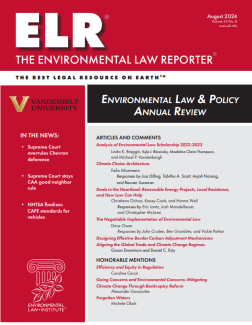
The Environmental Law and Policy Annual Review (ELPAR) is published annually in an August issue of the Environmental Law Institute’s Environmental Law Reporter (ELR) in collaboration with Vanderbilt University Law School (VULS).
Ecosystem services research has traditionally emphasized the essential role of healthy ecosystems in supporting human well-being by showcasing the critical benefits they provide, such as clean air and fertile soil. While this research has been important to communicating these benefits and even creating market-based solutions to sustain them, it often neglects a key element: the social dimensions of equity, justice, and resource distribution.
The Environmental Law and Policy Annual Review (ELPAR) is published annually in the August issue of The Environmental Law Reporter (ELR) in collaboration with Vanderbilt University Law School (VULS) and ELI. Each year, Vanderbilt Law students work with an expert advisory committee, senior staff from ELI, and Vanderbilt law professors to identify some of the year’s best academic articles that include creative and feasible law and policy proposals.
Each year, the Environmental Law and Policy Annual Review (ELPAR)—a collaboration between Vanderbilt University Law School (VULS) and ELI— identifies some of the year’s best academic articles that present legal and policy solutions to pressing environmental problems.
Each year, the Environmental Law and Policy Annual Review (ELPAR)—a collaboration between Vanderbilt University Law School and ELI—identifies some of the year’s best academic articles that present legal and policy solutions to pressing environmental problems. ELI Senior Attorney Linda Breggin, Vanderbilt Law Prof. Michael Vandenbergh, and students in a Vanderbilt law class select 20 of the most creative, persuasive, and feasible proposals in the environmental legal literature.
In “Measuring the NEPA Litigation Burden: A Review of 1,499 Federal Court Cases,” Prof. John C. Ruple and Kayla M. Race quantitatively demonstrate that the National Environmental Policy Act (NEPA) compliance and litigation burdens may be overstated—findings they argue should inform any revisions to NEPA. The article was originally published in Lewis & Clark Law School’s Environmental Law in 2020. The piece was also selected as a top 20 article for the Environmental Law and Policy Annual Review in 2020, an ELI-Vanderbilt Law School project that identifies innovative environmental law and policy proposals each year.
Electricity generation, one of the leading sources of greenhouse gas emissions, rarely accounts for the social cost of damages caused by carbon dioxide emissions. Embedding these costs into market rates is one way to address the pressing need for decarbonization. In this year’s Environmental Law and Policy Annual Review (ELPAR), a special issue of The Environmental Law Reporter, authors Bethany Davis Noll and Burcin Unel argue that addressing the price of emissions falls within the authority of the Federal Energy Regulatory Commission (FERC). The authors examine how imposing a cost on carbon aligns with FERC’s main goal of ensuring just and reasonable rates, and they explore opportunities and limits for FERC’s authority.