No Liability, Yet? What Lliuya v. RWE A.G. Means for Transnational Climate Litigation
Andes Peru
Wednesday, June 18, 2025

On May 28, Germany’s Higher Regional Court of Hamm dismissed a lawsuit brought by a Peruvian farmer, Saúl Luciano Lliuya, against the German energy company RWE AG. The court found that Lliuya had not demonstrated a sufficiently imminent or acute threat to his property to justify legal relief. 

Ranking the Court’s Top Cases
Author
John C. Cruden - Beveridge & Diamond
Seth Gertz-Billingsley - Harvard Law School
Beveridge & Diamond
Harvard Law School
Current Issue
Issue
6
Ranking the Court’s Top Cases

In Federalist No. 78, Alexander Hamilton described the judiciary of the proposed U.S. government as the “least dangerous” of the three branches. Events of the past few years might have Hamilton reconsider his famous position, as the Supreme Court has consistently appeared in the press for controversial society- and government-shaping opinions.

Whole cottage industries dedicate themselves to finding the Greatest of All Time in virtually every endeavor, from NFL quarterbacks and NBA guards to fashion designers and artists. Academics have their own such lists, with annual examinations of the greatest presidents, economics policies, and, yes, Supreme Court holdings.

While we enjoy reading all the lists, the Supreme Court has a special place in our hearts. Inconspicuously positioned off the National Mall, the Court often operates in the background of the frantic D.C. political hullabaloo. But from the beginning of our constitutional republic, the high court has punched above its weight. Never afraid of reminding the country of its jurisdictional superpowers, the Court has given the last word on some of our most important national issues, from abortion rights to gay marriage to health care availability.

That is particularly evident in the world of environmental law, as the Supreme Curt sought to interpret the explosion of statutes passed in the 1970s and 1980s. Those cases largely still govern most of the environmental realm today. Guided by rules of statutory interpretation, and no shortage of policy persuasions, the Court directed the development of law and established both opportunities and setbacks along the winding road toward sustainability.

Many scholars have addressed the question of identifying the most significant of the Supreme Court’s environmental decisions. In a series of articles in the Environmental Forum, for instance, Professors J.B. Ruhl and James Salzman identified what they called “American Idols” by polling professionals in 2001, 2009, and 2019. Their results were presented in a chart of the most important 10 decisions. Interestingly, but perhaps unsurprisingly, the top result changed each time they conducted the poll. TVA v. Hill headed the chart in 2001, but Massachusetts v. EPA took the spotlight in 2009. Completely expectedly, Chevron v. NRDC stole the hearts of voters and swept the 2019 competition.

While we completely laud Professors Ruhl and Salzman for their fascinating polling data, their lists are a little bit like a beauty pageant, voting for the most likeable. We decided to flip in at least a flavor of objectivity, beginning with the premise that the most important decisions would be those that lower courts most relied on, as of (Month) 2024.

Our strategy at the start seemed simple enough—we intended to take each case and track its citing references using Westlaw and Lexis, to observe its life over time. We anticipated that cases with higher citing references would have a greater impact than cases with fewer citations. But we quickly encountered some challenges. Some cases, like Lujan v. Defenders of Wildlife, undoubtedly changed litigation strategy. Counsel would not advise wasting resources just to have a case thrown out for standing, but that would also mean numerous cases that could be never were. We also found that some cases were coopted by other fields of law—criminal, administrative, etc.—and therefore had ghost citations that had nothing to do with our core subject. Finally, several cases had tens of thousands of cites, enough to keep a team of dedicated research assistants busy for semester after semester. Slowly, our research methods changed. In the end, we settled on total citations, ghosts and all, divided by years since the decision dropped. That ratio would give the average citations per year—not unlike a Major League batting average.

Our final list is composed of those environmental cases which had the most significant impact on the law as judged by how many courts, Supreme or otherwise, employed them in decisions. We then simply ranked the decisions by that average to produce a top-10 list—our Heavy Hitters.

A brief note on some other methods we considered. Initially, we anticipated employing the headnotes feature on Westlaw and Lexis. We thought that filtering for only those cases which cited the environmental headnotes of the case would allow us to find cases that only sat within the environmental law space. This method had several critical flaws. For one, it relied on a surprisingly ineffective system. The headnotes themselves often both over- and under-include relevant citing sources. Certain environmental headnotes, like the cases themselves, were also adopted by other fields of law. Additionally, some critical environmental holdings, especially in older cases, either were incorrectly headnoted or lumped into other headnotes. As a result, the search programs would say these cases received only a handful of citations, even though this was simply not true.

Abandoning the headnotes, we considered keyword searches in the lists of citing references, but we ran into similar problems. Nonetheless, it is worth noting that, with some exceptions, our efforts to sort by headnote or keyword largely tracked the total citations. With the notable exceptions of Winter and Lujan, our Heaviest Hitters generally made the cut whether we used either methodology, though the list would change order somewhat. This generally makes sense, as the cases above (again excluding Winter and Lujan, as well as Chevron) tended not to stray too far from the environmental fold. But uncertainties in our results led us to keep the methodology and scope described above.

Our list shares a lot with the list composed by Professors Ruhl and Salzman. Winter, Lujan, Chevron, Massachusetts, Penn Central, Sierra Club v. Morton, UARG, and Whitman appear in both our lists. The one case that made our cut and not the Professors’ is Bestfoods.

This of course creates just a bit of confusion. After all, we based our results solely on citations, and the professors used qualitative methods to arrive at their conclusions. So what is with the overlap? The correct answer is the simplest: Important cases get cited more frequently.

Maybe a more important question is what cases that made the cut for the professors didn’t stick around on ours. Looking at the 2019 survey, Rapanos, TVA v. Hill, and Overton Park didn’t pull through. On our master list, TVA v. Hill came in 12th, with 37 cites a year, Rapanos placed 15th, with 26 cites a year, and Overton Park landed in 21st, with only 16 cites per year. These cases didn’t do too terribly, and if we had knocked out the Winter, Lujan, Chevron outliers for their ghost citations, TVA v. Hill would have kept its spot on the list.

At risk of sacrificing our quantitative impartiality, we do have our own views as to why these top 10 cases were cited so much. Environmental law often drives watershed changes in administrative law. The recent FDA v. All for Hippocratic Medicine case provides a good example. In that decision, the Supreme Court found the doctors challenging the abortion pill lacked Article III standing. The case relies heavily on Lujan, Summers v. Earth Island Institute, and other environmental cases not for their environmental implications, but their standing doctrines. As Hippocratic Medicine illustrates, some key environmental cases wear multiple hats. We call these cases “dual hatted,” meaning that they could be cited for both environmental and administrative law reasons.

Top Environmental Heavy Hitters, Raked by Average Citations Per Year

1 Winter v. NRDC (2008) is a National Environmental Policy Act case that primarily considers the impact of sonar on marine mammals—but it has had an outsized impact for its straightforward presentation of the standard of law on preliminary injunctions.
Total Cites 21,832; Average Per Year 1,365

2 Lujan v. Defenders of Wildlife (1992), a case about the Endangered Species Act, remains the quintessential case on standing. Justice Antonin Scalia wrote that the plaintiffs lacked standing under Article III of the Constitution, because they based their claims on speculative environmental harms rather than “actual or imminent invasion of a legally protected interest.” TC 35,308; APY 1,103

3 Chevron v. NRDC (1984), which just entered oblivion, was not—despite what many commentators have suggested—the most cited case of all time, and the Supreme Court has not cited it since 2016, according to Loper Bright, the case that supplants it. But it still made it into the top echelon. TC 18,640; APY 466

4 Massachusetts v. EPA (2007) is, of course, the ultimate environmental decision. However, it is also the case to be cited by a state seeking standing, by giving states “special solicitude” to “protect[] [their] quasi-sovereign interests.” TC 1,302: APY 77

5 United States v. Bestfoods (1998) is one of the dual-hatted cases. It is first and foremost a Superfund decision on the liability of parent’s corporations. However, its corporate law discussion is relevant beyond the 1980 Comprehensive Environmental Response, Compensation, and Liability Act into other areas of law. TC 1,797; APY 69 (tie)

6 Penn Central v. City of New York (1978) said a city can restrict alteration and development of historical sites without causing a taking. This landmark decision established the now famous Penn Central test for compensation for a regulatory taking with three factors: “economic impact of the regulation on the claimant”; the extent to which the regulation interferes with “distinct investment-backed expectations”; and the character of the government action. TC: 3,171; APY 69 (tie)

7 Sierra Club v. Morton (1972) held that the club lacked standing to sue under the Administrative Procedure Act because it failed to show that any of its members had suffered or would suffer injury as a result of the defendants’ actions. Justice Potter Stewart wrote the opinion for the 4-3 majority, in which the Court held that, in order to have standing to sue under the APA, the plaintiffs must demonstrate they had directly suffered an injury as a result of the actions that led to the suit. TC 3,193; APY 61

8 Sackett v. EPA (2023), a new decision, made the list because it received so many citations within the first year after releasing. That is due, in no small way, to how extensive the controversy on “waters of the United States” under the jurisdiction of the Clean Water Act is right now. However, because Sackett now determines CWA jurisdiction, it is likely to remain an often-cited decision. TC 51: APY 51

9 UARG v. EPA (2014). Justice Scalia delivered the opinion of the court considering the regulation of greenhouse gases from stationary sources under the Clean Air Act, holding that EPA reasonably interpreted the act to require sources that would need permits based on their emission of conventional pollutants to comply with Best Achievable Control Technology but lacked authority to “tailor” the act’s numerical thresholds to accommodate its greenhouse-gas-inclusive interpretation of the permitting triggers. TC 501; APY 50 (tie)

9 Whitman v. American Trucking (2001), another dual-hatted decision, and also written by Justice Scalia, held that the Clean Air Act properly delegated legislative power to EPA, and that the agency could not consider implementation costs in setting primary and secondary National Ambient Air Quality Standards. The Court also found EPA’s implementation of the NAAQS was unreasonable. This case, however, is most often cited for its ruling on the allegation of illegal delegation of legislative authority and the inability to consider costs in this instance. TC 1,151; APY 50 (tie)

TESTIMONY In the box score on page 49, the authors present the heavy hitters—the most influential environmental decisions by the nine justices, ranked by how often courts cited the cases in later holdings.

Judging in a Changed Climate
Author
Sandra Nichols Thiam - Environmental Law Institute
Paul Hanle - Environmental Law Institute
Environmental Law Institute
Current Issue
Issue
4
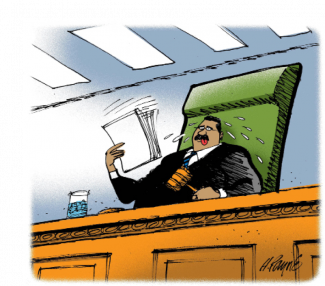
Sweating judge fanning himself with papers

Climate change is driving a groundswell of litigation in a very broad range of legal categories. These lawsuits are critical not just for the parties in the cases but for the many social impacts that will reach far beyond the specifics of a given controversy. Many of these matters gain urgency in view of the lag in policy responses to the challenges posed by a changing natural environment. Plaintiffs in this wave are asking not so much for novel uses of the law as for applying existing law and precedent to a changed factual context.

When there are such significant shifts in litigation trends, judges typically prepare for the challenge by identifying changes in management and resources they may need—and by seeking education on new issues. Because of the profound implications of climate change and efforts to stem it, and the nature of the science that explains it, today’s judges are seeking just this kind of support. Through ELI’s Climate Judiciary Project, we are meeting the need for specialized education on the science and law of this threat.

Climate change is already affecting every aspect of life. It runs through our environment, society, and economy. Right now, species vanish from the Earth faster as habitats decline, deeper droughts and more severe heat waves afflict communities, sea-level rise places infrastructure and buildings at risk and financially burdens governments, owners, and insurers—all because the oceans and troposphere have grown warmer.

Yet the dynamics of climate change are so difficult to grasp, the impacts so vast and trends so slow, that this severe problem can seem far removed and abstract to most people. Atmospheric carbon increases by only a few parts per million each year. In the same time span, sea levels rise by a few millimeters. The global average temperature has risen but two degrees Fahrenheit in a century and a half. These changes are scientifically significant but virtually undetectable to the average person, making it particularly hard for society to respond with recognition, much less resolve.

The main drivers of these changes, fossil fuels, are integral to our economic system and have also been responsible for unprecedented prosperity. How to disentangle this commodity from global markets and from countries that rely on oil and gas revenues? What to do about oil and gas infrastructure around the world? What about the jobs involved? How do you begin to tackle such a massive challenge? In addition to clashing political views about the proper size and structure of government, and enormous investment by fossil fuel interests to obscure the true situation, these factors have greatly impeded society’s response to climate change despite the scientific understanding coalescing year by year.

Time is precisely what we do not have. With rising trends in sustained droughts, heavier downpours, strong hurricanes, frequent large wildfires, more extreme-heat events, and growing sea-level rise, climate change is already assaulting humanity and Earth’s natural systems—and will only accelerate in its impacts.

All of this is against a backdrop of historic injustice. Benefits of our industrial economy have often disproportionately accrued to the privileged while environmental burdens devolved in outsize portions to the disadvantaged. In a time of social and political transition, historic power structures will tend to be reinforced. Thus, the climate problem poses yet another injustice: impacts are already disproportionately felt by people of color and low-income communities who are least responsible for their creation in the United States and around the world.

While response has been painfully slow, it has already influenced our legal system at every level of government, and across every branch. Sweeping and ambitious attempts—the Waxman-Markey legislation of the 2000s and the Juliana litigation—have failed to gain the resolution their proponents sought. At the same time, a steady flow of less-conspicuous actions in policymaking and in quotidian federal decisionmaking were mainstreaming climate change action. These included legislative and executive actions like the Infrastructure Investment and Jobs Act passed last year and President Biden’s Executive Order on Tackling the Climate Crisis at Home and Abroad. Climate is now a constant in federal environmental and energy law decisionmaking, in environmental assessments, Endangered Species Act listing decisions, and permitting of gas pipelines.

These federal actions are eclipsed by legal developments at the state and local level, where many governments have adopted greenhouse gas reduction targets, developed climate action and adaptation plans, and are investing in renewable energy. Both New York and California, for example, committed to reducing greenhouse gas emissions to nearly zero by 2050, and Hawaii passed a law committing to achieving 100 percent clean energy by 2045. In recent years, the pace of legal activity has intensified and diversified as pressure grew from civil society, (mostly) progressive politicians, and the private sector. Despite political swings, the trend over the last few decades is clear: climate-responsive laws and policies have accumulated over time. Accompanying the steady drumbeat of growing climate impacts, a rule of law of climate change is emerging.

This new body of law and policy related to climate change is developing in response to the challenges—as law has always evolved in response to new circumstances. But it is taking place in the absence of a comprehensive legal and policy strategy. The law and policy transition is accelerating, but scientific evidence and impacts themselves are outpacing this progress. In addition, there remain powerful countercurrents against an emerging consensus. In particular, some in the fossil-fuel industry remain resistant to adjusting to the new realities, with, for example, counter suits over their role in creating a climate crisis.

The courts have a critical role to play in this transformation of society, our economy, and even our governance system. Rights and responsibilities will be rewritten. Duties of care and reasonableness redefined. Government roles reshaped and reallocated. All these are matters to be processed through the courts. Litigation has the benefit not only of addressing the specific controversy between the parties to the case but of uncovering previously unknown efforts to defraud the public, raising the public profile of the issues, and providing an incentive for adaptation efforts as the standard for reasonable behavior changes.

As defined by the Intergovernmental Panel on Climate Change’s most recent report, climate litigation is an attempt to control, order, or influence the behavior of others in relation to climate governance. Some define the category as “litigation motivated by a concern about climate change or climate change policy” and others, such as the Sabin Center for Climate Change Litigation, more broadly as “cases that raise material issues of law or fact relating to climate change mitigation, adaptation, or the science of climate change.” Regardless of where you draw the boundary around these cases, more and more of them are being filed.

As of April 2022, the Sabin Center Database documents over 1,400 climate cases in the United States. The rate of filings is increasing—82 cases were filed in 2017, and the number almost doubled by 2018, with 159 cases filed that year. Total cases nearly doubled between 2017 and 2020, from around 650 to 1,200. The current trajectory of filings, coupled with continual refinement of climate science that yields more robust results, suggests this trend may well accelerate.

Climate litigation involves parties from all levels of government—federal, state, and local—non-governmental organizations, industry and industry associations, and individuals. Plaintiffs pursue an expanding range of legal theories, extending to a wide variety of constitutional, statutory, administrative, and common law claims, at both the federal and state levels. The focus of these claims includes issues related to adaptation, mitigation, and financial risk, with overlap among the issues central to some cases.

While more and more cases are being filed, it seems the courts have treated core questions about climate change response as a hot potato. While Massachusetts v. EPA gave plaintiff states standing and found that the agency was required to regulate carbon emissions from motor vehicles, and the resulting endangerment finding was also upheld, subsequent efforts to carry out this mandate have been hung up. In Connecticut v. AEP, the Supreme Court found that most federal common law claims are displaced by the Clean Air Act, effectively pushing such claims to state courts. In Native Village of Kivalina v. ExxonMobil, the Court held that money damages are also displaced to state courts. When youth plaintiffs in Juliana took a different tack and argued for a constitutional right to a stable environment, the Ninth Circuit demurred, saying that the courts are not a proper venue for addressing climate change. The Supreme Court is currently reconsidering the question of EPA’s authority to regulate carbon emissions in West Virginia v. EPA. In the meantime, many of the state cases seeking to hold parties accountable for climate change have been hung up at the procedural stage.

While small government ideology and continued resistance from fossil-fuel producers played important roles, these decisions reflect primarily that as a society we have not had the requisite reckoning about how we will allocate responsibility for climate change. That reckoning is coming, and the courts will play a critical part in shaping the future governance of our changed environment and society.

Crucial to humanity’s response is scientific understanding of the causes and effects of climate change. This understanding, built squarely on long-understood basic science, has emerged from the careful collective efforts of hosts of experts. Leading scientists such as Inez Fung have dedicated decades to understanding the dynamics of Earth’s atmosphere. Christopher Field of Stanford University and Katharine Mach of the University of Miami have dedicated their careers to understanding the relationships between changes in the climate system and impacts felt on the ground. Benjamin Strauss, CEO of Climate Central, has led research describing the status and trends of sea-level rise and its economic and social implications. And still others, such as Jalonne White-Newsome, document the relationships between climate change and health equity. These findings and many more will be essential to enabling judges to apply laws to the new realities.

Judges will need to understand the science at issue in cases, but they also require a fundamental understanding of what is in store for us from climate change, and why it is happening. To fulfill their role, judges must be able to respond in an informed way to these new challenges. The law, policy, and justice challenges posed by climate change do not require new kinds of law, however. Rather, what is needed here is the clear-eyed application of existing law and precedent with understanding of how completely the entire factual landscape has changed.

At the Environmental Law Institute, we strive to find the best ways to use laws and policies to address society’s environmental priorities. The Institute was established in 1969 to shepherd the development of the new, emerging area of law related to the natural environment. We document and disseminate law and policy trends, and we work with partners to use law and policy to address their problems. For these efforts, we seek the best, most reliable information about scientific facts and effective legal approaches. One thread that runs throughout is our specialized education to support stronger governance.

Prominent is our long-standing program educating judges, which sprang from a request for help in this regard from Judge James L. Oates in his speech accepting the 1989 ELI Award. Starting a year later, judges have come to ELI seeking analysis of foundational and emerging topics related to environmental, public health, and natural resource rights and responsibilities in their jurisdictions. In 32 years, the program has enabled thousands of jurists in 28 countries—including federal and state judges in the United States—to fully and effectively play their role in addressing society’s challenges.

ELI is not alone in using education to advance environmental solutions. Climate Central is another such organization; it researches and reports on the science and impacts of climate change. It too targets influential audiences—such as television meteorologists—as well as the general public.

In 2018, former president of Climate Central Paul Hanle was seeking a new focus for his climate science education efforts. On the climate policy front at the time, the Trump administration was moving to block and undo established policies and programs at every level, pushing much of the action to the courts. In his scoping to identify opportunities to advance climate education, he met with former BP Energy Vice President David Van Hoogstraten, a long-time ELI friend, who suggested the power that might arise from bringing Paul’s climate science education to ELI’s judicial education program.

Recognizing the potential of such a program, but also the challenges associated with introducing a new and potentially contentious topic to the judicial education authorities, who very carefully protect judges from controversy and limit educational programs to only those considered critical to playing their role on the bench, ELI joined with Paul to test if a project on climate science for judges might be possible.

In early 2019, Sandra Thiam returned to ELI after five years abroad, to join Paul’s audacious effort to find out if judges saw a need for education on climate science and to meet that need. Sandy had a track record of educating judges in ELI’s international programs over many years and was excited for the chance to apply her experience to addressing one of the most pressing issues of our time.

Judges are, by definition, generalists. Very few have a background in science. And the science relevant to much climate litigation has only become clear in the last several years, long after any sitting judges completed their education. Lawyers often joke that they chose to pursue law in order to avoid science and math. The joke is not so funny when it affects the outcomes of cases.

The need for judges to understand elements of science is not new. In his introduction to the third edition of the Reference Manual on Scientific Evidence, Supreme Court Justice Stephen Breyer described how scientific and technical issues arise in litigation in our modern society. The manual provides information to judges on common scientific issues. Educational programs on key aspects of science also occur routinely. Common topics include implicit bias, neuroscience, forensics, and technology. These programs are convened by such institutions as the Federal Judicial Center, governed by a body chaired by the chief justice of the United States, as well as independent organizations such as the National Judicial College and the National Center for State Courts.

The project that we envisioned would be true to ELI’s core principles of being apolitical and serving as a technical informational resource without advocating for any policy or legal outcome. And it would further adhere closely to the core of the scientific endeavor—to explain the objective evidence and scientific understanding that climate change is real, human-caused, and has far-reaching and serious consequences for society and the planet. The content of the project would be mainstream science as reflected in assessments and consensus reports of leading scientific institutions such as the National Academy of Sciences, National Climate Assessment, and IPCC. It would focus particularly on the science that judges needed to know for the climate cases that were coming. And to do so, we would engage with the leading experts on these topics to shape their knowledge for presentation to the judiciary.

When we began to introduce the idea of education on climate science—at a judicial education conference on environmental law in Washington in 2018—several judges offered strong encouragement. One participant, a state chief justice, observed that there was a real need for this kind of program—and no one else was doing it. Consultations with leaders in judicial education helped us to understand current priorities. We were soon invited to submit a proposal for cosponsorship with the Federal Judicial Center of a pilot series of climate science seminars for federal judges to test if they thought it was needed. Leading universities around the country stepped up to host the pilot series, each for judges in the federal circuits in their region. We enlisted the aid of the American Association for the Advancement of Science to help us recruit leading scientists and evaluate if what they were presenting matched what judges expected. When we began the pilots, we had many questions about whether judges would see our content as a priority and how to meet their needs. So, we designed the pilots to encourage discussion and feedback from the judges about content and approach.

A long-time partner, the Sabin Center for Climate Change Law at Columbia University, hosted our inaugural program in June 2019 for judges from across the 1st, 2nd, and 3rd federal circuits. They came from western New York and San Juan, Puerto Rico, Boston, and the greater New York area. At our invitation, two New York state judges joined the group.

Radley Horton of the Lamont-Doherty Earth Observatory at Columbia, who had been a convening author of the Third National Climate Assessment, opened the program with lessons on the well-established science explaining why the climate is warming, the body of evidence that confirms it, and some impacts associated with the changing climate. Leading climate law expert and Director of the Sabin Center Michael Gerrard gave the first of many presentations he has contributed to our project, with an overview of trends in climate litigation, the history of litigation over EPA’s mandate to regulate greenhouse gases, the relatively routine environmental law cases, and the high-profile cases brought by cities and states against the oil companies.

While we learned more about sensitivities and interests at each of the five sessions, the enthusiasm for this content amongst the judges was unmistakable from the first. Our participants have consistently expressed the importance of being aware of such a critical new context in order to be able to play their role as judges. Overall, the message from participants has been clear: judges need and want the climate science education that we were delivering, and they are increasingly giving it priority in their continuing education.

The success of the pilots and indeed the project overall has relied on the contributions of dedicated and skilled experts to our programs and materials. Over the course of the pilot series, we worked with leading scientists from nine different institutions to present their expertise for judges. Two other climate litigation experts, in addition to Professor Gerrard, Professors Anne Carlson of UCLA and Dan Farber of Berkeley, gave legal talks during the sessions.

Altogether, in the pilot year, we delivered five half-day sessions to approximately 80 federal and state judges in New York, Washington, Berkeley, Chicago, and Atlanta. In addition to these programs, we were invited to present several sessions at scheduled gatherings of important groups of judges. Most noteworthy, perhaps, was the annual mid-winter meeting of the Ninth Federal Circuit a few days after it handed down the momentous decision to dismiss Juliana, where we delivered the first plenary session to approximately 100 judges including the presiding judges in that case.

Our final session took place in Atlanta on the fateful day of March 13, 2020, and was attended by judges from the 4th and 5th federal circuits as well as from North Carolina. Professor Gerrard joined scientists Karen Levy, Kim Cobb, and Marshall Shephard for that session. In spite of the world closing down over Covid, our program went ahead as planned with good attendance, a testament to the importance of this issue to judges.

By the time the pandemic spread, we had presented our program to judges from almost all of the federal circuits and four states. It was clear that there was a demand for the content. In response, we launched the Climate Judiciary Project.

The Climate Judiciary Project exists to serve the needs of the bench and relies on the contributions of climate scientists and legal scholars. Since its inauguration, we have attracted the support of leading federal and state judges, who connect the project with opportunities to reach more judges and to develop educational materials to meet their needs. We have expanded our partnerships to include the National Judicial College and the National Center for State Courts, as well as the Conference of Chief Justices. Through these groups, we have a steady stream of invitations to give presentations of various lengths, both virtually and in person, in different parts of the country.

One particularly exciting program is Judicial Leaders in Climate Science, a partnership with the National Judicial College. It is a year-long program with a cohort of 23 state judges that combines climate science and leadership. Coming from a very wide range of backgrounds from states and territories around the country, the group responded with great interest to the leadership and science curriculum we presented in March. Many of the participants told us how much they appreciated the information about how climate scientists validate climate facts. Even more jurists appreciated connecting with science presenter Benjamin Santer on a personal level, and understanding the values and rigorous scientific way that he has responded to challenges to his work. The group left the first session eagerly anticipating future gatherings, most notably a deeper dive into the science in Woods Hole in September.

Engaging directly with the judges on these topics is the most powerful way of sharing climate science information they need to apply the law to these new realities. Written materials will allow us to deepen our impact. After several years of conducting programs, we have polished our content and messaging and are developing a first-of-its kind curriculum designed explicitly to meet judge’s needs for understanding climate science that is relevant to litigation.

The work is overseen by a distinguished advisory committee of 13 leading judges, scientists, and legal scholars—the top-tier of such leaders in the nation. We draw our content from the established literature of the nation’s and the world’s expert climate scientists, represented by the extensively validated reports of the National Academy of Sciences, the National Climate Assessment, and the Intergovernmental Panel on Climate Change (a program of the United Nations and World Meteorological Organization).

The curriculum includes information on both the specific areas of climate science that are likely to arise in cases and their methodologies—in particular emphasizing how norms of science differ from norms for the legal process and how climate scientists know what they know. Topics range from basic climate science, climate justice, impacts, attribution, and solutions to the uses of this science in administrative law, procedure, tort litigation, and other kinds of cases. Each module is being written by leading experts on the topic.

Whether through dissemination of modules of the curriculum, or by delivery of seminars and webinars, in the next three years we will focus our outreach on states and federal jurisdictions where cases will be heard. And in addition to the scientists who have already become CJP partners, we are also developing a cadre of outstanding senior and mid-career scientists with expertise on the topics critical to upcoming litigation to lead our seminars.

The trajectory of climate impacts will continue to increase for the foreseeable future. Efforts to use the law to stem greenhouse gas emissions and to adapt to these impacts will continue and ensuing controversies will be brought to court. We need judges to help make sense of rights and responsibilities in this new world.

To be able to do that, they need to become familiar with the chains of causation and trends of impacts that scientists are continuing to refine and verify. Our children are faced with the challenges of our legacy of climate change. But they have the benefit of receiving a clear scientific understanding of the unequivocal nature of human-caused warming. Vast scientific effort has given us this opportunity. Jurists currently on the bench, along with the rest of society, are just catching up to these realities. We will look to judges to sort out rights and responsibilities in the coming energy transition. The Climate Judiciary Project is supporting the bench in this process, providing the connection to the scientific community that jurists need to respond to our changing environment. R&P

ELI Policy Briefs represent the conclusions of the ELI Research & Policy Division. They first appear in the Forum and are later distributed in booklet form to other professionals, key decisionmkers, and the public.

ELI POLICY BRIEF No. 17 Spurred by government actions and court decisions—and accompanied by a drumbeat of growing impacts—a rule of law of climate change is emerging. ELI’s Climate Judiciary Project is preparing the bench to understand the science and ensure justice in the new legal environment.

No Big News Yet From a Changed Court’s Environmental Docket
Author
Bethany A. Davis Noll - NYU Law’s State Energy & Environmental Impact Center
NYU Law’s State Energy & Environmental Impact Center
Current Issue
Issue
4
Bethany A. Davis Noll

With the addition of Justice Amy Coney Barrett to the Supreme Court this term, environmental advocates are alert for inklings of how the Court’s new makeup will affect their work. What is notable is just how little has changed so far. Decisions this term show continued respect for states’ rights and a refusal to inject the Court into policy disputes.

Several cases settled disputes between states, in a way that emphasized the Court’s special solicitude toward state sovereignty and illustrated the heightened impact of climate change. In Florida v. Georgia, the two states argued over whether Georgia as the upstream state overused water from the Apalachicola River, causing the collapse of Florida’s downstream oyster fishery. The Court emphasized Florida’s high burden, given the “competing sovereign issues” in the case, and ultimately held that Florida had not carried its burden, given other significant causes for the collapse, including climatic factors such as seasonal rainfall changes.

In another case, New Mexico and Texas disputed implementation of their Pecos River Compact, after a tropical storm caused heavy rains. Texas had asked New Mexico to store water upstream to avoid flooding in Texas, but a significant amount of the water evaporated while stored. New Mexico then wanted credit for the evaporated water. Placing a strong emphasis on the agreement between the states, the Court gave New Mexico the credit.

With more severe storms and changing weather patterns a reality now, the Court’s natural resources docket is likely to continue to include more state-versus-state cases like these.

PennEast Pipeline Co. v. New Jersey also directly implicates states’ rights. The case is about whether a pipeline company can use delegated eminent domain authority under the Natural Gas Act to seize state land without the state’s permission. New Jersey has argued that the statute lacks a clear statement abrogating state sovereign immunity. Undecided at press time, the case is interesting because it pits gas interests against a state’s right to protect its parkland.

In another set of cases, the Court has so far declined the invitation to decide policy issues that are not squarely presented — or to rock the boat too much in general.

BP P.L.C. v. Mayor and City Council of Baltimore is one of many cases where a state or municipality alleges that oil and gas companies concealed environmental harms of fossil fuels, and defendants have removed the case from state to federal court. Ordinarily, a remand order is not appealable. But in 2011, a federal statute made remand decisions reviewable when the defendants relied on federal officer removal authority in the U.S. Code. In this case, after a remand order, the court of appeals held that reviewability applied only to the federal officer removal issue. But the Supreme Court reversed, holding that all the removal grounds could be reviewed. The companies had also asked the High Court to settle whether the case should be heard in state or federal court. The Court ducked that contentious issue though, deciding only the extent of appellate review.

Similarly, in Fish and Wildlife Service v. Sierra Club, the Court issued a Freedom of Information Act decision with the potential to affect environmental advocacy, but the ultimate holding will likely lessen its impact. FOIA requests are a significant source of pressure for environmental advocates. For example, Sierra Club FOIA requests uncovered former EPA administrator Scott Pruitt’s travel boondoggles and decision to enlist an aide to attempt to obtain a Chick-fil-A franchise for his wife, leading to ethics investigations and likely contributing to his mid-2018 resignation.

In this year’s case, the Sierra Club sought disclosure of a Department of the Interior analysis finding that a proposed EPA rule would jeopardize certain fish species. The Court held that the analysis was protected by the deliberative-process privilege because it was treated as a draft and concerned an option that “died on the vine.” Because EPA ultimately finalized a different rule, the Court analogized the analysis to an email or memorandum about a draft rule. Though advocates worried the case would allow agencies to withhold anything stamped “draft,” the decision is not likely to meaningfully extend the privilege.

Several petitions for certiorari that are pending seek review of the D.C. Circuit’s decision vacating the Trump administration’s Affordable Clean Energy Rule. Petitioners are asking the Court to settle how the Clean Air Act applies to greenhouse gases from existing power plants. But the Biden administration is still considering how to interpret the statute. Given the approach that this Court has taken so far to policy disputes, the bedrock rule that courts wait for an agency to take a position before ruling is unlikely to be thrown out anytime soon.

No Big News Yet From a Changed Court’s Environmental Docket.

Can Biden Get the Job Done?
Author
Jeremy Bernstein - InsideEPA
InsideEPA
Current Issue
Issue
1
Can Biden Get the Job Done?

Joe Biden may not have been the first presidential candidate to have pledged to address climate change and environmental justice, but he is the first to have developed such ambitious plans — and to have made implementing them top-tier priorities. “Our nation is grappling with a pandemic, an economic crisis, powerful calls for racial justice, and the existential threat of climate change,” Biden said shortly after winning the election. “We can’t simply go back to the way things were before. The team being assembled will meet these challenges on Day One and build us back better.” Build us back better has become his slogan and foreshadows both his environmental aspirations and his starting point, with many of the Obama-Biden administration’s achievements undercut or undone and huge challenges like the pandemic, the jobs crisis, crumbling infrastructure, and worsening climate impacts looming.

While his plans may be ambitious, implementing them in the face of a narrowly divided Senate, a resurgent House GOP, and a conservative Supreme Court will almost certainly temper Biden’s options. So too will former President Donald Trump, who, regardless of whether he runs for re-election in 2024, will be tweeting from the sidelines, urging his supporters to defend his deregulatory record.

“One thing is for certain: if Joe Biden shuffles into the White House, he will do so lacking any kind of mandate to make energy more expensive, restrict the use of our domestic natural resources, ban fracking on federal lands, or impose a carbon tax or other restrictive carbon policies on the American public,” says Tom Pyle, president of the American Energy Alliance, who led Trump’s Energy Department transition team. Still, there may be some smaller-bore options for bipartisan cooperation to address climate change, especially given what some Democrats see as a shift in Republican attitudes. “The folks who used to come to the floor and rail about Chinese hoaxes and fake science — all that has been shut up,” says Senator Sheldon Whitehouse (D-RI). ”We are just not hearing any of that nonsense any longer.”

Although Congress is unlikely to provide major legislative victories, there is no shortage of regulatory, administrative, and other executive options the incoming administration is considering. But it is not clear whether such actions will satisfy a range of progressive groups, whose leaders are warning that failure to deliver on his campaign promises will lead to a loss of support from many of the youth voters who fueled his campaign. “Joe Biden [is] about to get whiplash from how quickly young people turn back into his harshest critics if he doesn’t deliver on the political mandate this election delivered,” the climate-focused Sunrise Movement said in a statement after Biden’s win. “We showed up to vote Trump out with clearer margins than any generation. We expect results.”

Politics aside, cutting greenhouse gases is widely viewed as an imperative, especially given the effects of Trump rollbacks and the slowdown in constraining emissions. “The impact of the Trump administration on emissions has been significant, but the actual regulatory rollbacks were only part of it,” says Trevor Houser of the Rhodium Group. “The bigger impact was four years of lost federal policy action.”

Entering the White House after the unprecedented deregulatory actions of the Trump administration, Biden will have his work cut out — especially given his primary initial focus on the coronavirus pandemic and its economic fallout. “I expect to see all levers of the federal government mobilized in appropriate ways to at first repeal very pernicious policies of the Trump administration and then set forth an attractive affirmative agenda,” says Ricky Revesz, the Lawrence King professor of law at New York University. But reversing many of Trump’s rollbacks will take years — especially if incoming officials hope to avoid imitating the string of litigation losses racked up by their predecessors’ shoddy rulemaking practices — so Biden is also expected to quickly sign executive orders, step up enforcement actions, and take other steps that can have immediate effects.

Some are also suggesting Biden declare a climate “emergency,” which will authorize use of a range of budget, enforcement, and other tools to address climate change without congressional action. Certainly President Trump made use of this authority in diverting funds from the Pentagon to his border wall.

Much of the agenda will be guided by campaign plans. For example, his initial Plan for a Clean Energy Revolution and Environmental Justice — which was developed by a unity task force Biden created with Senator Bernie Sanders (I-VT) as an alternative to the Green New Deal — promises a range of short- and longer-term actions, including, on Day One rejoining the Paris Agreement, setting an economy-wide target of net-zero greenhouse gas emissions by 2050 and a carbon-free power sector by 2035, and rescinding Trump’s deregulatory executive orders. EPA will immediately be ordered to restore “aggressive” methane limits for new and existing oil and gas operations. The agency will have to set “rigorous” fuel economy standards for light- and medium-duty vehicles to eventually achieve zero emissions and require annual fuel-efficiency “improvements” for heavy-duty trucks, the plan says. On public lands, Biden is promising to impose a moratorium on new oil and gas leases, restore the Obama-era moratorium on new coal leasing, reintroduce climate analysis into National Environmental Policy Act reviews, encourage renewable energy projects, and reconsider land management plans. But faced with a 6-3 conservative majority on the Supreme Court, such rules could face some high hurdles. For example, approaches like the Obama-era Clean Power Plan, which sought to regulate greenhouse gases across the power sector, are unlikely to pass muster.

Within his first 100 days as president, Biden also promised to convene a climate world summit to persuade other leaders to “join the United States in making more ambitious national pledges, above and beyond the commitments they have already made.” His related Plan to Secure Environmental Justice and Equitable Economic Opportunity in a Clean Energy Future calls for strengthening the Clinton-era Executive Order 12898. When implemented, this should increase enforcement to protect fence-line and other vulnerable communities, and strengthen environmental monitoring requirements. It will require EPA to create new, real-time notification requirements for communities exposed to facility releases, and ensure neighborhoods are engaged in any remediation planning. And it will set a range of environmental cleanup standards to address widespread contamination from troublesome PFASs —per- and polyfluoroalkyl substances.

Biden later detailed an even more ambitious climate plan, serving as much to spell out his policy agenda as to unite opposing labor, environmental, and other factions within the Democratic coalition. Framed around a pledge for at least $2 trillion in clean energy-related investments within four years, his subsequent proposal outlines a range of additional commitments. These include building modern infrastructure, long on policymakers’ wish list. Biden also wants to position the auto sector to “win the 21st century” while the nation achieves a “carbon pollution free” power sector by 2035. The proposal would make dramatic investments in energy efficiency in buildings, require a “historic investment” in clean energy innovation, and advance “sustainable agriculture and conservation.”

Although Biden is not expected to target natural gas in the direct way that President Obama’s regulations went after coal, whatever regulatory policies he imposes on methane from the oil and gas sector and emissions standards for new power plants, together with large investments in wind, solar, and other clean renewables, are nevertheless expected to eventually drive natural gas and other fossil fuels out of the market. “De-carbonization isn’t a debate — it’s a fossil-fuel death sentence,” says Kevin Book, managing partner of ClearView Energy Partners, a consulting firm. “It means a resource is going off the grid. That is the inevitable implication.”

To address such far-reaching challenges, Biden is taking a “whole of government” approach, implementing a policy architecture across the federal system while reinventing parts of it too. “From the very beginning of the campaign, when President-elect Biden rolled out his climate plan, he made it clear he sees this as an all-of-government agenda, domestic, economic, foreign policy,” says Stef Feldman, Biden’s campaign policy director. “From the very beginning, when he talked about infrastructure, he talked about making sure that it built in climate change, that we are making our communities more resilient to the effects of climate change.”

EPA and Interior will certainly be mobilized, but so too will Agriculture, Transportation, Treasury, and other departments that can focus on climate change without the need for congressional action. Biden has already made clear, for example, that he will re-orient the Transportation Department to advance deployment of electric vehicles and their charging infrastructure. A post-election discussion with General Motors’ CEO Mary Barra about building 550,000 EV charging stations may already have borne results: days later, the company dropped its support for the Trump administration’s scaled-back fuel economy standards. Biden also has called for climate measures at the Treasury Department that promote carbon reductions through tax, budget, and regulatory policies. Other options include creation of a “carbon bank” under the Agriculture Department’s Commodity Credit Corporation that could pay farmers and other landowners to sequester carbon, and changes to the department’s crop insurance program to develop healthier soils.

Of particular interest are agencies overseeing the financial system, including the Securities & Exchange Commission and the Federal Reserve. For example, Biden has already called for the SEC to craft a regulation requiring corporations to disclose climate risks and greenhouse gas emissions. Similarly, the Federal Reserve is expected to soon join the Network of Central Banks and Supervisors for Greening the Financial System, the global coalition dedicated to dealing with risks posed by climate change, though membership is conditional on Biden’s return to the Paris Agreement. And the new administration is expected to undo a Labor Department rule restricting environmental, social, and governance investing.

Biden’s climate and environmental justice plans provide broad frameworks to address not only adverse environmental effects of climate change and ambient pollution but also a governing agenda across a range of policy areas, including infrastructure, economic development, and finance. “There is no more consequential challenge that we must meet in the next decade than the onrushing climate crisis,” Biden says. “When Donald Trump thinks about climate change, the only word he can muster is ‘hoax.’ When I think about climate change, the word I think of is ‘jobs.’”

To oversee such a wide-ranging agenda, the incoming administration is likely to take a series of steps to restructure the federal government, starting with the White House itself. Biden has already tapped John Kerry, the former secretary of state and architect of the Paris Agreement, to serve as a presidential climate envoy with a seat on the National Security Council. “For the first time ever, there will be a principal on the National Security Council who will make sure climate change is on the agenda in the Situation Room,” Biden says. The new president also plans to create a domestic climate czar to elevate the issue in the White House, along with the creation of a National Climate Council — that is to be co-equal to the Domestic Policy Council and the National Economic Council — that will coordinate actions across federal agencies.

To bolster consideration of environmental justice concerns, Biden has also called for elevating EPA’s National Environmental Justice Advisory Council into a White House office to advise policymakers, and for creating the White House Environmental Justice Interagency Council to coordinate government-wide efforts. Both will be reporting to the Council on Environmental Quality. And he promises to “overhaul” EPA’s civil rights office to “ensure it brings justice to frontline communities that experience the worst impacts of climate change and fence-line communities that are located adjacent to pollution sources.” He added, “For too long” the office has “ignored its requirements under Title VI of the 1964 Civil Rights Act. That will end in the Biden administration.”

The president-elect also pledged to “strategically support ongoing plaintiff-driven climate litigation against polluters,” bringing federal resources to the ongoing court battles that teen plaintiffs have been waging against oil and gas companies, but which have become mired in procedural disputes. Such an effort would be aided by his plan to create an Environmental & Climate Justice Division within the Department of Justice that would complement the existing Environment and Natural Resources Division.

“This represents a significant escalation in potential liability risk for fossil fuel companies, as not only does the federal government possess greater resources to prosecute such actions, but it is possible that the DOJ may bring enforcement actions under an aggressive theory of liability in addition to the civil tort actions currently prevalent,” says Jacob Hupart, a lawyer who has represented oil and gas companies. And should Biden depart from the Trump administration’s view that such litigation is preempted by federal law, “then the legal position of fossil fuel companies in the existing climate change lawsuits may also be under additional pressure.”

To staff such efforts, Biden has already selected experienced personnel, many with a history of dealing with climate change in the Obama administration. His initial high-level cabinet appointments — including Secretary of State Tony Blinken and Treasury Secretary Janet Yellen — have lengthy resumes advocating for actions to address climate change. “What I see is a growing recognition on both sides of the aisle that climate change is a very serious concern and that action needs to occur,” says Yellen, the former chair of the Federal Reserve. She has long called for a carbon tax with a dividend paid to taxpayers.

Others have seen the effects of climate change up close. Ron Klain, the new White House chief of staff, led the Obama’s administration’s response to the Ebola outbreak, an experience that made clear the connections between climate change and deadly diseases. “As the Earth’s climate alters, we are seeing changes in where and how humans live; these changes increase the risk that deadly diseases will emerge and spread more rapidly,” Klain wrote in 2017 with Brian Deese, Obama’s former climate advisor, whom Biden has tapped to lead his National Economic Council. “While the interactions between climate change and disease are hard to predict with certainty, the scientific linkages are unmistakable. If we fail to integrate planning for the impact of climate change with planning for the prevention and management of pandemic disease, the consequences will be deadly,” they wrote.

Getting nominees confirmed by the narrowly divided Senate will be a heavy lift for some. Neera Tanden, whom Biden has picked to lead the Office of Management and Budget, is “radioactive,” says Senator John Cornyn (R-TX). But Biden will only be able to make some selections if they can first run the gauntlet of progressive groups over their ties to fossil fuel and other corporate entities. A case in point: Representative Cedric Richmond (D-LA), whom Biden has tapped as a senior advisor and director of the White House Office of Public Engagement, with a broad portfolio that initially will include climate and other issues. Richmond’s appointment “feels like a betrayal,” the Sunrise Movement said after his selection, “because one of President-elect Biden’s very first hires for his new administration has taken more donations from the fossil fuel industry during his congressional career than nearly any other Democrat, cozied up to Big Oil and Gas, and stayed silent and ignored meeting with organizations in his own community while they suffered from toxic pollution and sea-level rise.”

Such criticisms have turned frosty the goodwill that had built up between Biden’s team and Sanders-aligned groups, who face the risk of being tuned out. “They can either continue to just beat the drums on the streets or they can start to leverage the relationship they have. It’s up to them which strategy they adopt,” says one Democrat in touch with Biden’s team.

Such tensions also reflect a stormy debate among Democrats in Congress, where moderates and progressives are arrayed in a circular firing squad over who is to blame for surprising electoral losses that have left Speaker Nancy Pelosi (D-CA) with the smallest majority in 18 years and limited legislative prospects. Many moderates blame progressive policies like the Green New Deal and calls to ban fracking for such losses. “We pay the price for these unprofessional and unrealistic comments about a number of issues, whether it is about [defunding] the police or [banning] shale gas,” says Representative Conor Lamb (D-PA), who held onto his gas-heavy district in western Pennsylvania. “Those things aren’t just unpopular, they’re completely unrealistic, and they aren’t going to happen. And they amount to false promises by the people that call for them.”

But progressives, like Representative Alexandria Ocasio-Cortez (D-NY), author of the Green New Deal, are promising to continue pushing their agenda through the 2022 mid-term elections, a ballot that has usually seen the president’s party lose seats. Ocasio-Cortez, who co-chaired the Biden-Sanders unity task force on climate change with Kerry, says she expects Biden to make good on his promises. “We’re not going to forget about that agreement, for the sake of an election, are we? What we’re gonna do is that we’re going to organize and demand that this administration — which I believe is decent, and kind, and honorable — keep their promise,” she says. Corralling such a fractured caucus will be a tough road for Pelosi, who has promised an array of climate legislation early in the new Congress, including measures recommitting the United States to the Paris Agreement, and requiring states to account for climate change before implementing federally funded infrastructure projects — and to meet certain greenhouse gas emission goals when they accept the funding.

Still, there may be opportunities for some bipartisan House progress on environmental policy. Representative Debbie Dingell (D-MI), the lead sponsor of comprehensive bipartisan legislation to regulate PFAS releases under the pollution control statutes, says she plans to re-introduce her bill in January and quickly advance it “to keep the pressure on and signal to the incoming administration that this is a top priority of the Congress. We think this can be a fast environmental win.” Dingell says that she is working with House Energy and Commerce Committee Chairman Frank Pallone (D-NJ) to quickly advance the legislation. Dingell says she also plans additional PFAS legislation “where possible,” including banning the use of PFAS in food contact containers and cosmetics. But even as she prepares to act, Dingell says that she and her supporters are also working with incoming administration officials to help them “knock out PFAS regulations that won’t require an act of Congress.”

Winning Republican support for such measures may have been possible in the past, when GOP lawmakers from contaminated districts backed Dingell’s legislation, especially given the Trump administration’s reluctance to regulate. But with a Biden administration now expected to do some of the heavy lifting, Republicans may not have the same incentives. “Before people run out and file legislation [to address PFAS] you really want to make sure you’ve got everything, that all the consequences that this could affect, because if you don’t, you can have real serious consequences out there on what you’re doing and what’s happening in the market,” says Bob Latta (R-OH), a top Republican on the House Energy and Commerce Committee.

Prospects for bipartisan agreement on affirmative policies face similar hurdles in the Senate, where key Republican and Democratic leaders of the energy and environment committees hail from fossil-energy states. Senator John Barrasso (R-WY), who is slated to lead the Energy and Natural Resources Committee, has promised to keep his state’s abundant coal and gas resources at the center of his agenda. His Democratic counterpart is Senator Joe Manchin (D-WV), another fossil-fuel friendly senator who has a mixed environmental record. West Virginia Senator Shelley Moore Capito will lead Republicans on the Environment and Public Works Committee, where Senator Tom Carper (D-DE) will serve as her Democratic counterpart.

Despite their home-state biases, these lawmakers have previously cut deals that could provide a model for legislating in the Biden era. Barrasso, Capito, and Carper struck a legislative agreement in 2019 that led to an initial round of regulations on PFAS, such as Toxics Release Inventory reporting requirements and prohibiting future uses of some chemicals that have been phased out. Additional measures could be in the works, especially given that Capito has listed new drinking water standards for the chemicals as a priority.

Barrasso and Capito both back legislation that supports carbon capture from coal and other combustion, including tax credits and research, bills that Rhode Island’s Whitehouse also supports. That Democrat is also leading bipartisan measures to reduce emissions across a range of industry sectors, including bills to create voluntary greenhouse gas credit markets for the agriculture and forestry sectors, preserve existing nuclear power plants, encourage low-carbon manufacturing, support carbon capture and sequestration research, and phase down the use of hydrofluorocarbons with a high global warming potential.

Another possible area of agreement is including climate provisions in infrastructure spending legislation, an approach that the Senate environment committee has already adopted on a bipartisan basis and is strongly supported by the U.S. Chamber of Commerce. A bill the committee unanimously approved in 2019 provided $10.8 billion over five years for GHG-reduction measures, including $3 billion in new funding for states to support projects that lower highway-related emissions, as well as additional regulatory and financial incentives for states to conduct emissions planning and lower per-capita emissions. However, the infrastructure bill never came up for a vote on the Senate floor after environmentalists objected to provisions exempting some natural gas projects from NEPA reviews and other permit-streamlining measures.

But with a President Biden in the White House eager to cut deals with Republicans, such compromises may be the bitter pill that Democrats and environmentalists may have to swallow to make some progress on addressing climate change, environmental justice, and other critical issues. TEF

COVER STORY “Build us back better” has become his slogan and foreshadows both his environmental aspirations and his starting point, with many of the Obama-Biden administration’s achievements undercut or undone and huge challenges looming.

Climate Litigation Has at Least for Now Dodged a Possibly Fatal Blow
Author
Richard Lazarus - Harvard University
Harvard University
Current Issue
Issue
2
Richard Lazarus

This past fall, the “Trial of the Century” was scheduled to commence in a federal court in Oregon. The plaintiffs? Twenty-one children. The defendant? No less than the United States. And the accusation? That the federal government had violated the children’s constitutional rights by “creating, controlling, and perpetuating a national fossil fueled based energy system, despite long-standing knowledge of the resulting destruction.”

The remedy sought by the plaintiffs was no less ambitious than their claim that the Constitution’s Due Process Clause confers on individuals the right to “a stable climate system capable of sustaining human lives and liberties.” Plaintiffs sought a court order directing the government to implement “an enforceable national remedial plan to cease the constitutional violations by phasing out fossil fuel emissions and drawing down excess atmospheric CO2.”

The 50-day trial seemed unstoppable only days before its start date. The judge had repeatedly denied the government’s motions to dismiss the complaint. No less significantly, by declining to certify the case for interlocutory appeal, the judge had refused to allow the federal government the ability to appeal those rulings before trial.

Nor had either the Ninth Circuit or the Supreme Court been willing to come to the federal government’s rescue. The Ninth Circuit had twice denied the Department of Justice’s mandamus petitions to hear their arguments for dismissal before trial. And the Supreme Court in July had rebuffed the solicitor general’s request to stay the trial court proceedings.

Everything shifted, however, on the eve of trial. The case was postponed and its future remains uncertain. Reversing herself in late November, the trial judge agreed to certify the case for interlocutory appeal and the Ninth Circuit has scheduled the case for expedited consideration.

So what happened? What prompted the trial judge to change her mind?

When the justices denied the solicitor general’s request for a stay in July, too little attention was paid to the order’s fine print. While formally denying the government’s requests, the High Court simultaneously left little doubt it believed that the trial judge should have certified the case for interlocutory appeal. The July order set forth the central statutory touchstone for certification — a case raising a “controlling question of law as to which there is a substantial ground for difference in opinion” — and then offered the Court’s clear view that the “striking breadth of the plaintiffs’ claims present substantial grounds for difference in opinion.”

That is why when the trial court failed to take the initial hint and continued to insist on trial, the justices double-downed when the solicitor general a few days before trial filed a mandamus petition with the Court and again asked the justices to stay the trial. This time Chief Justice Roberts immediately stayed the trial to allow the full Court to consider the motion. And, although the Court once again denied the stay request, here again the fine print of the Court’s order left little doubt that it wanted the Ninth Circuit and trial judge to clean up this mess so that the Supreme Court would not have to take the extraordinary step of intervening.

The exclusive reason the High Court gave for denying a stay was not that mandamus was unwarranted but that the Supreme Court need not be the one to grant mandamus because there was good reason to believe the Ninth Circuit would. In Supreme Court-speak, that is about as close as one can get, short of a formal reversal, to the Court telling the Ninth Circuit to fix the problem. The wording was no doubt a compromise reached by the chief and some of more liberal justices seeking to avoid a worse outcome.

The Ninth Circuit plainly got the hint. A few days later, the appeals court stayed the district court proceedings and asked the trial judge to “promptly resolve” the government’s motion to reconsider the denial of interlocutory appeal. And, while insisting that it had not changed “its belief that this case would be better served by further factual development at trial,” the district judge subsequently made clear she understood what she was being asked to do, and certified the case for interlocutory appeal.

Indeed, the entire turnabout was so head-spinning that one of the three Ninth Circuit judges dissented from that court’s decision to hear the appeal. Judge Michelle Friedland wrote she did not believe the trial judge was truly “of the opinion” that interlocutory appeal was warranted but had “felt compelled to make that declaration.”

As disappointed as the plaintiffs no doubt are, I suspect climate litigation has at least for now dodged a fatal blow. Had the lower courts not retreated and the justices been forced to act, it is not hard to imagine the harsh ruling that would have likely resulted in such an extravagant case — with negative repercussions affecting all climate jurisprudence.

It is not hard to imagine the harsh ruling that would have likely resulted.

Climate litigation has at least for now dodged a possibly fatal blow.

"No Ordinary Lawsuit"
Author
Barry E. Hill - Vermont Law School
Vermont Law School
Current Issue
Issue
6
"No Ordinary Lawsuit"

Before rap, before hip-hop, there was the music of Gil Scott-Heron, the poet, singer, songwriter, musician, and author of the 1971 spoken-word anthem “The Revolution Will Not Be Televised.” Political consciousness was at the foundation of his work. According to Scott-Heron, “The revolution takes place in your mind. . . . When you want to make things better you’re a revolutionary.” Today, of course, the revolution is not only televised, it is Facebooked, Twittered, and Instagrammed. The kids who survived the horrible school shooting in Parkland, Florida, became successful young revolutionaries in the fight for stronger gun laws via social media and 24-hour news channels.

But in a quiet federal district courtroom in Oregon, another group of kids are becoming revolutionaries, too, but via legal briefs rather than tweets and mass rallies and talking heads on cable and YouTube. The Supreme Court itself, in denying the Trump administration’s application for a stay, unanimously said last summer it will not interfere with the progress of the youngsters’ lawsuit against the federal government for failing to protect them against a worsening environment caused by emissions of greenhouse gases. To be clear, this suit was not a reaction to the Trump administration; it was filed in August 2015, when Trump was still a long-shot candidate. But it has been injected with renewed fervor by the president’s withdrawal from the Paris climate agreement and his anti-climate regulatory rollbacks.

Millennials — the grandchildren of Baby Boomers like Scott-Heron — are speaking out and demanding comprehensive reform of government policy regarding climate change. They have more at stake than their aged progenitors in ensuring that the habitability of the planet doesn’t erode in their lifetimes. Their youthful energy and enthusiasm, and demand for change, is evident broadly in the environmental law and policy area, and specifically in litigation in federal and state courts.

These Generation Y activists believe in the pluralism of a diverse country and in environmental justice. They affirm the basic principle that all people, regardless of age, race, color, national origin, or socioeconomic status, are entitled to fair treatment and meaningful involvement with respect to the development, implementation, and enforcement of climate change policy. Finally, these revolutionary persons believe the federal government is required to protect the environment and the atmosphere in particular as part of its public trust responsibilities. Otherwise, in denying them life, liberty, and the pursuit of happiness, the federal government is violating these due process rights under the Constitution.

Sadly, EPA’s new policy is to deny that greenhouse gas emissions are driving climate change. This abegnation, however, is entirely inconsistent with the law. Notably, the agency’s current position is contrary to that established by then Administrator Lisa Jackson in response to Massachusetts v. EPA, in which the Supreme Court ruled in 2007 that the agency must regulate pollutants that cause climate change. Consequently, in the 2009 Final Endangerment Finding under Section 202(a) of the Clean Air Act, Jackson determined that greenhouse gases released into the atmosphere threaten public health and the welfare of future generations. The Trump administration’s change in policy and pullout from the Paris Agreement is contrary to the dictates of the Massachusetts decision and to the findings of the U.S. Global Change Research Program, the National Academy of Sciences, and the Intergovernmental Panel on Climate Change that the warming of the climate system in recent decades is unequivocal.

Fortunately, a diverse group of 21 young people, between the ages of 8 and 19, from across the country are challenging in federal district court in Oregon the Trump administration’s strained views on climate change and climate science in a landmark lawsuit, Juliana v. United States. The youngsters complain that the federal government, in causing climate change, has violated the newest generation’s constitutional rights to life, liberty, and property in violation of the Due Process Clause of the Fifth Amendment. The complaint alleges that the federal government promotes the development and use of heat-trapping fossil fuels. The climate youth plaintiffs argue that the government has known for decades that fossil-fuel emissions are destroying the climate system and not only failed to restrict those emissions but also continued to authorize fossil-fuel-development projects that amplify the danger and foreclose the opportunity to stabilize the atmosphere. The climate youth plaintiffs seek a court order requiring the president to implement immediately a national plan to decrease atmospheric concentrations of carbon dioxide to a safe level, 350 parts per million by the year 2100, which is based upon sound climate science.

In denying them their constitutional rights, the youths argue that the federal government has failed to protect and conserve the nation’s public trust resources, including the atmosphere. This argument originates from the Atmospheric Trust Litigation Approach developed by Professor Mary Christina Wood of the University of Oregon’s Environmental and Natural Resources Law Center. According to Wood, “It’s kind of a straightforward exercise to apply the public trust to the atmosphere. The government is a trustee and has to protect it for the benefit of present and future generations.”

In Massachusetts v. EPA, the Supreme Court recognized the federal government’s public trust responsibility regarding the atmosphere. “When a state enters the union,” the Court wrote, “it surrenders certain sovereign prerogatives. Massachusetts cannot invade Rhode Island to force reductions in greenhouse gas emissions, it cannot negotiate an emissions treaty with China or India, and in some circumstances the exercise of its police power to reduce in-state motor vehicle emissions might well be preempted. . . . These sovereign powers are now lodged in the federal government.”

Understanding the climate youth plaintiffs’ arguments in this case requires a brief primer on the ancient public trust doctrine, which has been in existence since the time of the Romans. In the Institutes of Justinian, the Emperor Justinian articulated the idea of the public trust when he stated, “By the law of nature these things are common to mankind — the air, running water, the sea, and consequently the shores of the sea.” In its early form, the public trust doctrine sought to protect the public’s right to access certain resources, particularly navigable bodies of water. The English later incorporated the doctrine into their legal system, and, in 1215, the public trust emerged as part of the Magna Carta, which, among other things, specifically condemned interference with citizens’ access to navigable waters, and prevented the king from giving favored noblemen exclusive rights to hunt or fish in certain areas. Although the monarch was understood to own the land, he had an obligation to protect it for use by the public. Still later, the public trust doctrine became a part of American common law, particularly in state courts. And in 1983, in the seminal case National Audubon Society v. Department of Water and Power of the City of Los Angeles, the California Supreme Court ruled, “The public trust is an affirmation of the duty of the state to protect the people’s common heritage of streams, lakes, marshlands and tidelands.” Other state courts have made similar findings.

The American Petroleum Institute, the National Association of Manufacturers, the American Fuel & Petrochemical Association, and other organizations immediately intervened in the Juliana case as defendants, joining the U.S. government in trying to have the case dismissed. (They later filed motions to withdraw, which were granted by the court last year.)

In April 2016, U.S. Magistrate Judge Thomas Coffin decided in favor of the 21 climate youth plaintiffs. Coffin characterized the case as an “unprecedented lawsuit” addressing “government action and inaction” resulting “in carbon pollution of the atmosphere, climate destabilization, and ocean acidification.” In ruling that the case should proceed, Coffin wrote: “The debate about climate change and its impact has been before various political bodies for some time now. Plaintiffs give this debate justiciability by asserting harms that befall or will befall them personally and to a greater extent than older segments of society. It may be that eventually the alleged harms, assuming the correctness of plaintiffs’ analysis of the impacts of global climate change, will befall all of us. But the intractability of the debates before Congress and state legislatures and the alleged valuing of short term economic interest despite the cost to human life, necessitates a need for the courts to evaluate the constitutional parameters of the action or inaction taken by the government. This is especially true when such harms have an alleged disparate impact on a discrete class of society.”

In November 2016, U.S. District Court Judge Ann Aiken upheld Coffin’s recommendation with the issuance of a historic opinion and order denying the motions to dismiss. “This is no ordinary lawsuit,” Aiken wrote. “This lawsuit is not about proving that climate change is happening or that human activity is driving it. For the purposes of this motion, those facts are undisputed. The questions before the court are whether defendants are responsible for some of the harm caused by climate change, whether plaintiffs may challenge defendants’ climate change policy in court, and whether this court can direct defendants to change their policy without running afoul of the separation of powers doctrine.”

With respect to the climate youth plaintiffs’ public trust argument, Aiken determined that the atmosphere is in fact a public trust asset, that the federal government has a public trust obligation, that the federal government’s public trust obligation is not displaced by federal environmental statutes, and that the youth plaintiffs have a private right-of-action to enforce the federal government’s public trust obligation.

In February 2017, President Trump was named a defendant and the new administration immediately took aggressive action in the litigation. The administration filed a motion seeking expedited appeal of Aiken’s opinion and order to the Ninth Circuit. And in June 2017, the administration filed a writ of mandamus petition with the Ninth Circuit seeking an extraordinarily rare review of Aiken’s opinion and order.

Ten months later, a unanimous three-judge panel of the Ninth Circuit rejected the Trump administration’s “drastic and extraordinary” petition for a writ of mandamus. The appellate court ruled that the case could proceed toward trial, and that the administration had not satisfied the factors necessary for an extraordinary writ of mandamus. Chief Judge Sidney R. Thomas wrote that the federal government’s request to halt the litigation was “entirely premature,” and that “the government’s concerns would be better addressed through the ordinary course of litigation.”

The Trump administration, surprisingly, filed a second petition for a writ of mandamus to dismiss the case altogether, or, in the alternative, to stay all discovery and trial. Last year, in a per curiam decision, Thomas wrote: “No new circumstances justify the second petition to grant mandamus relief,” and that “the merits of the case can be resolved by the district court or in a future appeal.” The request for a dismissal was denied, and that action was affirmed by the Supreme Court last summer.

In short, the administration cannot evade a constitutional climate change trial, which is scheduled to be underway at the time you read this. In order to prevail, the youth plaintiffs will need to show that the federal government’s actions created the danger to the plaintiffs; that the federal government knew its actions caused the danger; and that the federal government, with deliberate indifference, failed to act to prevent the alleged harm.

In the course of this litigation, the following questions arise: Do the actions of President Trump in withdrawing the United States from the Paris climate agreement, and in related policy actions such as reversing Obama’s regulations addressing carbon pollution from automobiles and power plants, make the plaintiffs’ case stronger? Are President Trump’s past statements that climate change is a “Chinese hoax” a boost to the plaintiffs? Will this case determine whether there is an enforceable human right to a clean and healthy environment for young people based upon the adverse effects of climate change? Will this case determine whether the Constitution guarantees a livable planet for young people? A jury of ordinary Oregon citizens will decide, among other things, the purpose of the public trust; the scope of the doctrine, particularly as it applies to the atmosphere; and the powers and duties of the federal government as trustee of the environment.

The climate youth plaintiffs are represented by the non-profit organization Our Children’s Trust, whose “mission is to protect the Earth’s atmosphere and natural systems for present and future generations.” This Oregon-based nonprofit has brought similar climate youth litigation in state court in Colorado, Maine, Massachusetts, New Mexico, North Carolina, Washington, Florida, and Alaska.

Our Children’s Trust spearheaded the climate youth litigation Reynolds v. Florida earlier this year. In that lawsuit, a diverse group of eight Floridians, ages 19 and younger, filed suit against the state and Governor Rick Scott for the “Defendants’ deliberate indifference to the fundamental rights to a stable climate system” in violation of Florida common law and Article I, Sections 1, 2 and 9; Article II, Sections 5, 7(a), and 8; and Article X, Sections 11 and 16, of the Florida Constitution. The youths argued: “All of Florida’s public trust resources, including without limitation, the atmosphere (air), submerged state sovereignty lands, lakes, rivers, beaches, water (both surface and subsurface), forests, and wild flora and fauna (individually, a “Public Trust Resource,” and collectively, “Public Trust Resources”), are essential for life, liberty, pursuit of happiness, and property, including human habitation and personal and economic health, safety, and wellbeing.”

Scott, who is now running for the U.S. Senate, is a noted climate denier. For example, in a 2010 interview aboard his campaign bus, when asked if he believes in climate change, he said, “I have not been convinced.” When asked what he needs to convince him, he stated, “Something more convincing than what I’ve read.” A few years later, he dodged the same question, saying only that he is “not a scientist.”

In Alaska, last October some 16 plaintiffs, many of whom were minors, filed a lawsuit in state court against the state, its governor, and its agencies alleging that the defendants had violated “their inalienable and fundamental rights to life, liberty, property, equal protection, public trust resources, and a stable climate system that sustains human life and liberty.” In Sinnok v. State of Alaska, the youth plaintiffs, represented by Our Children’s Trust, argue that in implementing its “Climate and Energy Policy,” which authorizes and facilitates activities producing greenhouse gas emissions and which does not implement needed climate mitigation standards, the defendants failed “to enforce Sections 1, 7, and 21 of Article I of the Alaska Constitution and Article VIII of the Alaska Constitution.”

Moreover, the youth plaintiffs argue, “All of Alaska’s Public Trust resources, including, without limitation, waters (surface, subsurface, and atmospheric), fish, and wildlife, air (atmospheric), the climate system, the sea and the shores of the sea, submerged and submersible lands, beaches, forests, and tundra (each individually a “Public Trust Resource,” and collectively “Public Trust Resources”), and correlative public uses to such resources, including, without limitation, public access, fishing, and navigation, are essential for Youth Plaintiffs’ rights to life, liberty, and property.”

This lawsuit is interesting in that oil and gas have represented the lifeblood of Alaska’s economy. Beginning in 1982, a family of four would have received a total dividend payment of $133,461 from oil and gas accounts. So this suit is hitting where it hurts in terms of the state’s traditional economy, which the plaintiffs view as neglectful of their public trust rights.

These revolutionary persons’ lawsuits in Florida and Alaska (and other states) mirror, in many respects, the legal arguments in the Oregon federal district court climate youth case. In the three suits, the climate youth plaintiffs argue that a government, whether federal or state, elected by and for the people has a duty to protect the public trust, which includes the atmosphere, for present and future generations. And if the executive and legislative branches of government fail to exercise that public trust duty, the judicial branch must intervene to reduce and mitigate any adverse effects.

Our Children’s Trust is part of a coordinated effort “to support youth and attorneys around the world who are developing and advancing legal actions to compel science-based government action on climate change in their own countries.” Our Children’s Trust’s U.S. and global lawsuits seek “climate justice,” which is the term used for framing global warming as an ethical and political issue, rather than one that is purely environmental in nature. This is done by relating the effects of climate change to modern concepts of justice, particularly environmental justice and social justice. The fundamental principle of climate justice is that those who are least responsible for climate change suffer the gravest consequences. Citizens, therefore, around the world are suing their own governments for failing to protect them. According to a May 2017 report issued by UN Environment and Columbia University’s Sabin Center for Climate Change Law, there were more than 900 such cases in 24 countries seeking climate justice, with more than 654 in the United States alone.

Climate justice litigation has shown a considerable amount of success, beginning with the precedent-setting 2015 lawsuit Urgenda Foundation v. Kingdom of the Netherlands, brought by 900 citizens against the government. The plaintiffs were represented by the Dutch environmental group Urgenda Foundation. The citizens won, which resulted in the court ordering the government to cut greenhouse gas emissions nationwide by at least 25 percent by the year 2020 (compared to 1990s levels). The case was upheld on appeal on October 9.

This case laid the foundation for similar lawsuits around the world, all relating to the governments’ obligations to mitigate climate change and grounded in part on rights-based theories rather than through reference to environmental statutory requirements. The Hague District Court in Urgenda said, “The state must do more to avert the imminent danger caused by climate change, also in view of its duty of care to protect and improve the living environment.” Our Children’s Trust continues to improve upon this rights-based litigation strategy with its climate youth lawsuits.

The Trump administration and the administrations of several state governments should heed the warning of one of the world’s most noted social justice icons. The Reverend Dr. Martin Luther King Jr. once said that it is imperative before it’s too late for humanity to “join with the Earth and each other, to bring new life to the land, to restore the waters, to refresh the air, to renew the forests, to care for the plants, to protect the creatures, to celebrate the seas, to rejoice in the sunlight, to sing the song of the stars, to recall our destiny, to renew our spirts, to reinvigorate our bodies, to recreate the human community, to promote justice and peace, to love our children and love one another, to join together as many and diverse expressions of one loving mystery, for the healing of the Earth and the renewal of all life.”

Consistent with the thrust of Dr. King’s words, young people in Utah, for example, were recently successful in getting the state legislature and the governor to issue the “Concurrent Resolution on Environmental and Economic Stewardship.” In March, Governor Gary Herbert signed H.C.R.7, the concurrent resolution, that, among other things, acknowledges the state’s tradition of stewardship of the natural resources and the environment; recognizes the need for responsible stewardship to mitigate the risks of, prepare for, and address the changing climate and its effects; encourages the use and analysis of sound science to understand the causes and impacts of local and regional climates; and expresses a commitment to create and support economically viable and broadly supported solutions, including solutions in rural communities.

Still further, a tight-knit group of technologically savvy youngsters created a nationwide coalition called Zero Hour, an environmentally focused movement led by climate justice advocates. This youth movement is committed to pressuring governments to move faster on climate change policy and action. Last July — a day after the appellate court’s decision in the Juliana case – Zero Hour members marched in Washington, D.C., Los Angeles, Seattle, and London, and met with various legislators to share their concerns about the lack of action on climate change by their governments. These kids will not stay silent on this issue. They are revolutionary persons.

In issuing a five-year strategic plan, EPA stated in 2010: “Environmental justice and children’s health protection will be achieved when all Americans, regardless of age, race, economic status, or ethnicity, have access to clean water, clean air, and healthy communities.” Or as Judge Aiken recognized more broadly in the suit before her in federal district court in Oregon, as described in the American University Law Review, “the right to a stable climate system, implicit in due process, is a constitutionally protected right, a consequence of the government’s dominion over trust resources like submerged lands and oceans.” Convincing a jury in her federal courtroom that that right has been abrogated by the government as trustee in ignoring greenhouse gas emissions and changing atmospheric conditions while supporting the fossil-fuel industry will be the job of the plaintiffs.

Watch the coverage of the lawsuit, which starts October 29. Outside the courtroom itself, this time the revolution is being televised, 24/7, and its precepts disseminated via Google, Facebook, and Twitter. The songwriter-poet Gil Scott-Heron would be proud of the grandchildren of the Baby Boomers who fought for the first racial justice and environmental laws. The kids support developing climate policy based on sound science, consistent with the principles of environmental justice and the federal and state constitutions. And as the 1950s chant regarding international coverage of civil rights events reminds us today, “The whole world is watching.” TEF


LEAD FEATURE ❧ Youth plaintiffs in Oregon are suing the federal government for climate inaction — one of many similar suits around the country and the world. Litigation based on the public trust doctrine can be difficult to win, but Millennials are speaking out about an issue that profoundly affects them.

William O. Douglas's Former Clerk Sitting on Key Climate Change Case
Author
Richard Lazarus - Harvard University
Harvard University
Current Issue
Issue
4
Richard Lazarus

A path-breaking climate case now pending in federal district court, The People of the State of California v. BP P.L.C., has surprising roots in the environmentalists’ most celebrated Supreme Court justice. William O. Douglas was an uncompromising green. He served on the Court for almost 37 years, longer than any other justice. Yet, to his great unhappiness, failing health compelled Douglas to resign in 1975 just when modern environmental law in the United States was emerging in full force.

Justice Douglas’s former law clerk, Judge William Alsup, is the presiding judge in the BP case, in which San Francisco and Oakland are suing under California public nuisance law the largest producers of fossil fuels. The complaint’s gist is that the defendants, “despite long-knowing that their products posed severe risks to the global climate,” nonetheless “produced fossil fuels while simultaneously engaging in large scale advertising and public relations campaigns to discredit scientific research on global warming.” The complaints seek an “abatement fund” to pay the costs of addressing rising sea levels.

The case before Judge Alsup is one of several such state common law climate cases recently brought by private tort plaintiff firms. The lawsuits are modeled after the successful multimillion-dollar litigation brought by states against the tobacco industry. Like the tobacco litigation, the climate complaints allege that the relevant industry knew and hid from the public scientific studies that demonstrated the harm its product was causing.

The new litigation is deliberately different from the climate nuisance cases rejected by the Supreme Court in American Electric Power Co. v. Connecticut in 2011. In AEP, a unanimous Court held that the federal Clean Air Act displaced the availability of a federal common law nuisance action for injunctive relief to limit the greenhouse gas emissions from the nation’s power plant industry.

First, these latest lawsuits are expressly based on state, not federal common law. They accordingly both avoid AEP’s holding that the federal common law of nuisance has been overridden by the CAA and take effective advantage of the act’s express preservation of state law causes of action.

Second, the defendants are the largest fossil fuel producers and not, as in AEP, the largest emitters. The suits accordingly do not, as in AEP, seek redress on the theory that the defendants themselves emitted unreasonably high levels of greenhouse gases. They instead allege that unduly high levels of greenhouse gas emissions resulted from defendants’ knowing concealment of scientific information that might well have prompted the public to demand, and the government to require, significant emissions reductions decades ago.

It is far too soon to discern whether these ambitious theories of tort liability will be successful. But, in early skirmishes, there has been a noteworthy development.

In February, Alsup granted the defendants’ motion to remove the cases from state court. The plaintiffs had argued removal was inappropriate because their cases relied exclusively on state and not federal law. Alsup held that removal was appropriate because plaintiffs’ complaint, though couched in terms of state nuisance law, must be understood to be based on federal common law. Relying on the Supreme Court’s 1972 ruling in Illinois v. City of Milwaukee, Alsup reasoned that it made no sense to have a lawsuit with such a broad geographic and national sweep be governed by state rather than federal common law.

Yet, the defendants who won their removal motion may regret their victory. The plaintiffs seem to be embracing their defeat. The likely reason for the reversal is that, in granting removal, Judge Alsup indicated that, unlike in AEP, a federal common law of nuisance action against fossil fuel producers might not be displaced by the CAA. Alsup’s suggested distinction is that the current cases base tort liability on concealment of information, which, unlike emissions levels, is not regulated by the federal statute.

Nor did Alsup stop there. He further ordered the parties to provide his court this past March with a five-hour “global warming and climate change tutorial.” A math major in college, Alsup pummeled the scientists and Chevron’s attorneys with specific questions on climate science.

Whether Alsup’s initial embrace of the case will lead to a favorable ruling for plaintiffs remains unclear. A different federal judge in California rejected an identical removal petition filed in another batch of municipal climate nuisance cases. What is clear, though, is that Judge Alsup’s former boss would be pleased. The author of the Supreme Court ruling in Illinois v. City of Milwaukee upon which Alsup relied for his ruling endorsing federal common law of nuisance was Douglas, of course, and Alsup was his law clerk at the time of that 1972 ruling.

William O. Douglas's former clerk sitting on key climate change case.