<h4><em>Under review</em></h4>
<p>Legal efforts to address climate change, which is caused by <a href="#greenhouse-gas-emissions">emission of greenhouse gases</a>, started at the <a href="#international-initiatives">international</a> level with the 1992 United Nations Framework Convention on Climate Change, but have struggled to take root in the United States at the <a href="#federal-greenhouse-gas-efforts">federal</a>, <a href="#state-initiatives">regional and state</a> levels.</p>
<blockquote>
<p>Listen to and download materials from the ELI seminar <a href="http://www.eli.org/events/summer-school-climate-change-introduction">Cl… Change: An Introduction</a>. ELI members can listen to ELI’s Monthly <a href="http://www.eli.org/events/monthly-climate-change-briefing-april-2015">C… Change Briefing</a> live or through archived files to follow the latest climate change law, policy, and management developments. For an in-depth discussion of climate change law, see Tom Mounteer, <a href="http://www.eli.org/eli-press-books/climate-change-deskbook">Climate Change Deskbook</a>.</p>
</blockquote>
<h3><a name="greenhouse-gas-emissions"></a>Climate change and greenhouse gas emissions</h3>
<p>Climate change resulting from human activity is one of the most pressing and high-profile environmental issues today. The <a href="http://www.ipcc.ch/&quot; target="_blank">Intergovernmental Panel on Climate Change</a> (IPCC) drew international attention to climate change in its <a href="http://www.ipcc.ch/ipccreports/far/wg_I/ipcc_far_wg_I_spm.pdf&quot; target="_blank">1990 Assessment Report</a>, where it reported that increases in greenhouse gas (GHG) emissions were causing substantial warming of the Earth’s surface beyond what would naturally occur. The IPCC’s “<a href="http://www.ipcc.ch/publications_and_data/ar4/syr/en/contents.html&quot; target="_blank">Fourth Assessment Report: Climate Change</a>,” released in 2007, stated unequivocally that human activities are <a href="#" title="Moreover, the IPCC found that “Most of the observed increase in global average temperatures since the mid-20th century is very likely [greater than 90% certainty] due to the observed increase in anthropogenic greenhouse gas concentrations.”">causing</a> an increase in GHG concentrations: “The global increases in carbon dioxide concentration are due primarily to fossil fuel use and land use change, while those of methane and nitrous oxide are primarily due to agriculture.” U.S. government <a href="http://www.globalchange.gov/publications/371&quot; target="_blank">reports</a> concur with this assessment.</p>
<p>For a detailed discussion of the science behind climate change, see <a href="http://www.eli.org/eli-press-books/reporting-on-climate-change%253A-und… on Climate Change: Understanding the Science, 4<sup>th</sup> ed.</a></p>
<p><img src="/sites/default/files/images/taxonomy-climate-image-1.png" alt="Reconstructed Temperature" title="Reconstructed Temperature" border="0" height="369" width="500"><br>Figure 1 from IPCC Third Assessment. <a href="http://en.wikipedia.org/wiki/File:1000_Year_Temperature_Comparison.png"…;
<p>Six main greenhouse gases drive climate change, with the most significant contributor being carbon dioxide. Global Warming Potential (GWP) is a relative measure of the amount of heat that a specific gas traps in the atmosphere over specified time periods.&nbsp; The GWP of carbon dioxide is 1 because it is the baseline unit to which all other gases are compared. Methane has a lifetime <a href="#" title="To really understand how GWPs work, it is important to note that GWP changes depending on the timeframe over which it is calculated. A gas that leaves the atmosphere quickly may have a large short-term warming effect – and thus a high initial GWP - but over the long term the GWP may fall significantly as the gas leaves the atmosphere. The converse is true for GHGs that stay in the atmosphere for a long time. Gases with the highest GWPs both trap a lot of heat and linger in the atmosphere for a long time.">GWP</a> of 12 which means that methane in the atmosphere has 12 times the warming potential as carbon dioxide.</p>
<table style="border-color: #000000; border-width: 1px; border-style: solid; width: 100%;" border="1" cellpadding="0" cellspacing="0">
<tbody>
<tr>
<td style="border-color: #000000; border-style: solid; border-width: 1px;" rowspan="2">
<p align="center"><strong>GWP values and<br>lifetimes from<br>2007 IPCC<br>Assessment</strong></p>
</td>
<td style="border-color: #000000; border-style: solid; border-width: 1px;">
<p align="center"><strong>Lifetime</strong></p>
</td>
<td style="border-color: #000000; border-style: solid; border-width: 1px;" colspan="3">
<p align="center"><strong>Global Warming Potential Time Horizon</strong></p>
</td>
</tr>
<tr>
<td style="border-color: #000000; border-style: solid; border-width: 1px;">
<p align="center"><strong>&nbsp;</strong></p>
</td>
<td style="border-color: #000000; border-style: solid; border-width: 1px;">
<p align="center"><strong>&nbsp;</strong></p>
<p align="center"><strong>20 years</strong></p>
</td>
<td style="border-color: #000000; border-style: solid; border-width: 1px;">
<p align="center"><strong>&nbsp;</strong></p>
<p align="center"><strong>100 years</strong></p>
</td>
<td style="border-color: #000000; border-style: solid; border-width: 1px;">
<p align="center"><strong>&nbsp;</strong></p>
<p align="center"><strong>500 years</strong></p>
</td>
</tr>
<tr>
<td style="border-color: #000000; border-style: solid; border-width: 1px;">
<p>Methane</p>
</td>
<td style="border-color: #000000; border-style: solid; border-width: 1px;">
<p>12</p>
</td>
<td style="border-color: #000000; border-style: solid; border-width: 1px;">
<p>72</p>
</td>
<td style="border-color: #000000; border-style: solid; border-width: 1px;">
<p>25</p>
</td>
<td style="border-color: #000000; border-style: solid; border-width: 1px;">
<p>7.6</p>
</td>
</tr>
<tr>
<td style="border-color: #000000; border-style: solid; border-width: 1px;">
<p>Nitrous Oxide</p>
</td>
<td style="border-color: #000000; border-style: solid; border-width: 1px;">
<p>114</p>
</td>
<td style="border-color: #000000; border-style: solid; border-width: 1px;">
<p>289</p>
</td>
<td style="border-color: #000000; border-style: solid; border-width: 1px;">
<p>298</p>
</td>
<td style="border-color: #000000; border-style: solid; border-width: 1px;">
<p>153</p>
</td>
</tr>
<tr>
<td style="border-color: #000000; border-style: solid; border-width: 1px;">
<p>HFC-23&nbsp; (hydrofluorocarbon)</p>
</td>
<td style="border-color: #000000; border-style: solid; border-width: 1px;">
<p>270</p>
</td>
<td style="border-color: #000000; border-style: solid; border-width: 1px;">
<p>12,000</p>
</td>
<td style="border-color: #000000; border-style: solid; border-width: 1px;">
<p>14,800</p>
</td>
<td style="border-color: #000000; border-style: solid; border-width: 1px;">
<p>12,200</p>
</td>
</tr>
<tr>
<td style="border-color: #000000; border-style: solid; border-width: 1px;">
<p>HFC-134a (hydrofluorocarbon)</p>
</td>
<td style="border-color: #000000; border-style: solid; border-width: 1px;">
<p>14</p>
</td>
<td style="border-color: #000000; border-style: solid; border-width: 1px;">
<p>3,830</p>
</td>
<td style="border-color: #000000; border-style: solid; border-width: 1px;">
<p>1,430</p>
</td>
<td style="border-color: #000000; border-style: solid; border-width: 1px;">
<p>435</p>
</td>
</tr>
<tr>
<td style="border-color: #000000; border-style: solid; border-width: 1px;">
<p>Sulfur Hexafluoride</p>
</td>
<td style="border-color: #000000; border-style: solid; border-width: 1px;">
<p>3,200</p>
</td>
<td style="border-color: #000000; border-style: solid; border-width: 1px;">
<p>16,300</p>
</td>
<td style="border-color: #000000; border-style: solid; border-width: 1px;">
<p>22,800</p>
</td>
<td style="border-color: #000000; border-style: solid; border-width: 1px;">
<p>32,600</p>
</td>
</tr>
</tbody>
</table>
<p>&nbsp;</p>
<p>Adapted from <a href="https://www.ipcc.ch/publications_and_data/ar4/wg1/en/ch2s2-10-2.html">h…;
<p>The human activities in the United States that contribute the largest portion of greenhouse gases to the atmosphere are electric power generation, transportation, industry, agriculture, and commercial buildings.</p>
<p><img src="/sites/default/files/images/taxonomy-climate-image-2.png" alt="Sources of Carbon Dioxide Emissions" title="Sources of Carbon Dioxide Emissions" border="0" height="274" width="500"></p>
<p>From <a href="http://elr.info//news-analysis/40/10547/implementing-behavioral-wedge-d…;
<p>While this list clearly illustrates that addressing greenhouse gas emissions requires efforts in the energy, transportation, building, industrial, and other vital economic sectors, everyday activities of the general population contribute significantly to GHGs as well:</p>
<p><img src="/sites/default/files/images/taxonomy-climate-image-3.png" alt="Sources of Green House Gas Emissions" title="Sources of Green House Gas Emissions" border="0" height="512" width="500"></p>
<p>From <a href="http://elr.info//news-analysis/40/10547/implementing-behavioral-wedge-d…;
<p>Thus, GHG regulation touches the entire economy and everyday choices we all make.</p>
<h3><a name="international-initiatives"></a>International Initiatives</h3>
<p>The <a href="http://unfccc.int/2860.php&quot; target="_blank">United Nations Framework Convention on Climate Change</a> (UNFCCC) was introduced in 1992 in an effort to control the emission of greenhouse gases that contribute to global climate change. The Convention established several principles for how the international would go about addressing climate change, including the notion that developed countries, who had contributed the most to global warming in the past, had a duty to take the lead in mitigating the adverse effects of climate change, also known as “common but differentiated responsibilities.” The parties to UNFCCC also agreed to develop national greenhouse gas emissions inventories, share scientific research and technology, and help create measures for climate change adaptation. None of these agreements, however, were legally binding.</p>
<p>In December 1997, the Kyoto Protocol to the UNFCCC established a binding commitment from 37 industrialized nations and the European Community to reduce <a href="#" title="Kyoto covers six greenhouse gases—CO2, methane, nitrous oxide, hydroflourocarbons, perflourocarbons, and sulfur hexafluoride.">GHG</a> emissions to an average of 5% below 1990 levels during the commitment period 2008 and 2012. These developed nations agreed to meet nation-specific targets to reduce their GHG emissions. In contrast, developing nations, even large developing nations such as India and China, were not required to meet emission reduction targets during this first round and would not be asked to meet emission targets.</p>
<p>In the summer of 1997, before the Kyoto Protocol was agreed to, the U.S. Senate on a 95-0 vote adopted a <a href="http://www.gpo.gov/fdsys/pkg/BILLS-105sres98ats/pdf/BILLS-105sres98ats…; target="_blank">resolution</a> to oppose any treaty that failed to impose similar duties on both developing and developed nations. Despite this vote, the U.S. president, Bill Clinton, signed the Protocol. However, the Protocol was never submitted to the Senate for ratification. By 2001, the United States announced that the Protocol would not be ratified. The Protocol entered into force in the ratifying countries on February 16, 2005.</p>
<blockquote>
<p>For a discussion of why the United States would not enter into the Kyoto Protocol and issues that constrain U.S. involvement in international efforts against climate change, see the suite of articles including Jody Freeman, “<a href="http://elr.info/news-analysis/41/10695/climate-change-and-us-interests"… Change and U.S. Interests</a>” and a <a href="http://elr.info/news-analysis/41/10726/reply">reply</a&gt; with responses by <a href="http://elr.info/news-analysis/41/10724/review-freeman-and-guzman%E2%80%… Hopkins</a>, <a href="http://elr.info/news-analysis/41/10720/critiquing-critique-climate-chan… Morgenstern</a>, <a href="http://elr.info/news-analysis/41/10717/response-climate-change-and-us-i… Sheeran</a>, and <a href="http://elr.info/news-analysis/41/10712/comment-climate-change-and-us-in… Johnson</a> as well as Richard Cooper, “<a href="http://elr.info/news-analysis/31/11484/kyoto-protocol-flawed-concept">T… Kyoto Protocol: A Flawed Concept</a>” and Robert Nordhaus, <a href="http://elr.info/news-analysis/30/11061/framework-achieving-environmenta… Framework for Achieving Environmental Integrity and the Economic Benefits of Emissions Trading Under the Kyoto Protocol</a>.</p>
</blockquote>
<p>The Protocol put in place <a href="http://unfccc.int/kyoto_protocol/mechanisms/items/1673.php&quot; target="_blank">three flexibility mechanisms</a> to help member countries reach emissions targets in addition to direct lowering of emissions: <a href="#" title="The emissions trading scheme is similar to the United States’ Clean Air Act Acid Rain Program. Under the Protocol, developed countries have an ‘assigned amount’ of allowable GHG emissions over the commitment period. Parties can buy and sell “assigned amount units” or other types of trading units, each of which correspond to the right to emit one CO2 equivalent ton.">emissions trading</a>, the <a href="#" title="The Protocol created the Clean Development Mechanism (CDM), which is the primary “offset” framework for helping industrialized countries achieve their reductions. In addition to reducing actual GHG output, industrialized countries can pay developing countries for certified emission reductions generated from projects that reduce GHG emissions in those countries—which is called an offset. CDM projects must show that the reductions achieved are above and beyond any that would otherwise occur—a concept called additionality. In other words, to get credit for reducing emission an investing country has to show the reduction was because of the collaboration and investment from an outside party and that but for that reductions would not have occurred. The CDM has met with significant controversy as implemented to date.">clean development mechanism</a>, and <a href="http://ji.unfccc.int/index.html&quot; title="Joint implementation allows two developed countries to transfer emission reductions.">joint implementation</a>.</p>
<blockquote>
<p>For a discussion of how offsets might work in the United States, see Kyle Danish, “<a href="http://elr.info/news-analysis/40/10610/international-offsets-and-us-cli… Offsets and U.S. Climate Change Legislation</a>.</p>
</blockquote>
<p>The first compliance period of the Kyoto Protocol was 2008-2012. At the <a href="http://unfccc.int/essential_background/items/6825.php&quot; target="_blank">Durban conference of the parties</a>, this was extended. The parties <a href="http://unfccc.int/resource/docs/2011/cop17/eng/09a01.pdf&quot; target="_blank">agreed</a> to negotiate by 2015 an agreement to take effect not later than 2020 that would involve both developed and developing countries to mitigate climate change and seek to keep global warming no greater than 2ºC.</p>
<p>As part of its effort to implement the Kyoto Protocol, the European Union has implemented perhaps the most advanced emissions trading scheme, the <a href="http://ec.europa.eu/clima/policies/ets/index_en.htm&quot; target="_blank">European Trading System</a> (ETS). <a href="#" title="ETS operates in 30 countries (27 EU member states plus the three additional members of the European Economic Area - Iceland, Liechtenstein and Norway) and applies to carbon dioxide (and some nitrous oxide) emissions from over 10,000 power plants, combustion plants, refineries, metal works and manufacturing facilities. In 2012, the aviation sector was added into the system, and in 2013 additional gases and industries will be added.">Europe’s</a> declared goal is for emissions in 2020 to be 21% lower than in 2005.</p>
<blockquote>
<p>For a discussion of California’s attempt to link to the ETS, see Hanna Chang, <a href="http://elr.info/news-analysis/37/10771/foreign-affairs-federalism-legal… Affairs Federalism: The Legality of California's Link With the European Union Emissions Trading Scheme</a>.</p>
</blockquote>
<h3><a name="federal-greenhouse-gas-efforts"></a>Federal Greenhouse Gas Efforts</h3>
<p>Congress has made multiple attempts to enact comprehensive greenhouse gas legislation, but so far no bill has passed both legislative houses. The most recent bill, the <a href="http://www.gpo.gov/fdsys/pkg/BILLS-111hr2454eh/pdf/BILLS-111hr2454eh.pd… Clean Energy and Security Act of 2009</a> (H.R. 2545), was passed by the House only to die in the Senate. The Act’s central mechanism was an economy-wide<a href="#" title="What is a Cap-and-Trade and How Does it Work? A GHG cap-and-trade program establishes a market whose goal is to reduce GHG emissions. The “cap” sets a limit on emissions that regulated industries can release into the atmosphere. The amount of this limit is reduced over time thus reducing the total amount of GHG emissions. The “trade” is the market that is created to allow companies to innovate in meeting their emission limit. A company that is able to adopt new mechanisms to come in under their allocated emissions limit can sell their emission credits in the market. A company that is unable to meet their emissions target must purchase credits from the market. In this way, reducing GHG emissions is economically incentivized."> cap-and-trade program</a> for greenhouse gas emissions. Under such a program, a regulatory agency sets a maximum level for annual GHG emissions and distributes emissions allowances for a specified amount of <a href="http://stats.oecd.org/glossary/detail.asp?ID=285">carbon dioxide equivalent</a>. Emitters subject to regulation must then reduce their emissions or acquire enough permits to cover their total output. The Act also included <a href="http://ase.org/resources/american-clean-energy-and-security-act-2009-ti…; target="_blank" title="Renewable Portfolio Standards set enforceable standards that require power providers to obtain energy from renewable sources. For example, in California, the goal is to have power providers in California use renewable energy sources for at least 33% of total power needs by 2020. The RPS works by 1. Setting and enforcing annual renewable energy procurement targets. 2. Approving the renewable energy procurement plans and reviewing renewable energy purchase contracts made by invester-owned utilities (IOUs). 3. Creating standard contract forms and conditions to be used by IOUs in making renewable energy purchases. 4. Determining market price referents (MPRs) for traditional, non-renewable energy sources to serve as benchmarks for pricing renewable energy.">renewable electricity generation standards</a>, a number of energy efficiency incentives, and support to industries that would be particularly affected by GHG regulation. Congress did <a href="http://frwebgate.access.gpo.gov/cgi-bin/getdoc.cgi?dbname=110_cong_bill…;, and EPA <a href="http://www.epa.gov/climatechange/emissions/ghgrulemaking.html">has implemented</a>, GHG emissions reporting.</p>
<blockquote>
<p>For a discussion of the Senate bills that addressed climate change, see Kenneth Richards, <a href="http://elr.info/news-analysis/39/10601/comparative-analysis-climate-cha… Analysis of Climate Change Bills in the U.S. Senate</a>.</p>
</blockquote>
<blockquote>
<p>For one approach to getting Congress to act on climate, and a <a href="http://elr.info/news-analysis/40/10757/genius-versus-zombies-address-cl…; to that approach, see Richard Lazarus, <a href="http://elr.info/news-analysis/40/10749/super-wicked-problems-and-climat… Wicked Problems and Climate Change: Restraining the Present to Liberate the Future</a>.</p>
</blockquote>
<blockquote>
<p>For a discussion of the EPA reporting rules, listen and download materials from the ELI Seminar <a href="http://www.eli.org/ghg-reporting-rule-so-far-lessons-learned-and-change… Reporting Rule So Far: Lessons Learned and Changes to Consider</a>.</p>
</blockquote>
<p>The <a href="http://www.epa.gov/&quot; target="_blank">Environmental Protection Agency</a> is currently regulating GHGs under the <a href="http://www.eli.org/keywords/air-1">Clean Air Act</a><a href="#_msocom_16"></a>. While the Clean Air Act regulates many forms of air pollution, it does not mention GHGs by name. On October 20, 1999, a group of private non-profit organizations petitioned EPA to begin regulating greenhouse gas emissions from automobiles as air pollutants under the Clean Air Act. After EPA determined that GHGs were not “air pollutants” subject to CAA regulation and denied the petition, these groups were joined by several states, cities, and citizens’ groups seeking review of EPA’s decision in federal court. In the landmark 2007 decision <a href="http://scholar.google.com/scholar_case?case=16923241216495494762&amp;hl… v. EPA</em></a><a href="#_msocom_17"></a>, the <a href="http://www.nationalaglawcenter.org/assets/crs/RS22665.pdf&quot; target="_blank">Supreme Court held</a> GHGs <em>can</em> be regulated under the Clean Air Act, and that the plaintiffs in the case had standing<a href="#_msocom_18">[SES18]</a> to sue EPA to ask the agency to begin regulating GHGs.</p>
<p>The result of the case was that greenhouse gases from mobile sources were officially considered “air pollutants.” Under the CAA, EPA was obligated to <a href="#" title="42 U.S.C. § 7521(a)(1).">determine</a> whether they “cause or contribute to air pollution which may reasonably be anticipated to endanger health or welfare.” In December 2009, the EPA Administrator issued an <a href="http://www.epa.gov/climatechange/endangerment/&quot; target="_blank">endangerment finding</a>, declaring that “six greenhouse gases taken in combination endanger both the public health and the public welfare,” and that emissions from new motor vehicles “contribute to the greenhouse gas air pollution.”</p>
<p>In light of the endangerment finding, EPA and the National Highway Traffic Safety Administration (NHTSA), issued <a href="http://edocket.access.gpo.gov/2010/pdf/2010-8159.pdf&quot; target="_blank">regulations</a> in May 2010 regulating emissions of these GHGs from <a href="http://www.epa.gov/otaq/climate/regulations.htm&quot; title="EPA and NHTSA have also proposed GHG emissions standards for medium- and heavy-duty vehicles that will apply to new vehicles beginning in 2014 and has proposed standards for cars and light trucks beyond 2017.">cars and light trucks</a> under Title II of the Clean Air Act.</p>
<p>With GHGs now regulated under the CAA, <a href="http://www.gpo.gov/fdsys/pkg/FR-2010-04-02/pdf/2010-7536.pdf&quot; target="_blank">EPA’s interpretation</a> of the Clean Air Act requires it to develop permitting standards for new stationary sources that are major sources of GHGs, such as power plants or manufacturing facilities. EPA is promulgating and implementing regulations for such sources under the <a href="http://www.epa.gov/compliance/monitoring/programs/caa/newsource.html&qu…; target="_blank">new source performance standards</a> and <a href="http://www.epa.gov/nsr/&quot; target="_blank">new source review</a> provisions of the CAA. EPA’s efforts are the subject of significant political controversy and litigation, although challenges to the foundational EPA GHG rulemakings failed to gain traction in court.</p>
<blockquote>
<p>For ELR articles addressing the ability of the Clean Air Act to tackle climate change, see Franz Litz, <a href="http://elr.info/news-analysis/40/10480/what-expect-epa-regulation-green… to Expect From EPA: Regulation of Greenhouse Gas Emissions Under the Clean Air Act</a>, Robert McKinstry, <a href="http://elr.info/news-analysis/41/10301/clean-air-act-suitable-tool-addr… Clean Air Act: A Suitable Tool for Addressing the Challenges of Climate Change</a>, and Brigham Daniels, <a href="http://elr.info/news-analysis/39/10837/regulating-climate-what-role-cle… Climate: What Role for the Clean Air Act?</a></p>
</blockquote>
<blockquote>
<p>Listen to and download materials from the ELI seminar <a href="http://www.eli.org/dc-circuits-rulings-epas-greenhouse-gas-rulemakings"… D.C. Circuit’s Rulings on EPA’s Greenhouse Gas Rulemakings</a> to learn how the court upheld EPA’s regulatory program and watch and download materials from a seminar immediately after the court’s oral arguments at <a href="http://www.eli.org/debrief-dc-circuits-oral-arguments-epas-ghg-rulemaki…; target="_blank">Debrief of the D.C. Circuit’s Oral Arguments on EPA’s GHG Rulemakings</a>.</p>
</blockquote>
<p>There are many other federal statutes and provisions that can be used to try to control GHGs, ranging from the <a href="http://elr.info/legislative/federal-laws/national-environmental-policy-… Environmental Policy Act</a> to the <a href="http://www.bdlaw.com/assets/attachments/Climate_Change_and_the_Clean_Wa…; target="_blank">Clean Water Act</a> and <a href="http://elr.info/legislative/federal-laws/endangered-species-act">Endang… Species Act</a> and presidential <a href="http://www.whitehouse.gov/assets/documents/2009fedleader_eo_rel.pdf&quot; target="_blank">Executive Orders</a>. In addition, some are trying to use the courts by arguing there are federal and state <a href="http://www.eli.org/keywords/governance#common-law">common law</a><a href="#_msocom_21"> </a>causes of action against emitters of GHGs as well as <a href="http://www.eli.org/keywords/governance#public-trust">public trust</a><a href="#_msocom_22"></a> doctrine claims.</p>
<h3><a name="state-initiatives"></a>State Initiatives</h3>
<p>States have taken various approaches to address climate change, including the formation of <a href="#regional-initiatives">regional programs</a><a href="#_msocom_23"></a> to address GHG emissions. Among states, <a href="#california-global-warming-solutions-act">California</a><a href="#_msocom_24"></a> has taken the most comprehensive steps toward GHG control, and many <a href="#local-initiatives">localities</a><a href="#_msocom_25"></a> have also undertaken GHG reduction initiatives.</p>
<h5><a name="regional-initiatives"></a>Regional Initiatives</h5>
<p>The <a href="http://rggi.org/&quot; target="_blank">Regional Greenhouse Gas Initiative</a> (RGGI) in the Northeast was the first regional GHG reduction effort to be formed, followed by the <a href="http://www.wci-inc.org/&quot; target="_blank">Western Climate Initiative</a> and the <a href="http://www.c2es.org/what_s_being_done/in_the_states/mggra&quot; target="_blank">Midwestern Greenhouse Gas Reduction Accord</a>. RGGI, formed in December 2005, includes several states in the Northeast and the mid-Atlantic. The agreement applies only to fossil-fuel powered electric generators above a certain size, and covers only CO2 emissions. The core mechanism of RGGI is a market-based cap-and-trade program. The <a href="http://www.rggi.org/docs/Documents/RGGI_Fact_Sheet.pdf&quot; target="_blank">agreement</a> caps CO2 emissions at 2009 levels and requires regulated power plants to hold allowances for each ton of CO2 they emit using a cap and trade program. States are given broad discretion over many aspects of implementation, including initial allocation of allowances, permitting procedures, and exemptions for certain types of facilities. All states are required to direct some percentage of allowance auction proceeds toward energy reinvestment programs that benefit consumers. For example, Maine uses a portion of auction proceeds to subsidize construction of combined heat and power units to improve energy efficiency in factories. In May 2011, New Jersey indicated it is withdrawing from RGGI, and the state legislatures in other states have attempted to withdraw other states from RGGI.</p>
<p>Two other regions have begun to take steps toward implementing their own GHG reduction programs. The <a href="http://www.wci-inc.org/&quot; target="_blank">Western Climate Initiative</a> (WCI), comprising several western states and parts of Canada, was formed in 2007. However, Mexico, Arizona, Washington, Oregon, Montana and Utah have all recently withdrawn leaving only California and four Canadian provinces in the program. WCI intended to implement a cap-and-trade program, similar to RGGI, beginning in 2012, but that is no longer likely, although California may push ahead, perhaps with Canadian partners or on its own. . The withdrawn states have all joined <a href="http://www.westernclimateinitiative.org/document-archives/general/North…; target="_blank">North America 2050</a>, a new initiative within WCI that does not include a cap-and-trade program. Seven Midwestern states and Canadian provinces formed the Midwestern Regional Greenhouse Gas Accord (MGGRA) and agreed to develop a <a href="https://web.archive.org/web/20140522105252/http://michigancondemnationb…; target="_blank">regional cap-and-trade program</a>, but the initiative has stalled.</p>
<h5><a name="california-global-warming-solutions-act"></a>California Global Warming Solutions Act</h5>
<p>California passed the <a href="http://www.leginfo.ca.gov/pub/05-06/bill/asm/ab_0001-0050/ab_32_bill_20…; target="_blank">Global Warming Solutions Act in 2006</a>, containing several major climate change initiatives. The Act’s overall goal is statewide reduction of GHG emissions to 1990 levels by 2020. The <a href="http://www.arb.ca.gov/homepage.htm&quot; target="_blank">California Air Resources Board</a> (CARB) is charged with developing and enforcing the implementing regulations of the Act, most of which are to become effective in 2012.</p>
<p>CARB’s <a href="http://www.arb.ca.gov/cc/scopingplan/scopingplan.htm&quot; target="_blank">Scoping Plan</a> outlines the implementation of the Global Warming Solutions Act, including:</p>
<ul>
<li>A statewide <a href="http://www.arb.ca.gov/cc/capandtrade/capandtrade.htm&quot; target="_blank">cap-and-trade program</a> encompassing sectors that account for over 80% of GHG emissions</li>
<li>Stricter energy efficiency standards for <a href="http://www.energy.ca.gov/title24/2008standards/index.html&quot; target="_blank">buildings</a> and <a href="http://www.energy.ca.gov/appliances/&quot; target="_blank">appliances</a></li>
<li>An increase in required percentage of renewable electricity production under the state’s <a href="http://www.cpuc.ca.gov/PUC/energy/Renewables/&quot; target="_blank">portfolio standard</a></li>
<li>Higher <a href="http://www.arb.ca.gov/msprog/zevprog/factsheets/advanced_clean_cars_eng…; target="_blank">fuel efficiency standards</a> for cars and light trucks</li>
<li>Low carbon <a href="http://www.arb.ca.gov/fuels/lcfs/lcfs.htm&quot; target="_blank">fuel standard</a></li>
<li><a href="http://www.arb.ca.gov/cc/energyaudits/energyaudits.htm&quot; target="_blank">Energy efficiency auditing</a> at industrial facilities.</li>
</ul>
<p>CARB has <a href="http://www.arb.ca.gov/cc/implementation/implementation.htm&quot; target="_blank">implemented</a> rules requiring <a href="http://arb.ca.gov/cc/reporting/ghg-rep/ghg-rep.htm&quot; target="_blank">GHG emissions reporting and verification</a> and identified “<a href="http://www.arb.ca.gov/cc/ccea/ccea.htm&quot; title="CARB has created nine early action regulations to reduce GHGs: • Low-carbon fuel standards • Methane capture from landfills • Reduction of HFC-134a, a hydroflourocarbon common in mobile air conditioning units • Reduction of GHGs produced by the semi-conductor industry • Multi-sector reduction of sulfur hexafluoride (the most potent GHG) • Limiting GHGs used in consumer products, such as aerosol propellants • Improving fuel efficiency for large semi-trucks • Regulations to encourage greater maintenance of car tire pressure to improve fuel efficiency. • Rules requiring docked ships to obtain power from sources other than their onboard diesel engines. Early Action Items (July 6, 2011).">early action items</a>” reduction measures that could be acted on quickly while the larger implementing regulations are under development.</p>
<p>To further support the goals of the Global Warming Solutions Act, California passed the <a href="http://www.leginfo.ca.gov/pub/07-08/bill/sen/sb_0351-0400/sb_375_bill_2…; target="_blank">Sustainable Communities and Climate Protection Act of 2008</a> and a companion bill <a href="http://www.leginfo.ca.gov/pub/07-08/bill/sen/sb_0701-0750/sb_732_bill_2…; target="_blank">Senate Bill 732</a>. The Sustainable Communites law requires ARB to develop regional GHG emission reduction targets for passenger vehicles and to establish targets for the State's 18 metropolitan planning organizations (MPOs). The MPOs are required to develop a <a href="http://www.arb.ca.gov/cc/sb375/sb375.htm&quot; target="_blank">“sustainable communities strategy”</a> that will meet the emissions reduction targets through adopting sustainable land use, housing and transportation policies. Senate Bill 732 establishes and funds a <a href="http://sgc.ca.gov/&quot; target="_blank">Strategic Growth Council</a> to support these sustainable planning activities.</p>
<h5><a name="local-initiatives"></a>Local Initiatives</h5>
<p>Many localities have undertaken efforts to reduce GHG emissions, such as through the <a href="http://www.usmayors.org/climateprotection/agreement.htm&quot; target="_blank">U.S. Conference of Mayors Climate Protection Agreement</a> and <a href="http://www.iclei.org/&quot; target="_blank">ICLEI</a>. Municipal government steps to address climate change have included developing climate change mitigation and adaptation plans, developing plans to encourage green development and encouraging new programs such as solar energy programs and energy efficiency drives that serve as models for other cities.</p>
<blockquote>
<p>For a discussion of the role of localities in climate law and policy, read Patricia Salkin,<a href="http://elr.info/news-analysis/40/10562/cooperative-federalism-and-clima… Federalism and Climate Change: New Meaning to "Think Globally--Act Locally"</a> and Michael Burger, <a href="http://elr.info/news-analysis/39/11161/empowering-local-autonomy-and-en… Local Autonomy and Encouraging Experimentation in Climate Change Governance: The Case for a Layered Regime</a>.</p>
</blockquote>
<h3>Climate Adaptation Efforts</h3>
<p>While many efforts to address climate change focus on greenhouse gas emission reduction, also known as mitigation, adaptation to climate change is also an important aspect of climate change governance. Increasingly, federal, state and local governments are recognizing the importance of planning for a changing climate and the effects it will have on public health, the environment, and the built environment. For example, a Council on Environmental Quality <a href="http://www.whitehouse.gov/administration/eop/ceq/initiatives/adaptation…; target="_blank">task force</a> developed recommendations for federal agencies to follow in integrating climate change adaptation planning into their regular planning activities. Many U.S. cities, such as <a href="http://www.epa.gov/statelocalclimate/documents/pdf/reed_presentation_11…; target="_blank">Chula Vista, CA</a>, and <a href="http://www.epa.gov/statelocalclimate/documents/pdf/engert_presentation_…; target="_blank">Keene, NH</a>, have begun the process of adaptation planning at the local level. <a href="http://unfccc.int/cooperation_and_support/financial_mechanism/adaptatio…; target="_blank">International efforts</a> are also beginning to focus on <a href="http://www.eli.org/climate-energy/strengthen-capacity-adapt-climate-cha…; as well as mitigation.</p>

Electrifying Transportation is the Next Big Step in Smog Reduction
Author
Kathleen Barrón - Exelon Corporation
Exelon Corporation
Current Issue
Issue
4
Kathleen Barrón

A total of 51 areas in 22 states are in nonattainment with national ozone standards. Ground-level ozone, or smog, harms both human health and the environment. Elevated ozone levels can cause myriad medical problems, particularly for children, the elderly, and asthmatics. Ozone can also harm vegetation, including agricultural produce. Ozone is formed when nitrogen oxides and volatile organic compounds react in the presence of sunlight. Major sources of NOx and VOCs include fossil fuel-fired power plants and industrial facilities, motor vehicle exhaust, gasoline vapors, and chemical solvents.

EPA’s nonattainment designations trigger an obligation for states to develop a comprehensive assessment of sources, current and projected emissions levels, and measures to reduce ozone levels by each state’s attainment deadline, the earliest of which is 2021. These State Implementation Plans have focused on seeking emissions reductions from large stationary sources, such as power plants and industrial facilities.

But in today’s complex circumstances, states must also be attuned to the risk that emissions from such sources may actually increase. Pollution from high-emitting power plants has the potential to rise in two scenarios. First, emissions will grow whenever the supply of lower-emitting natural gas to fuel power plants is disrupted, such as during the cold snaps last winter. In both New England and the 13 mid-Atlantic states, higher-emitting sources such as coal- and oil-fired generation ran more frequently when natural gas was diverted to home heating. With severe weather more frequent, these circumstances may occur more often, including during the summer ozone season, resulting in episodes of higher smog levels throughout the year.

Second, and more permanently, when zero-emissions nuclear plants retire prematurely, emissions rise as fossil-fuel power plants run more frequently. Again, this scenario is increasingly likely, with greater and greater numbers of nuclear plants retiring prematurely. States must take these scenarios into account when predicting future emissions, and state measures that prevent or mitigate either of these scenarios should be counted toward compliance with SIPs developed to address ozone formation.

In order to demonstrate attainment — as well as to protect their citizens — states will also need to seek non-traditional emissions reductions not only from stationary sources but from the transportation sector as well. According to EPA’s latest National Emissions Inventory, 56 percent of NOx emissions is from transportation, while only 24 percent is from power plants and industrial facilities. States will have to be more creative in reducing emissions from cars, trucks, buses, and trains, because states are in large part preempted from directly establishing emissions standards for vehicles. States have used inspections and maintenance requirements to seek some reductions from this sector, but potential gains from these limited measures are minimal.

However, advances in technology offer a variety of options for states willing to get creative with direct reduction measures and with partnerships to lower pollution. For example, the NOx and VOCs reductions from wider deployment of electric vehicles, including mass transit, could be substantial. While meaningful deployment of electrification is a big task, working together, states, utilities, and others could achieve a significant local environmental benefit due to reduced emissions of NOx, VOCs, and metals, as well as carbon dioxide.

A recent paper in Environmental Science & Technology estimates that, in a case where only 17 percent of miles traveled by light duty vehicles (cars) and 8 percent by heavy duty vehicles are electrified, NOx emissions alone would decrease by 209,000 tons annually nationwide. Electrification on this scale would also offer significant reductions in VOCs, CO2, and other pollutants, further magnifying the benefit.

States will need to utilize a number of policy tools to incentivize transportation electrification, such as building out public charging infrastructure, offering additional incentives for purchase of electric or hybrid-electric vehicles, and investing in government-owned electric buses, garbage trucks, and other heavy-duty vehicles.

This reality highlights a key task for states moving forward — with the lowest-hanging fruit of emission reductions identified, states need to align incentives with their full array of policy goals. This includes ensuring that policies at environmental protection agencies, usually the main SIP authors, align with public utility commissions and departments of transportation to maximize electrification. Leveraging market incentives will encourage additional emissions reductions to be as cost-effective as possible.

The author is grateful for the assistance of Kathy Robertson in developing this column.

Electrifying transportation is the next big step in smog reduction.

On Being a Trigger for Peace
Author
Ken Conca - American University
Geoff Dabelko - Ohio University
American University
Ohio University
Current Issue
Issue
4
On Being a Trigger for Peace

Ken Conca

Environmental change can be a trigger for conflict. It heightens our sense of group difference. It can make us think about hunkering down rather than reaching out. It tempts us to visualize a world of scarcity and of constraint rather than a world of opportunity and transformation. People assume scarcity begets grievances and grievances beget violence. Our work challenges that determinism.

I would never deny the potential for violence around environmental change. According to Ban Ki-Moon, the former secretary general of the United Nations, climate change “not only exacerbates threats to international peace and security, it is a threat to international peace and security. . . . Mega-crises may well become the new normal.” The human rights organization Global Witness has built a database on the assassinations of environmental activists in the last 10 years or more. The number is large.

What we risk losing if these narratives are only about security and conflict is the possibility that we can instead cooperate around them. They can bring people together, even people who may not be comfortable working together. They can lead us down a path of peace.

The Earth Summit in Rio de Janeiro in 1992 was the high-water mark for international environmental cooperation. By the late 1990s, when the international community was planning a 10th-anniversary summit meeting in Johannesburg, the bloom was off the rose of international environmental cooperation. The idea of welfare gains and sustainable development was not strong enough to get governments to live up to the commitments they had made in Rio. Many environmental policymakers and activists started casting around for another framework that might give governments that sense of urgency. Environmental security as a concept was born in that quest for agenda setting.

The Cold War was over. It was a time when people who thought about conflict and security were open to new ideas. There was a perception, which today seems quaint, that we would realize a peace dividend, that those massive resources that went into the preparation for war could be redeployed for a more affirmative social purpose.

It was the combination of the quest for urgency and the fluidity in the security space that produced this idea of environmental security. In the run-up to Rio+10, there were governments and activists who wanted environmental security to be the dominant framework for the dialogue and for policy initiatives. In my experience, when the North finds a security incidence in the South, the South would be well advised to duck. They fought too hard to throw off colonialism and have sovereignty over their natural resources to see it be framed simply as someone else’s security agenda.

It also bothered Geoff Dabelko, as the newly minted director of the Environmental Change and Security Program at the Woodrow Wilson International Center for Scholars. Out of this strategic concern an idea occurred to us. If the environment can be a trigger for conflict, maybe environmental imperatives can be a trigger for peace.

There are three premises to our work.

The first is that because environmental issues ignore human boundaries, they demand cooperation across those boundaries, whether they are between nations, or clans, or identity groups, or neighborhoods, or the people who live upstream and upwind and those who live down. That interdependence can be used to create cooperative incentives, even among actors who are not inclined to cooperate with each other, even among actors in conflict.

The second premise is that the environment can create in people a deeply rooted sense of place. Maybe that can be used to strengthen people’s shared identities, or at least to soften some of the more divisive and conflict-oriented identities that can also take root in specific places.

And third: environmental problems are technically complex, and they challenge us to think forward into an uncertain world. Maybe that uncertainty creates opportunities for learning together. And maybe that learning can be used as a tool to build trust again among parties who might not be inclined to trust.

We never say that environmental cooperation will inevitably lead to peace. Environmental cooperation sometimes only leads to more efficient resource plundering. We instead assess whether particular types of environmental cooperation might be used strategically to make peace by creating cooperative incentives, or by enhancing trust, or by reworking conflict-laden identities.

There is now a large body of evidence that this can in fact be done. There are refugee camps where scarcities of water, or of firewood, or other resources trigger conflict, either within the camp or between the camp and the host community. But there are just as many where we see people developing creative, cooperative solutions. We know that climate change and water scarcity can cause tensions and conflicts between herders and farmers in the world’s dry grassland regions. But we also see creative adaptation under those same stresses. Farmers start to herd, herders start to farm, their children start to intermarry. Grievances are not the only factor. Much depends on our capacity to channel those grievances as productively.

A related observation is that much of what we know is not derived from the work of scholarly research. It is derived from practice.

There is a lot of rich experimentation by communities, by donors, by nongovernmental organizations, by intergovernmental organizations like UN Environment. That raises questions about selection bias. Are people only working in places where it’s easiest? It raises questions about the quality of the data, about long-term effects after the NGOs or the donors go away. It raises questions about community ownership of these processes.

A third observation is that there is not enough attention paid to the institutions that are tasked with implementing these initiatives, such as the UN Security Council. We have to study the institutions that are supposed to deliver on these programs.

Peace is not always the goal. The Palestinians we work with in the West Bank don’t want to talk about peace. They want to talk about justice, they want to talk about dignity. In Flint, Michigan, when the taps started spewing toxic water, those people weren’t interested in peace, either. People who are most directly involved in these conflicts often do not see peace as the principal challenge or the principal problem.

And on the other hand we know that violence can shred any possibility for attaining these other social goals. Peace, even in the most limited sense of forestalling violence, is a very good thing. It’s essential to the realization of other goals. But it’s often not the goal of most of the people who are involved. And we scholars or practitioners who come bearing peace strategies without an emphasis on justice will be looked at skeptically.

Geoff Dabelko

Environmental peacebuilding is often saddled with unrealistic expectations. Some observers ask, Why try environmental peacebuilding if you are not going to solve the whole conflict between India and Pakistan? Where is the evidence environmental peacebuilding works if you are not resolving a conflict? Is it not better to wait to address environmental conditions, goes the argument, until the country is rich, peaceful, and democratic? In this way of thinking, the environment is viewed as a luxury item in post-conflict settings rather than a critical input to saving lives, jump-starting agrarian livelihoods, and spurring economic activity.

Some early practitioners of environmental peacebuilding came from unexpected quarters. Fears of radioactive contamination in the Barents Sea provided an avenue for Russian, Norwegian, and American militaries to interact as the Cold War ended. The resulting Arctic Military Environment Cooperation Program included scientific assessment and safer storage of spent nuclear materials in the Russian Northwest. While radioactivity was a real concern, the collaboration between opposing militaries provided a means to interact regularly on less divisive topics. The program helped U.S. and Norwegian leaders figure out who was in charge of the former Soviet military in the uncertain transition period. Joint scientific assessment and environmental risk management were tools to help build confidence and a post-Cold War peace.

Environmental peacebuilding has faced numerous challenges, and early iterations demonstrated tangible shortcomings. In Johannesburg in 2002, at the World Summit on Sustainable Development, only one speaker on a well-attended environment and security panel got questions, many of them hostile. A representative from the Peace Parks Foundation fielded questions about his organization’s peace park efforts in post-Apartheid southern Africa. Signing ceremonies with Nelson Mandela and other heads of state made for good optics, but the beneficiaries of these early transboundary conservation efforts were primarily political elites and large business owners. Local people bore the cost of increased human-wildlife conflict that came with the sudden removal of border fences. They reaped few of the benefits of increased tourism. Fortunately, many early environmental peacebuilders changed their programs, learned lessons, and adapted subsequent efforts inside and outside southern Africa.

The aftermath of the 1990s Yugoslavian civil war was an important place for UN Environment and its post-conflict assessments to make concrete steps toward environmental peacebuilding. Like AMEC, the UN took advantage of the relative lack of controversy around objective scientific assessment in post-conflict settings to tackle the peace and conflict dimensions of the environment and natural resources.

UN Environment identified environmental hotspots and natural resource management steps critical to restarting economies. Their comprehensive reports, done with the permission of host governments, assigned some degree of responsibility for environmental damage and helped formulate a plan forward. The plan was a little more subversive than we realized at the time. UN Environment assessed the role natural resources may have played in starting, extending, and recovering from conflict. It helped formulate a possible foundation for peace through environmental management institutions.

Those field assessments were fairly straightforward steps compared to the politics that surround peace and conflict issues at the United Nations. UN Environment still had many battles about environmental peacebuilding at its headquarters in Nairobi and at UN headquarters in New York. Member governments routinely assert their right to sovereign control of resources as an impediment to engaging in environmental actions designed to prevent conflict in particular. They commonly maintain that environmental issues are not security issues but instead economic ones better suited to be addressed by the economic and environmental bodies at the UN.

Despite these regular objections, those UN-focused efforts have had success. However, I would flag one dilemma raised by this example. I call it “What’s in a name?” What we call environmental peacebuilding really matters to the parties on the ground. Peacebuilding as an enterprise is inherently politically sensitive. The advantage of the environmental sector is often the issues are less so as illustrated by the earlier examples. But labeling an effort as environmental peacebuilding rather than environmental management can make the goal harder to achieve. Parties assume defensive positions and the conflict is renewed rather than reconciled. If making the peacebuilding objectives explicit makes it harder to achieve, how do we do it without that label? When do you use that label explicitly and when is it a critical but unstated goal?

Some have reacted that such a labeling decision can be troubling, since they value transparency and participation among all stakeholders from the outset. It raises challenging tradeoffs for small group negotiations and less transparent approaches versus all-inclusive negotiations in public. In the age of diplomacy by press release and even tweet, this transparency can actually make it harder to achieve success.

Let me share one more case to illustrate the environmental peacebuilding work yet to be done. In this example, practitioners are asking questions of researchers and scholars that we cannot yet answer definitively. I have worked closely with the U.S. Agency for International Development and their Conflict Management and Mitigation team. Many of you have had similar experiences with many other partners in the field. How do we practice, how do we pursue, how do policymakers grapple with environmental peacebuilding within a climate change context?

Twenty-five years ago, climate change was seen as a long-term, diffuse, incremental, and future topic for environment and security scholars and practitioners. The existential threat to small island states, for example, was not yet widely perceived. Steps to address climate change and security were largely separate conversations.

Today, the script has flipped. Since 2007, climate change has become the primary entryway into the environment and security conversation, almost to the exclusion of other important environment and natural resource topics. USAID’s conflict management staff now evaluate the agency’s climate change assistance by asking two questions: Is this climate-related investment going to create new conflict or contribute to existing conflicts? and, How can it be designed to contribute to additional development or peace-supporting solutions? If this investment is in a fragile state, or a conflict-affected state, how can we do environmental peacebuilding with this climate intervention?

Indeed, both scholars and practitioners need to develop better answers to these questions even if one can easily claim climate adaptation and mitigation efforts remain limited within countries and the international community. Our argument should be for finding ways to capture co-benefits and the triple bottom line even as we experiment and develop a research base for better knowing what works. In a financial resource-constrained policy environment, let us collaborate to achieve climate, poverty alleviation, and peacebuilding goals together with coordinated responses.

These are the challenges before us. There has been promising progress. There is lots more to do. TEF


AL MOUMIN AWARD WINNERS ❧ A colloquy on how to use environmental cooperation to alleviate, end, and hopefully prevent armed conflict, by two veteran “soldiers” in the field.

Right on Green
Author
Daniel A. Farber - Center for Law, Energy, and the Environment at the University of California, Berkeley
Center for Law, Energy, and the Environment at the University of California, Berkeley
Current Issue
Issue
3
Right on Green

The founders of modern conservatism saw a role for the state in ensuring environmental quality by regulating polluters. While that changed in more recent decades, there are signs that a new generation of conservatives favors a governmental role in reducing emissions.

Daniel A. FarberDaniel A. Farber is the Sho Sato Professor of Law and codirector of the Center for Law, Energy, and the Environment at the University of California, Berkeley.

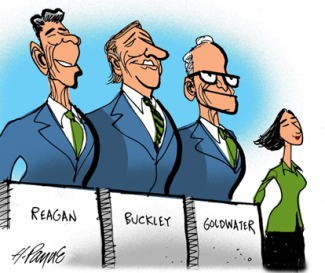
Today, conservatism is associated with anti-environmentalism. It comes as something of a shock, therefore, to discover that in the 1960s and 1970s, in the midst of establishing the modern conservative movement, iconic figures such as Ronald Reagan, Barry Goldwater, and William F. Buckley all took staunchly pro-environmental positions, including a willingness to countenance regulations that might be considered too radical for today’s Democrats. Yet today, conservatism has become associated with skepticism about environmental science, enthusiasm for expanding development activities on public lands, a firm belief in the merits of fossil fuels, and an instinctive hatred for regulation.

The process by which these pro-environmental views were forced out began in the 1980s but did not reach fruition until the conservative backlash against the Obama administration. The way was eased for these anti-regulatory views to triumph by large infusions of money from conservative business leaders, especially from the fossil fuel industries — such as the Koch family. Pro-development interests in the western states also played a role, starting with the Sagebrush Rebellion that started in the 1970s. Political and economic forces, more than logic or empirical evidence, gave anti-environmental views ascendancy among conservatives.

Despite the seeming hegemonic dominance of anti-environmentalism within the conservative movement, there are some hopeful straws in the wind. The coal industry is in seemingly irreversible decline, and the major oil companies have begun to moderate their views on environmental issues, including climate change. Meanwhile, the renewable energy sector is becoming an increasingly powerful economic and political force, even in red states such as Texas, Iowa, and Kansas. Some western states have begun to diversify their economies and no longer view mining and oil as unmitigated benefits. And a handful of conservative thinkers have started to rethink the anti-environmental verities they learned from an older generation. Indeed, just before this article was written, Congress passed a defense spending bill that calls climate change a serious threat to national security. In the House, 46 Republicans crossed the aisle to vote in favor of that provision.

Rediscovering this lost history is important because it shows that vigorous environmental protection can be consistent with strong conservative values. A revival of this school of thought could enrich discourse within the conservative movement and help heal the growing schism between conservatives and scientists. It would also begin to depolarize debates over environmental policy, helping to defuse knee-jerk reactions on both sides and move policy debates in a more constructive direction. If the signs of a conservative-environmentalist revival come to fruition, the result could be a healthier political atmosphere and a more stable, better-designed regulatory regime.

This article will follow a largely chronological path, beginning with the surprisingly pro-environmental views of the founding fathers of modern conservatism. The focus then turns to the backlash that began in the late 1970s and has carried through to the present. Finally, we will turn to examine some hopeful signs that may herald the beginning of a shift in conservative values.

Conservative thought in some form or another goes back to the ancient Greek philosophers, but modern American conservatism has more recent roots. The movement arose from William F. Buckley’s efforts to fuse three strands of conservative thinking: libertarianism, traditionalism, and anti-communism. Buckley’s podium, the National Review, remains the leading conservative journal today. Yet, even before environmental issues received attention from Congress, Buckley himself viewed environmental problems very seriously — and as prime prospects for regulation.

Buckley ran for mayor of New York in 1965 with a campaign designed to educate the public about conservative views rather than securing electoral victory. (When asked what he would do if by chance he won, Buckley quipped, “Demand a recount.”) Buckley took a strongly environmentalist position. He called pollution control “a classic example of the kind of thing that government should do . . . because the people cannot do it themselves.” He proposed that all cars sold in the city or entering the city be required to comply with California’s new, stricter air pollution standards for vehicles. In order to reduce traffic, he advocated a toll to discourage cars from entering Manhattan and an elevated bikeway for 125 blocks down Second Avenue.

Barry Goldwater’s 1964 presidential campaign marked the emergence of modern conservatism on the national stage. His followers began the conservative takeover of the Republican Party and established institutional structures, rhetoric, ideology, and political strategies such as mass fundraising efforts that prevail even today. Goldwater was generally a harsh critic of federal regulation, so his views on the environment may come as something of a surprise. His 1970 book The Conscience of a Majority has a chapter entitled “Saving the Earth.” “Our job,” he said, “is to prevent that lush orb known as the Earth . . . from turning into a bleak and barren, dirty brown planet.” Continuing to paint environmental problems in stark terms, he added: “It is difficult to visualize what will be left of the Earth if our present rates of population and pollution expansion are maintained.”

Goldwater said the pollution issue “should be much more than a political football for aspiring office-holders or office-keepers.” He said, “Although I am a great believer in the free, competitive enterprise system and all that it entails, I am an even stronger believer in the right of our people to live in clean and pollution-free environments.” Thus, he said, “When pollution is found, it should be halted at the source, even if this requires stringent government action against important segments of our national economy.” He added that the American people might need “to make some unhappy and large-sized sacrifices in order to preserve their environment.” For instance, he said, it might be necessary to crack down on pollution from coal-fired power plants, and that in turn might require sharp cuts in electricity use.

Ronald Reagan, too, embraced environmentalism. In 2015, a writer in the Los Angeles Times called Reagan “the most environmental governor in California history — protecting wild rivers from dams, preserving a Sierra wilderness by blocking highway builders, creating an air resources board that led to the nation’s first auto smog controls.” This may be an overstatement, but there were indeed some major environmental achievements during his tenure. Concern about the environment was not just a political gambit for Reagan. His childhood along the Rock River in Illinois and his experiences in filming movies in the West had left him with a warm regard for nature.

One of Reagan’s accomplishments as governor was safeguarding Lake Tahoe from impacts of surrounding development. Although he had a strong preference for local control of land use, once he had seen the lake’s condition he agreed that an interstate solution was required, and he signed a compact with the governor of Nevada establishing a joint regional planning authority.

There were other examples of Reagan’s efforts to protect nature. A particularly arresting example of his environmentalism involved a dramatic horseback ride through the Sierras to stop a federal highway project. He also blocked dam proposals on the Eel River and on the Middle Fork of the Feather River. Perhaps more notably, he signed California’s wild and scenic rivers legislation. During the Reagan years, California also added 145,000 acres of land to its state park system along with areas of the Pacific Ocean. And even more notably, Reagan signed the California Environmental Quality Act, which has been a thorn in the side of development interests ever since.

Reagan also signed legislation creating the California Air Resources Board, one of the strongest state regulatory agencies in the country. During Reagan’s term as governor, CARB set air quality standards for stationary sources such as power plants and adopted the nation’s first nitric oxide standard for vehicles.

This liaison between conservatives and environmentalism was not to last. Instead, regulatory backlash increasingly dominated both the conservative movement and the Republican Party. It is important to understand the roots of this backlash and especially the role played by business interests and wealthy political donors in catalyzing the metamorphosis.

In response to the new regulatory climate, a symbiotic relationship began to emerge between anti-regulatory ideologues and parts of the business community (particularly manufacturing, mining, and oil). This alliance between business and movement conservatives — of which Reagan would become an exemplar — can be seen as early as the 1960s, when Fred Koch (father of today’s Koch brothers) ordered copies of Goldwater’s conservative manifesto, Conscience of a Conservative, for every library and newspaper in Kansas. By the time Reagan left office, the Koch family had also launched the Cato Institute, which “promoted the purest strands of libertarian thinking.”

A memo by soon-to-be-Justice Lewis Powell for the U.S. Chamber of Commerce became a manifesto for corporate resistance to regulation. Shortly before going on the bench, Powell wrote the influential memo decrying what he considered an anti-capitalist intellectual climate and calling for the chamber to finance cadres of more sympathetic scholars. The Powell memo received considerable attention from conservative elites. Although the chamber did not take action, others heeded the call to develop a counterweight to liberal academics.

The anti-regulatory movement led to the establishment of major Washington think tanks. The American Enterprise Institute had been created years earlier by the chairman of the country’s largest asbestos manufacturer, but its budget increased tenfold during the 1970s. Even more important was the Heritage Foundation, which bills itself as promoting “conservative public policies based on the principles of free enterprise, limited government, individual freedom, traditional American values, and a strong national defense.” Heritage and AEI provided key staff for the Reagan administration and later for George W. Bush and Donald Trump. Both foundations experienced surges of funding in the mid-1970s, but Heritage outdid AEI by developing a new model of politically engaged, less-academic activity.

By the late 1970s, the Republican Party had begun to move away from environmental protection. Instead, renewed stress was placed on increased resource development and introducing balance between environmental and economic values. By 1980, the change from an early embrace of environmental protection was dramatic. The Republican Platform that year blamed “excessive regulation” for “our nation’s spiraling inflation” and for stifling “private initiative, individual freedom, and state and local government autonomy.” The platform reflected both the influence of the business community and a backlash of rural interests in western states against conservation.

Reagan’s positions in the first few years of his presidency were in tune with the GOP platform and strikingly at odds with his actions as governor. But he revamped his approach when the initial anti-environmental initiatives ran into trouble. In the end, he went along with a considerable number of new protections for the environment. He accepted significant environmental legislation from Congress, toughening regulation of hazardous waste (the Resource Conservation and Recovery Act) and requiring public disclosures of the use and discharge of toxic chemicals (the Toxics Release Inventory).

On at least one major occasion during his presidency, Reagan personally championed environmental protection. He signed the Montreal Protocol to protect the ozone layer, calling it a “monumental achievement.” The president sided with EPA and the State Department on regulations to phase out ozone-destroying chemicals over the objections of cabinet members who argued for distributing hats and sunglasses as a cheaper alternative to preventing skin cancer. In his diary, he referred to the ozone protocol as “an historic agreement.”

Reagan also signed legislation addressing climate change. In 1983, EPA had warned about the risk of a runaway greenhouse effect, though others in the administration considered this alarmist. The Global Climate Protection Act of 1987 contains congressional findings about the possible risks of climate change. The law goes on to state that “necessary actions must be identified and implemented in time to protect the climate.” It calls for international agreement and requires the president to “present a coordinated national policy on global climate change” to Congress. In the House, conservative stalwart James Sensenbrenner said he “support[ed] the development of a coordinated national policy so this country can continue its effective participation with other nations to address this important issue.”

The 1987 Global Warming Act grew out of a summit between Reagan and Soviet President Mikhail Gorbachev earlier that year. The two leaders agreed they would “continue to promote broad international and bilateral cooperation in the increasingly important area of global climate and environmental change.” In a letter to the New York Times, the head of a scientific organization called this agreement “the best-kept secret of the Reagan-Gorbachev summit — and potentially the most portentous for global well-being during the 21st century.”

The dominant strain in current conservative thought, and in an increasingly conservative Republican Party, is vehemently anti-environmental, coupled with seemingly unbounded enthusiasm for developing public lands and fossil fuel resources. As in the 1980s, this rightward push has been supported by funding from energy interests and enthusiasm by rural western voters. Yet some of these forces may now be abating, at least a little.

There is no doubt that the interests of the fossil fuel industry still carry important weight in American politics. But part of the fossil fuel coalition has been seriously weakened by economic changes. The coal industry’s economic plight is well known. In 2016, coal production was the lowest since a major strike 35 years ago, and coal use dropped over 25 percent from the previous year. In April 2016, Peabody Coal filed for bankruptcy, joining most of the other major firms. Coal production rebounded slightly in 2017, mostly due to an uptick in exports. Economists expect continued decline in the industry, notwithstanding the efforts of the Trump administration to prop it up. Moreover, the fleet of coal-fired power plants is rapidly aging, with new generation now relying almost wholly on other energy sources such as natural gas, solar, and wind. In 2016, for the first time, more Americans were employed in clean-energy jobs than in oil and natural gas extraction or coal mining.

The oil industry, while far from showing signs of similar decline, has begun to readjust its views of climate change. The major oil companies acknowledge the reality of climate change, and many endorse the need for government action. For instance, when he was CEO of ExxonMobil, former Secretary of State Rex Tillerson said that “for many years ExxonMobil has held the view that the risks of climate change are serious and do warrant action.” The energy giant’s assessment of new projects assumes that eventually it will have to pay a carbon tax or some other cost for a project’s carbon emissions.

Meanwhile, some conservatives are beginning to rethink their reflexive opposition to environmental protection. One hopeful sign can be found in the writing of “reform conservatives,” many of whom are profoundly disenchanted with the Trump administration. Newspaper opinion writers such as Ross Douthat of the New York Times and Michael Gersen and Jennifer Rubin of the Washington Post have rejected denial of climate science as an untenable conservative position. The idea of a carbon tax is also getting a serious hearing among some conservatives, such as the libertarian Niskanen Center. Indeed, Niskanen filed an amicus brief in a federal lawsuit filed by children claiming that unrestricted emissions violate the public’s property rights under the Public Trust Doctrine.

Within the legal academy, there are also some signs of change. Perhaps the most sustained effort to elaborate a new conservative environmentalism has come from a younger libertarian law professor, Jonathan Adler. Adler laments that “the dominant alternative on the political right has been reflexive — almost reactionary — opposition to anything green,” characterized by the view that “whatever the Sierra Club or Al Gore supports must be opposed.”

Indeed, he says, “This reactionary posture has expanded beyond reflexive opposition to environmental policy proposals to encompass a reflexive denial that environmental problems, of whatever sort, actually exist.” Adler endorses the polluter-pays principle, calling for emissions fees, including a carbon tax. Notably, Adler has argued that sea-level rise caused by climate change is a violation of private property rights of coastal landowners. Adler does not stand alone, as a number of younger legal scholars are beginning to rethink conservative viewpoints.

It is too soon to say whether these new voices and the changing configuration of business interests will alter the tenor of conservative environmental views. But at the very least, they do offer grounds for hope.

Today’s anti-environmental stance is not an unalterable component of conservative thought. As we’ve seen, the founding fathers of modern conservatism took a strikingly different stance in the early days of the modern environmental era. Buckley, Reagan, and Goldwater, the iconic figures of modern movement conservatism, apparently saw no contradiction between right-wing philosophies and enthusiastic support for environmental protection. Even after changing times had pushed them in the other direction, they still showed flashes of environmentalism, such as Reagan’s support of the Montreal Protocol.

Much of the pressure against environmentalism came from the fossil fuel industry and from extractive industries in the western states. Those pressures could now be abating, as the coal industry’s long-term influence declines, and the oil industry repositions itself in response to rising pressures to address climate change.

A thaw in conservative views about the environment could enrich a public discourse that has seemingly become trapped in tribalism. Liberals would benefit from more thoughtful responses, while the conservative movement would benefit from more fruitful internal debate. In short, both the right and the left have something to gain if pro-environmental views were once again more prevalent among conservatives. TEF

COVER STORY ❧ The founders of modern conservatism saw a role for the state in ensuring environmental quality by regulating polluters. While that changed in more recent decades, there are signs that a new generation of conservatives favors a governmental role in reducing emissions

Are Market Mechanisms Moral?
Subtitle
Morality Matters at the Climate Conference
Climate Policy Requires Markets — and Equity
Markets Alone Can't Produce Social Justice
Markets Are Mostly Moral — But It Depends
Markets Can Be Socially Responsible
Tapping Our Better Nature to Solve Global Woes
Author
Leslie Carothers - Environmental Law Institute
Joel Darmstadter - Resources for the Future
Caroline Farrell - Center on Race, Poverty, and The Environment
Stephen F. Harper - Intel Corporation
Bob Perciasepe - Center for Climate and Energy Solutions
Lucia A. Silecchia - Catholic University of America
Environmental Law Institute
Resources for the Future
Center on Race, Poverty, and The Environment
Intel Corporation
Center for Climate and Energy Solutions
Catholic University of America
Current Issue
Issue
2

While using all available tools may seem wise when faced with the formidable challenges presented by climate change, there are moral authorities — including Pope Francis — who have cautioned against blind acceptance of one popular approach, market-based mechanisms.

Lessons Learned for Today
Author
Henry L. Diamond - Beveridge & Diamond, P.C.
Beveridge & Diamond, P.C.
Current Issue
Issue
2

The 2015 ELI Award winner on how the 1965 White House Conference on Natural Beauty set the stage for the environmental and natural resource laws passed in the next quarter century. Politicians involved in the gridlock of the ensuing twenty-five years would do well to learn from the bipartisan conference’s example.