
Vibrant Environment
All
All | Biodiversity | Climate Change and Sustainability | Environmental Justice | Governance and Rule of Law | Land Use and Natural Resources | Oceans and Coasts | Pollution Control
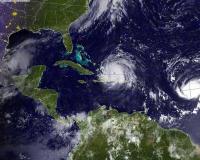
The National Oceanic and Atmospheric Administration (NOAA) reported in August that this year’s Gulf of Mexico dead zone was unexpectedly small—in fact, the third-smallest ever measure in the 34-year record. Interestingly, this comes just two months after NOAA had forecasted a larger-than-average dead zone in early June. The cause of this shift appears to be Hurricane Hanna, whose large, powerful waves agitated the water column, disrupting algal accumulation in the Gulf.
The National Oceanic and Atmospheric Administration (NOAA) reported in August that this year’s Gulf of Mexico dead zone was unexpectedly small—in fact, the third-smallest ever measure in the 34-year record. Interestingly, this comes just two months after NOAA had forecasted a larger-than-average dead zone in early June. The cause of this shift appears to be Hurricane Hanna, whose large, powerful waves agitated the water column, disrupting algal accumulation in the Gulf.
The National Oceanic and Atmospheric Administration (NOAA) reported in August that this year’s Gulf of Mexico dead zone was unexpectedly small—in fact, the third-smallest ever measure in the 34-year record. Interestingly, this comes just two months after NOAA had forecasted a larger-than-average dead zone in early June. The cause of this shift appears to be Hurricane Hanna, whose large, powerful waves agitated the water column, disrupting algal accumulation in the Gulf.

By C. Scott Fulton
It’s easy to grow numb in the face of the parade of problems our country has been experiencing, but news of the Trump Administration’s recent decision to defund diversity training across the federal government and to try to prevent federal contractors and grantees from engaging in such training jolted me with the force of a defibrillator. It is shocking that in the midst of a period of the worst racial unrest in many decades, this is what the Administration is bringing forward.
By C. Scott Fulton
It’s easy to grow numb in the face of the parade of problems our country has been experiencing, but news of the Trump Administration’s recent decision to defund diversity training across the federal government and to try to prevent federal contractors and grantees from engaging in such training jolted me with the force of a defibrillator. It is shocking that in the midst of a period of the worst racial unrest in many decades, this is what the Administration is bringing forward.

By C. Scott Fulton
As the country wrestles with racial justice issues, driven both by police atrocities and the uneven distribution of COVID-19 infection and deaths, it’s time for renewed focus on environmental justice. The quest for EJ remains perhaps the most challenging unsolved problem in the environmental arena. And until we arrive at a place where environmental benefits and burdens are both more equally distributed across society, EJ will remain a problem that differentially compromises not only quality of life, but also health and resilience in the face of maladies like the coronavirus.

By James M. McElfish, Jr.
Acting in response to Executive Order No. 13807, Establishing Discipline and Accountability in the Environmental Review and Permitting Process for Infrastructure, the Council on Environmental Quality (CEQ) rewrote the governmentwide regulations implementing the National Environmental Policy Act (NEPA) this year. CEQ published its proposal to substantially amend the NEPA rule on January 10, 2020, and published its final rule on July 16, 2020 (85 Fed. Reg. 43304). The new rule becomes effective today, September 14, 2020, and CEQ added language to the final rule to provide that it will apply directly to federal agency actions and preempt all “inconsistent” agency procedures as of that date.
By James M. McElfish, Jr.
Acting in response to Executive Order No. 13807, Establishing Discipline and Accountability in the Environmental Review and Permitting Process for Infrastructure, the Council on Environmental Quality (CEQ) rewrote the governmentwide regulations implementing the National Environmental Policy Act (NEPA) this year. CEQ published its proposal to substantially amend the NEPA rule on January 10, 2020, and published its final rule on July 16, 2020 (85 Fed. Reg. 43304). The new rule becomes effective today, September 14, 2020, and CEQ added language to the final rule to provide that it will apply directly to federal agency actions and preempt all “inconsistent” agency procedures as of that date.
By James M. McElfish, Jr.
Acting in response to Executive Order No. 13807, Establishing Discipline and Accountability in the Environmental Review and Permitting Process for Infrastructure, the Council on Environmental Quality (CEQ) rewrote the governmentwide regulations implementing the National Environmental Policy Act (NEPA) this year. CEQ published its proposal to substantially amend the NEPA rule on January 10, 2020, and published its final rule on July 16, 2020 (85 Fed. Reg. 43304). The new rule becomes effective today, September 14, 2020, and CEQ added language to the final rule to provide that it will apply directly to federal agency actions and preempt all “inconsistent” agency procedures as of that date.

By ELR Staff
Almost one-quarter of all U.S. CO2 emissions come from fossil fuels extracted from public lands. Producing more than 274 million barrels of oil, 3.3 billion cubic feet of natural gas, and 302 million tons of coal each year, BLM’s management decisions have a significant impact on climate change. In this month’s issue of ELR—The Environmental Law Reporter, authors Jamie Gibbs Pleune, John Ruple, and Nada Wolff Culver argue that the Bureau has not only the authority, but a legal duty to mitigate climate change in its permitting decisions. Using existing legal structures, they provide a road map for requiring all new BLM oil and gas development to achieve net-zero emissions.