
Vibrant Environment
All
All | Biodiversity | Climate Change and Sustainability | Environmental Justice | Governance and Rule of Law | Land Use and Natural Resources | Oceans and Coasts | Pollution Control
By Anna Beeman
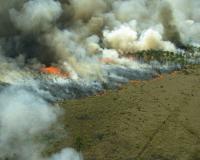
In the last two weeks, Indonesian islands Sumatra and Borneo began experiencing severe forest fires, evoking fears within the region that the fires could have similar effects to the fires of 2015, which was one of the worst years for transboundary haze in Southeast Asia. Following the 2015 fires, Indonesia took steps to limit the burning and draining of peatland to reduce the outbreak of fires in addition to improving environmental sustainability and air quality in the region. However, due to a combination of governance challenges and climate change-intensifying dry seasons, the country has struggled to keep up with implementing fire mitigating activities in all fire-prone areas.
By Anna Beeman
In the last two weeks, Indonesian islands Sumatra and Borneo began experiencing severe forest fires, evoking fears within the region that the fires could have similar effects to the fires of 2015, which was one of the worst years for transboundary haze in Southeast Asia. Following the 2015 fires, Indonesia took steps to limit the burning and draining of peatland to reduce the outbreak of fires in addition to improving environmental sustainability and air quality in the region. However, due to a combination of governance challenges and climate change-intensifying dry seasons, the country has struggled to keep up with implementing fire mitigating activities in all fire-prone areas.
By Anna Beeman
In the last two weeks, Indonesian islands Sumatra and Borneo began experiencing severe forest fires, evoking fears within the region that the fires could have similar effects to the fires of 2015, which was one of the worst years for transboundary haze in Southeast Asia. Following the 2015 fires, Indonesia took steps to limit the burning and draining of peatland to reduce the outbreak of fires in addition to improving environmental sustainability and air quality in the region. However, due to a combination of governance challenges and climate change-intensifying dry seasons, the country has struggled to keep up with implementing fire mitigating activities in all fire-prone areas.
By Anna Beeman
In the last two weeks, Indonesian islands Sumatra and Borneo began experiencing severe forest fires, evoking fears within the region that the fires could have similar effects to the fires of 2015, which was one of the worst years for transboundary haze in Southeast Asia. Following the 2015 fires, Indonesia took steps to limit the burning and draining of peatland to reduce the outbreak of fires in addition to improving environmental sustainability and air quality in the region. However, due to a combination of governance challenges and climate change-intensifying dry seasons, the country has struggled to keep up with implementing fire mitigating activities in all fire-prone areas.
By Anna Beeman
In the last two weeks, Indonesian islands Sumatra and Borneo began experiencing severe forest fires, evoking fears within the region that the fires could have similar effects to the fires of 2015, which was one of the worst years for transboundary haze in Southeast Asia. Following the 2015 fires, Indonesia took steps to limit the burning and draining of peatland to reduce the outbreak of fires in addition to improving environmental sustainability and air quality in the region. However, due to a combination of governance challenges and climate change-intensifying dry seasons, the country has struggled to keep up with implementing fire mitigating activities in all fire-prone areas.

By Margaret Spring
With summer in full swing and trips to the beach on our minds, the timing is perfect to consider the role of environmental law and the courts in guiding decisions with implications for the health of our oceans. This blog highlights recent updates from two major federal players with authority over what happens in the waters of the United States covering the three- to 200-mile exclusive economic zone (EEZ): the National Oceanic and Atmospheric Administration (NOAA) and the U.S. Department of the Interior (DOI).
By Margaret Spring
With summer in full swing and trips to the beach on our minds, the timing is perfect to consider the role of environmental law and the courts in guiding decisions with implications for the health of our oceans. This blog highlights recent updates from two major federal players with authority over what happens in the waters of the United States covering the three- to 200-mile exclusive economic zone (EEZ): the National Oceanic and Atmospheric Administration (NOAA) and the U.S. Department of the Interior (DOI).
By Margaret Spring
With summer in full swing and trips to the beach on our minds, the timing is perfect to consider the role of environmental law and the courts in guiding decisions with implications for the health of our oceans. This blog highlights recent updates from two major federal players with authority over what happens in the waters of the United States covering the three- to 200-mile exclusive economic zone (EEZ): the National Oceanic and Atmospheric Administration (NOAA) and the U.S. Department of the Interior (DOI).

By Karin P. Sheldon
Fifty years ago, on June 22, 1969, the Cuyahoga River of Ohio burst into flame. Although it was not the first time an oil slick burned on the heavily polluted river, the event is often credited as one of the key environmental crises that galvanized the American public to recognize that pollution and other environmental damage were not just local problems, but required national attention.
By Karin P. Sheldon
Fifty years ago, on June 22, 1969, the Cuyahoga River of Ohio burst into flame. Although it was not the first time an oil slick burned on the heavily polluted river, the event is often credited as one of the key environmental crises that galvanized the American public to recognize that pollution and other environmental damage were not just local problems, but required national attention.