

Vibrant Environment
All
All | Biodiversity | Climate Change and Sustainability | Environmental Justice | Governance and Rule of Law | Land Use and Natural Resources | Oceans and Coasts | Pollution Control
By James M. McElfish, Jr.
Climate change presents immense challenges to coastal communities and to ecosystems affected by sea-level rise, salt water intrusion, changes in average temperature, storm frequency, and species composition. Existing wetland complexes are among the “natural and nature-based features” that currently buffer human communities from catastrophic storm events and that help ecosystems rebound from major stresses and impacts.
By James M. McElfish, Jr.
Climate change presents immense challenges to coastal communities and to ecosystems affected by sea-level rise, salt water intrusion, changes in average temperature, storm frequency, and species composition. Existing wetland complexes are among the “natural and nature-based features” that currently buffer human communities from catastrophic storm events and that help ecosystems rebound from major stresses and impacts.

By Stephen R. Dujack
There is an alarming new study out, funded by NASA and the National Science Foundation. It was published in Geophysical Research Letters and announced at the American Geophysical Union fall meeting. Together, these are the heavyweights in climate change research and analysis. Their findings: The world’s lakes are warming at an alarming rate, much faster than the oceans or the atmosphere. The study monitored 235 lakes, spanning six continents and representing half the world’s freshwater supply, for 25 years.

By Emmett McKinney, By Linda Breggin, By Carol Adaire Jones
Strategies for cities and states to reduce food waste can be thought of through the lens of the “Three Rs” of EPA’s Food Recovery Hierarchy—reduction, reuse, and recycling. In food waste terms, the Three Rs mean preventing wasted food at the source, donating wasted food leftovers, and recycling food waste through composting or anaerobic digestion.
The recent ReFED report on reducing food waste quantifies the economic value and diversion potential of different strategies related to each of the Three Rs. According to ReFED, source reduction and donation generate the most economic value per ton of food saved, while food recycling and composting have the potential to divert a much greater quantity of food from landfills.
By Emmett McKinney, By Linda Breggin, By Carol Adaire Jones
Strategies for cities and states to reduce food waste can be thought of through the lens of the “Three Rs” of EPA’s Food Recovery Hierarchy—reduction, reuse, and recycling. In food waste terms, the Three Rs mean preventing wasted food at the source, donating wasted food leftovers, and recycling food waste through composting or anaerobic digestion.
The recent ReFED report on reducing food waste quantifies the economic value and diversion potential of different strategies related to each of the Three Rs. According to ReFED, source reduction and donation generate the most economic value per ton of food saved, while food recycling and composting have the potential to divert a much greater quantity of food from landfills.
By Brett Korte
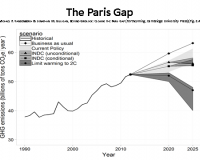
Early in the fall of 2016, there was growing cause to celebrate the international momentum building around climate mitigation. In October, United Nations actors reached agreements to limit airline emissions and later HFCs. On November 4, the Paris Agreement under the U.N. Framework Convention on Climate Change went into effect. Then, four days later, Donald J. Trump was elected president, casting doubt on the U.S. climate commitments made by President Obama’s Administration. Though his Tweets and stump speeches may not equate directly to his eventual climate policy, the surprise election results have certainly caused consternation among advocates of climate mitigation and adaptation.

By Sam Gutter
Angus Macbeth died in his sleep on January 22. With his passing, the environmental bar lost a founding father, an extraordinary advocate who helped establish the Natural Resources Defense Council, built and led the environmental practice in the U.S. Department of Justice (DOJ), and grounded the environmental practice group at Sidley Austin LLP.
Along with many others, I lost a friend and mentor—a man who shaped our collective approach to the law not through lectures or pronouncements, but by brilliant example, always finding the best analytical path, the right words to sum up the central theme, the most convincing advocacy.

By Cassie Phillips
The public debate around President Trump’s environmental nominees follows an old script, playing jobs against the environment. But the script’s not just old, it’s obsolete. Being anti-environment hasn’t been a winning political strategy since at least President Reagan’s first term, in which he famously appointed three people who were hostile to the environmental programs they were named to lead: James Watt as Secretary of Interior, the late Ann Gorsuch as EPA Administrator, and Rita Lavelle as head of the Superfund program. In the name of deregulation, the “gang of three” cut staff, budgets, and agency enforcement actions. Whatever success they enjoyed was short-lived, however, as a strong backlash drove all three from office in 1983.

By ELR Staff
In the February issue of ELR’s News & Analysis, ELI President Scott Fulton and Visiting Attorney Dr. Maria L. Banda highlight the role that national judiciaries worldwide have played in developing the field of “climate law.” In Litigating Climate Change in National Courts: Recent Trends and Developments in Global Climate Law, Fulton and Banda examine the procedural tools and interpretive principles that judges have used to decide novel legal issues in climate litigation, focusing on some of the key lawsuits from civil and common-law jurisdictions that may influence climate law beyond their borders.

By Dave Rejeski
Can our machines become self-motivated environmental learners?
The environmental movement has always been challenged by machines—the internal combustion engine, steam-powered turbines, production devices of every type and size—mechanisms consuming resources and generating waste during the long chain of events required to produce products (which often ended up themselves as waste). Old machines had rudimentary feedback systems like governors, gyroscopes, and other servomechanisms. These systems rarely provided any control of environmental parameters, but they did have an important characteristic: they operated independent of human operators—a precursor of things to come.