

Vibrant Environment
All
All | Biodiversity | Climate Change and Sustainability | Environmental Justice | Governance and Rule of Law | Land Use and Natural Resources | Oceans and Coasts | Pollution Control
By Emmett McKinney, By Linda Breggin, By Carol Adaire Jones
In 2015, the U.S. Department of Agriculture and Environmental Protection Agency announced an ambitious goal of reducing food waste in the United States by 50% by 2030. While the change in presidential administrations presents new obstacles for many federal environmental initiatives, reducing food waste continues to offer fertile ground for cooperation.
By Emmett McKinney, By Linda Breggin, By Carol Adaire Jones
In 2015, the U.S. Department of Agriculture and Environmental Protection Agency announced an ambitious goal of reducing food waste in the United States by 50% by 2030. While the change in presidential administrations presents new obstacles for many federal environmental initiatives, reducing food waste continues to offer fertile ground for cooperation.

By Loyti Cheng, By David A. Zilberberg
President-elect Donald Trump's environmental agenda to date has generally been focused on undoing certain specific Obama administration regulations, such as the Clean Power Plan (CPP) or the Waters of the United States (WOTUS) rule, and relaxing restrictions on domestic fossil fuel exploration and production.
By Loyti Cheng, By David A. Zilberberg
President-elect Donald Trump's environmental agenda to date has generally been focused on undoing certain specific Obama administration regulations, such as the Clean Power Plan (CPP) or the Waters of the United States (WOTUS) rule, and relaxing restrictions on domestic fossil fuel exploration and production.
By Elana Harrison
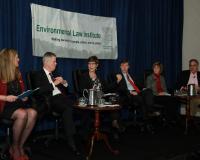
Prior to the 2016 ELI Award Dinner, ELI convened an expert panel of business leaders, legal minds, and nongovernmental advocates to discuss “The Business of Water.” This conversation was particularly timely, because as climate change alters global weather patterns and the Earth’s population continues to grow and urbanize, water resources are poised to become an ever-increasing point of contention, even in regions where water scarcity has not historically been an issue. Water law and policy is complex, varying regionally, country by country, and even within national borders. As more stakeholders compete for water resources, businesses around the world are changing the way they value water within their business models, and policymakers are looking at new levers to ensure responsible use of this increasingly precious resource.

By John Pendergrass
The annual business meeting of the parties to the United Nations Framework Convention on Climate Change (UNFCCC), the 22d such Conference of the Parties (COP 22), just concluded in Marrakech, Morocco. At the top of the agenda was implementation of the Paris Agreement, which entered into force November 4, 2016, just days before the COP opened and the U.S. election. The latter apparently shifted the focus of hallway conversations as President-elect Donald Trump’s views on climate change and climate treaties were of great interest to participants and observers.
By Laura Goldman
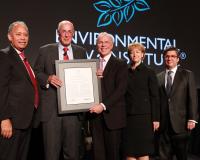
Each year, ELI hosts its Annual Dinner, bringing together the best and brightest environmental professionals to celebrate the accomplishments of the winner of the Institute’s Environmental Achievement Award. On October 25th, at the Omni Shoreham hotel in Washington, D.C., ELI honored Henry M. “Hank” Paulson, Jr. for his efforts to improve cooperation on environmental protection endeavors between the United States and China.

By Nyasha Frank Mpahlo
Human threats to pangolins in Zimbabwe have been kept in check for hundreds of years by traditional practices, but the recent globalization of illicit trade in these scaly, anteater-like mammals has threatened to exterminate them. Held in high regard by traditional chiefs, village headmen, and the tribal communities in general, the pangolin has historically benefitted from human protection in Africa. Zimbabwean folklore advised that the hunting of the pangolin (haka) be strictly controlled, and the deliberate taming of the pangolin was a serious offense.
By Nyasha Frank Mpahlo
Human threats to pangolins in Zimbabwe have been kept in check for hundreds of years by traditional practices, but the recent globalization of illicit trade in these scaly, anteater-like mammals has threatened to exterminate them. Held in high regard by traditional chiefs, village headmen, and the tribal communities in general, the pangolin has historically benefitted from human protection in Africa. Zimbabwean folklore advised that the hunting of the pangolin (haka) be strictly controlled, and the deliberate taming of the pangolin was a serious offense.

By C. Scott Fulton
Here at the Environmental Law Institute, we have started getting questions about the meaning of the election for environmental protection, and, in particular, for environmental law. As a 50 year-old non-partisan think-and-do tank focused on building good governance and rule of law in the environmental arena, we think it is important to look past campaign rhetoric in responding to this question. The election of President-Elect Trump was not in our view a referendum on the environment.