
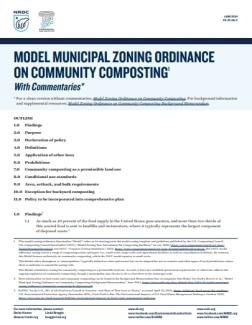
Composting provides many environmental, economic, and social benefits. Community composting is designed to meet local needs, serve local interests, and engage the community. Unfortunately, municipal zoning codes can present unintended barriers for community composters—for example, by treating composting facilities the same way as large waste facilities. The NRDC/ELI Model Municipal Zoning Ordinance on Community Composting is intended to establish and govern community composting as a permissible land use across five basic zoning district categories. The version with commentaries includes analysis, examples, and alternative approaches. For a deeper dive, check out this blog.
Also check out the accompanying resources: (1) Model Ordinance without Commentaries, (2) Background Memorandum, (3) Model Resolution, and (4) Slide Presentation.
This resource is part of a broader effort by ELI’s Center for State and Local Governance to develop adaptable model governance tools that make it easier for state and local governments in the United States to advance climate, environmental, and waste reduction solutions. You can find the full suite of model governance tools here.