

Vibrant Environment
Oceans And Coasts
All | Biodiversity | Climate Change and Sustainability | Environmental Justice | Governance and Rule of Law | Land Use and Natural Resources | Oceans and Coasts | Pollution Control
By Sebastian Duque Rios
Accounting for nearly half of the planet’s surface (or about two-thirds of its ocean), the high seas are a critical component of Earth’s oceanic ecosystem.
By Taalin RaoShah, By Sofia O'Connor
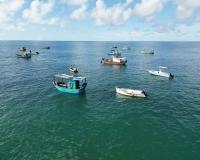
Recreational and commercial fishing in The Bahamas sustains over 25,000 jobs and generates over $1 billion annually in economic activity, equivalent to roughly 20% of the country’s GDP.

By John Saylay Singbae II
By Simone Maloz
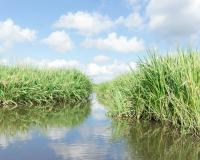
Campaign Director, Restore the Mississippi River Delta, and 2025 National Wetlands Awardee

By ELR Staff
The Chesapeake Bay is the largest estuary in the United States. More than 150 major rivers and streams flow into the Bay's 64,299-square-mile drainage basin, which covers parts of six states (Delaware, the District of Columbia, Maryland, New York, Pennsylvania, Virginia, and West Virginia) and all of Washington, D.C. (the Bay jurisdictions). With its diverse flora and fauna, the Chesapeake Bay is a very important feature for the ecology and economy of these regions.
By Sonja Michaluk
If you told me years ago that I would be pursuing a degree in statistics and machine learning, I would not have believed you. Even after receiving the 2021 National Wetlands Award and immersing myself in a vibrant and innovative college environment, I have come to more fully appreciate the many ways we can approach wetlands conservation and education efforts.

By Mark Beardsley
In one of the most famous speeches in American history, President John F. Kennedy implored his fellow Americans to “Ask not what your country can do for you—ask what you can do for your country.” I’m borrowing JFK’s words to illustrate how I approach restoration: Ask not what the land can do for you—ask what you can do for the land. This maxim evokes something greater than oneself that deserves respect, service, and ethical treatment. For JFK, it was country. For me it is the land, or to be more accurate, an ecosystem.
By Ted LaGrange
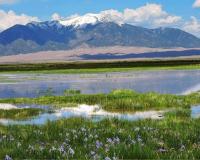
Having worked to conserve Nebraska’s wetlands over the past 30 years, and in honor of National Wetlands Month, I have been reflecting on what factors make wetland conservation successful. Thanks to the collaboration of many different partners, including landowners, we can be proud of the accomplishments made in wetland research, restoration, and management. To build on these successes, I believe it is important to broaden the network of people who understand wetlands and support their conservation. To do this, we need to expand and improve our outreach and education efforts.
By Scott Fisher
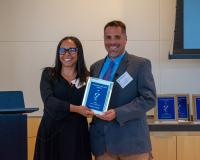
He aliʻi ka ʻāina, he kauā ke kānaka. This frequently spoken ʻōlelo noʻeau, or proverb, succinctly sums up the Hawaiian view on the human relationship to our environment: the land is the chief, and people are the servants. Traditionally, wetlands in particular were revered as agriculturally productive lands where the elder sibling of the Hawaiian people and staple of life, kalo (taro), was grown.
By Cecilia Diedrich
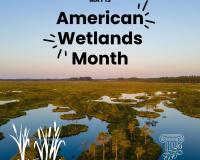
Wetlands are critical ecosystems that provide important benefits for people and wildlife. They provide flood protection, resilient infrastructure, carbon storage, increased water quality, and are integral to the culture and economy of local communities. The urgency of preserving these important resources is only heightened by the reality of climate change.