
Research Reports
ELI publishes Research Reports available for free download that present the analysis and conclusions of the policy studies ELI undertakes to improve environmental law and policy. These reports contribute to education of the profession and disseminate diverse points of view and opinions to stimulate a robust and creative exchange of ideas. Those publications, which express opinions of the authors and not necessarily those of the Institute, its Board of Directors, or funding organizations, exemplify ELI’s commitment to dialogue with all sectors.
July 2026
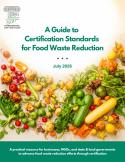
The use of certification standards can provide benefits to both certified entities and the general public, including by helping businesses and other organizations increase credibility and marketability; enabling more informed decision-making among consumers, investors, and others; and motivating the adoption of certain practices—such as food waste reduction—more broadly.
Read More >
July 2026
In April 2026, the Environmental Law Institute (ELI) and NRDC released a Model State Law on Reducing Food Waste in K–12 Public Schools, a template law that can be adapted and enacted by states to advance food waste reduction measures in kindergarten through 12th grade (K–12) public schools.
Read More >
April 2026
Substantial food waste is generated from the roughly seven billion meals that are served each year to the nation’s 45.4 million children enrolled in K–12 public schools. Measures to reduce food waste in schools can provide environmental benefits, increase meal consumption, lead to substantial cost savings, and help combat food insecurity. The ELI/NRDC Model Resolution on Reducing Food Waste in K–12 Public Schools can be adopted by state legislative bodies to help the state consider how food waste reduction measures for K–12 public schools can be adapted to their particular context.
Read More >
April 2026
Substantial food waste is generated from the roughly seven billion meals that are served each year to the nation’s 45.4 million children enrolled in K–12 public schools. Measures to reduce food waste in schools can provide environmental benefits, increase meal consumption, lead to substantial cost savings, and help combat food insecurity. The ELI/NRDC Model State Law on Reducing Food Waste in K–12 Public Schools—which can be adapted to the contexts of individual states—provides a range of measures to advance food waste reduction in K–12 Public Schools.
Read More >
April 2026
Substantial food waste is generated from the roughly seven billion meals that are served each year to the nation’s 45.4 million children enrolled in K–12 public schools. Measures to reduce food waste in schools can provide environmental benefits, increase meal consumption, lead to substantial cost savings, and help combat food insecurity. The ELI/NRDC Model State Law on Reducing Food Waste in K–12 Public Schools—which can be adapted to the contexts of individual states—provides a range of measures to advance food waste reduction in K–12 Public Schools.
Read More >