Inter-American Environmental Program
III. Capacity-Building Initiatives
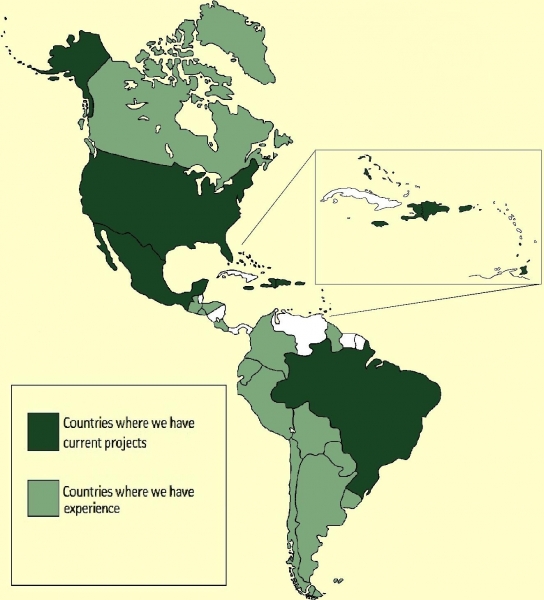
A key component of ELI’s mission is to strengthen the practice of environmental law and policy throughout the Americas. Sustainable development and protection of land, biodiversity, and water resources depend on increased trade and investment as well as responsible management of natural resources. Environmental enforcement officials, including judges, public prosecutors, and agency staff, as well as community leaders, serve an important role as guardians of the environment. Our unique multi-lingual training courses promote the transfer of knowledge and skills critical to effective environmental law implementation through multi-sector involvement and through improved enforcement. Our courses also promote the understanding and advancement of private sector participation in environmental governance. Effective implementation of environmental laws protecting the region’s unique ecosystems — particularly the more progressive aspects — requires more knowledge by a variety of players, both within and outside of government. ELI seeks to provide greater understanding of what the law contains and how it might be applied to promote sustainable development, preserve biodiversity, and protect water and other natural resources through capacity-building and educational programs.
A. U.S./Chile Environmental Cooperation Workshop Exchange Program
Under the 2003 U.S.-Chile Free Trade Agreement, the U.S. and Chile made a precedent setting commitment to cooperate on environmental enforcement and to promote civil society participation in these cooperative activities. The U.S. Departments of State and Justice and the Chilean government invited ELI to assist in fulfilling these commitments.
In April 2006, ELI organized the First Judicial Capacity Building Workshop on Environmental Matters in Santiago, Chile with support from the Weeden Foundation and UNEP. Twenty-three Chilean judges attended the training course, which was taught by U.S. and Chilean faculty. Topics included an introduction to environmental law, Chilean and U.S. environmental institutions, the Chilean environmental legal framework, international environmental treaties, sectoral environmental laws, environmental enforcement mechanisms, procedural issues in managing litigation, constitutional issues, restoring damage to the environment, claims for compensation, and the rule of law. The culmination of the workshop was a moot exercise in which the judge participants divided into small groups to discuss the issues raised by a hypothetical case.
The Forestry and Wood Processing Capacity Building Program, undertaken in 2006, focused on sharing experiences of voluntary environmental instruments and voluntary efforts by the forestry and wood products industry to improve environmental performance. The Program combined the efforts of ELI, Chile’s National Commission of the Environment (CONAMA), as well as the U.S. Environmental Protection Agency, the U.S. Forest Service, U.S. Department of State, and the American Forest & Paper Association (AF&PA). ELI led a three-day workshop in April 2006 in Concepción, Chile on voluntary pollution prevention measures and environmental management systems, as well as forest sector-specific voluntary codes. In July 2006, ten Chilean representatives from CONAMA and CORMA came to the U.S. to learn more about sustainable forest and forest products management and partnerships to improve environmental performance. The program included meetings and lectures in Washington, DC and field visits in Wisconsin to learn more about forestry management, conservation, and permitting.
ELI also developed a Mining Capacity Building Program to improve the capacity of Chilean officials to estimate the costs of reclaiming mined land and to establish appropriate amounts for bonds to assure reclamation is completed. In January 2006, 29 Chilean officials attended a training course, “Financial Assurance for Hardrock Mine Reclamation,” organized by ELI and taught by Stephen Hoffman of EPA’s Office of Solid Waste and Jim Kuipers of Kuipers and Associates in Santiago, Chile. Eleven Chilean mining officials from COCHILCO, SERNAGEOMIN, CONAMA and the Ministry of Mines then attended an eight-day U.S. study tour. The tour focused on 1) how the current bonding reclamation and closure bonding regulations function, and 2) the strengths and weaknesses of the current approaches. The participants visited mine sites and met with State regulators in New Mexico, Montana, and Utah.
B. Paraguay Judicial Training
In March 2005, ELI organized three one-day judicial training workshops on environmental law for Magistrates of Judicial Districts Ñeembucú, Itapúa, and Alto Paraná and the Paraguayan NGO, Instituto de Derecho Economía y Ambiente (IDEA), in the cities of Pilar, Encarnación and Ciudad del Este. These venues were chosen because they are border towns in the recharge areas of the Guaraní Aquifer. In addition, Encarnación and Ciudad del Este are in areas experiencing particularly aggressive and unsustainable agricultural practices and deforestation; unsustainable fishing practices are common near Pilar.
While the seminars were designed for judicial magistrates, other judicial staff also attended, as well as Prosecutors, staff from the Prosecutors’ offices, and police officers, indicating a high level of interest among enforcement officials in these communities. Expert faculty presented on a range of topics including international environmental law, Paraguayan environmental institutions, and liability for environmental damages. Course faculty included a Senior Advisor from the U.S. Department of State’s Bureau of Oceans, an Environmental Crimes Prosecuting Attorney from IDEA's legal staff, and the Director of the Fundación Ambiente y Recursos Naturales (FARN) Citizens' Participation Area in Argentina. ELI and IDEA coordinated these workshops with UNEP-RONA and UNEP-ROLAC.
C. Mexico Environmental Management Strategy Training
With funding from the U.S. Environmental Protection Agency, the U.S. Agency for International Development, and United Technologies, ELI led a two-year training program from 2000 to 2002 to help three Mexican municipalities, Nogales, Sonora; Piedras Negras, Coahuila; and Zapotlán El Grande, Jalisco, develop and implement an environmental management system (EMS) for one operation in each municipality. The ELI team included EMS experts from the Lexington Group, Instituto Tecnologico y de Estudios Superiores de Monterrey, and Eco Consulta. In addition to the assistance provided by the ELI team two of the three municipalities had U.S. corporate mentors with experience in designing and implementing an EMS for their operations in Mexico. Otis Elevators was the mentor for Nogales and IBM Guadalajara was the mentor for Zapotlán El Grande. The role of the mentors was to serve as a source of local expertise.
The project consisted of three components:
- Training courses. These courses consisted of an initial four-day intensive EMS training course, a follow-up three-day training and a final training, evaluation, and graduation session. The initial skills training, held in May 2001 in Guadalajara, Mexico, provided the participants with a detailed introduction to the conceptual, legal, and policy framework for EMSs; an overview of the tools, skills, and resources needed to develop and implement an EMS; and advice on how to implement EMSs. The second training course, held in October 2001 in San Diego, California, was designed to both further augment the skills gained from the initial course and to address the progress and pitfalls that each municipality had encountered thus far in the implementation process. This second course incorporated both classroom interactive learning and visits to the City of San Diego’s municipal facilities with EMSs. The site visits provided the municipal officials with an opportunity to “see” a functioning EMS and speak with the implementation teams about the implementation process. The final training, evaluation, and graduation session was held in May 2002 in San Diego. In addition to receiving recommendations about implementing an EMS, participants had the opportunity to publicly present their case studies to representatives of other Mexican municipalities. The participants, project sponsors, and members of the ELI team also had an opportunity to evaluate the training program and discuss steps for improving and expanding Municipal EMS training in Mexico.
- Web-based training and technical assistance. As an integral part of this project, ELI created a website as both a tool for training the municipalities in the concepts of EMS implementation as well as a clearinghouse for information on EMSs and progress by each municipality. The project web site assisted participants by providing exposure to appropriate models and other documentation used by similar organizations that have successfully designed EMSs, including record-keeping systems, training logs, tracking systems, examples of environmental policies, environmental performance indicators, and other important operational components of an EMS.
- On-site training and technical assistance. Each of the three experts from the ELI team was assigned to a specific municipality and made multiple visits to work directly with the assigned team on site for up to four days. While on-site they helped to resolve issues that require more specific knowledge or EMS experience, reviewed progress made to date, noted any areas that appear to present special problems for each team and provided guidance on how to resolve them, accompanied each team on briefings of senior managers if the team wished, and reviewed EMS work conducted during the training sessions. The final site visit, held in May 2002, included instruction on auditing the EMS. At the end of the final visit the EMS expert and the team performed a light internal audit.
In June 2002, the final evaluation and graduation ceremony was held in San Diego. The municipal teams, project sponsors and course faculty evaluated the project and identified options for improving and expanding the training in Mexico. The municipal teams also presented their experiences to representatives from other border cities.
D. San Diego Transboundary Enforcement Workshop
In May 2000, ELI conducted the third in a series of binational workshops on transboundary enforcement between the U.S. and Mexico. The workshop was held in San Diego and brought together U.S. and Mexican environmental officials and NGOS to discuss new directions in civil, criminal, and administrative law, as well as developments in access to information and public participation. ELI worked with USEPA’s Region 9 to organize this event. A final workshop report was completed in September 2000, United States-Mexico Transboundary Environmental Enforcement.
ELI followed up this work by developing a report to assist border environmental enforcement officials and public interest environmental organizations in overcoming barriers to transboundary enforcement. Strengthening U.S.-Mexico Transboundary Environmental Enforcement: Legal Strategies for Preventing the Use of the Border as a Shield Against Liability analyzes a variety of legal issues that arise when the border is used as a shield against liability, and discusses considerations for overcoming the obstacles to bringing enforcement actions in those situations.
Inter-American Program Outline
Introduction
I. Mexico
II. Land and Biodiversity
III. Advancing an Agenda for Pollution Prevention
IV. Capacity-Building Initiatives
V. Promoting Public Participation
VI. Related Publications
|